

15 Free Black Wall Street Coloring Pages About the People and Businesses of Greenwood
Before Greenwood became a name many people encountered in a history lesson, it was home. Families bought groceries, children went to school, neighbors ran businesses, and people made plans for the future. These Black Wall Street coloring pages begin with that everyday life.
The 15 hand-drawn scenes introduce the Greenwood District of Tulsa, Oklahoma, through shops, classrooms, family outings, and community care. Five simple, five medium, and five detailed designs give children different ways to explore the collection.
Use the pictures alongside a clear account of Greenwood’s history, including the 1921 Tulsa Race Massacre and residents’ rebuilding. The illustrations focus on community life; they do not tell the whole history on their own.
All 15 pages. One easy download. Get the complete hand-drawn, ready-to-print PDF for $4.99, available instantly with a download link emailed to you for easy access anytime.
Prefer free JPGs? Right-click on any coloring page and select “Save image as,” or press and hold the image on your phone to save it.
The PDF pages are US Letter size. Select “Fit” in your print settings if needed.

Less searching. More MEANINGFUL moments.
When kids recognize themselves on the page, coloring changes.
The Inclusive Family Coloring Collection includes 25 human-drawn illustrations centered on everyday moments — designed to make inclusion feel normal, joyful, and intentional.
Because representation shouldn’t be reserved for one month.
A Note from Louisa (Founder of MyKidColors)
My mother owned and ran a gas station in Nigeria. As a child, I rarely met women doing that kind of work. Her business helped make it possible for my twin sister, me, and some of our siblings to study abroad.
That is something I bring to this collection: an understanding that a business can become part of a family’s opportunities.
Greenwood’s history is its own, and it deserves to be learned on its own terms. Alongside that history, I hope these pages help you talk with your child about the people behind the shop counters, the skills they bring, and the lives connected to their work.
Conversation Corner: 3 Questions to Ask While Coloring
Choose one question for the page your child is coloring. They can answer with words, pictures, pointing, signs, or their communication device.
- For “The Barber” (Page 2): “What does a barber help people do?”
- For “The Doctor’s Visit” (Page 11): “What would you like to ask this doctor?”
- For “A Walk Through the Neighborhood” (Page 15): “What would you put in a shop of your own?”
For a younger child, point to two familiar places or objects and offer a choice. Keep the conversation grounded in what they can notice on the page.
The Collection: 15 Black Wall Street Coloring Pages
Greenwood was a Black neighborhood and business district in Tulsa, Oklahoma, widely known as Black Wall Street. Residents built businesses and community institutions amid racial segregation and discrimination.
On May 31 and June 1, 1921, white mobs attacked Greenwood, killed Black residents, and burned homes and businesses. This is known as the Tulsa Race Massacre. Survivors and other residents worked to rebuild. Teaching about Greenwood means remembering the people, the violence committed against them, and their continuing community life.
For adults preparing a lesson, the Museum of Tulsa History’s account of the massacre provides historical background.
About the illustrations: These are imagined scenes inspired by Greenwood, with contemporary inclusive details alongside period-inspired settings. They are not photographs, exact street maps, or verified portraits of particular residents. The archway on page 15 is an artistic title device, not a documented historical landmark.
For Little Hands: Families, Shops, and Play (Pages 1–5)
The simpler pages center on a person or a small everyday scene. Hair, tools, and clothing details offer smaller spaces within the larger outlines.
- Page 1: A father and daughter hold hands outside a shop awning. Their clothing and the storefront provide a few separate areas to color without a crowded street scene.
- Pages 2 & 3: A barber holds a comb and clippers beside a barber pole. A child then sits on porch steps with a spotted dog, watching a streetcar pass.
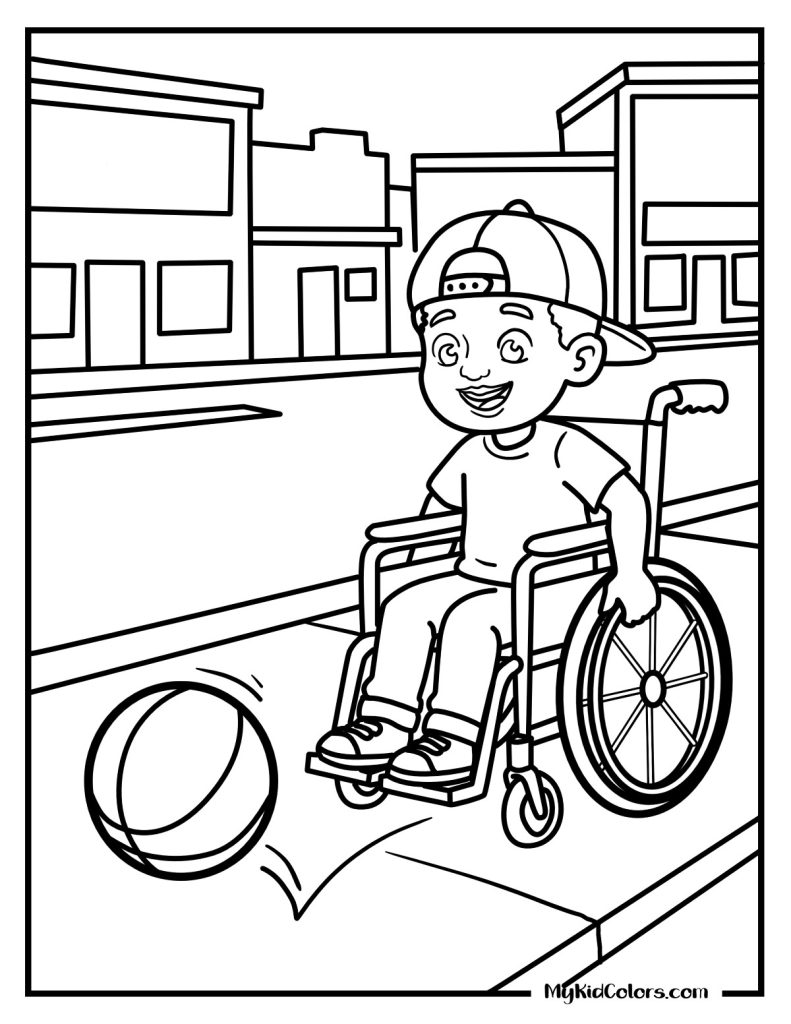
- Pages 4 & 5: A girl enjoys an ice cream cone beneath a striped awning. A boy using a wheelchair follows a bouncing ball along a sidewalk, with buildings behind him.


Save any page above free as a JPG. Want the full set in one easy download? Get all 15 hand-drawn pages in the complete PDF pack for $4.99.
Shops, Learning, and Places to Gather (Pages 6–10)
These medium scenes add people, shelves, furniture, and other details around the main activity.
- Page 6: A woman stocks a grocery shelf while a girl arranges apples in a crate. A cat and a hanging scale add more things to notice around the shop.
- Pages 7 & 8: A stylist works on a client’s hair while a girl reads nearby. In the barbershop scene, a child reads in the waiting area as a barber works with an adult client.
- Pages 9 & 10: Children sit at desks while two girls turn toward each other with their hands raised. A church choir sings beside a piano beneath a stained-glass window.


Save any page above free as a JPG. Want the full set in one easy download? Get all 15 hand-drawn pages in the complete PDF pack for $4.99.
Community Care, Streets, and Family Life (Pages 11–15)
The detailed group brings together more people and objects. These pictures work well for shared observation as well as a longer coloring session.
- Page 11: A doctor with an illustrated prosthetic arm examines a child while a nurse stands nearby with a chart. Bottles, an anatomical poster, and a patterned rug fill the room.
- Pages 12 & 13: A newspaper seller holds up a paper with a dog beside him. The next street scene includes cars, a fruit cart, shopfronts, and a girl using a wheelchair accompanied by an older adult.
- Pages 14 & 15: A family gathers around a dinner table with a dog underneath. The final illustration follows a family down a street beneath an arch bearing the collection’s Greenwood title.


Save any page above free as a JPG. Want the full set in one easy download? Get all 15 hand-drawn pages in the complete PDF pack for $4.99.
Activities for Learning About Community and Business
Keep the imaginative activities separate from verified historical facts. Children can draw, dictate, write, or use their usual communication tools.
- Build a neighborhood needs map with Pages 6 and 11. On a separate sheet, draw a grocery shop and a place for medical care. Ask what each provides, then add another place your family uses. Explain that the activity is about how neighborhoods work, not an exact map of Greenwood.
- Match people with their work. Use pages 2, 6, and 11 to connect a barber with hair care, a grocer with food, and a doctor with medical care. Our community helpers coloring pages offer more jobs to discuss.
- Compare an illustration with a historical photograph. An adult can select an appropriate pre-1921 Greenwood street or business photograph from a museum collection. Look for one similarity and one difference beside page 13. Talk about how an artist’s imagined scene differs from a historical source.
- Design an imaginary business. After coloring a shop page, invite your child to draw a sign showing what their business offers. Add a picture of one customer it could help. Our lemonade stand coloring pages offer another child-centered business activity.
- Record a family meal memory with Page 14. Ask a relative about a food or gathering they remember. Write down one detail and add the person’s name. Keep their actual memory distinct from what the illustrator imagined.
Pair the collection with our African American history coloring pages for a broader unit, while keeping the specific place, people, and events of Greenwood clear.
Human-Drawn Scenes With People at the Center
A girl arranging apples, a child waiting with a book, a family walking past shopfronts: this collection puts everyday activity into the picture. The people have work to do, places to go, and others beside them.
Our human illustrators include varied hair textures and styles, children using wheelchairs, and a doctor with an illustrated prosthetic arm. Some of those details are contemporary interpretations within the Greenwood-inspired setting. They should not be treated as evidence of particular people, equipment, or events in 1921.
Every page is hand-drawn. The simpler scenes leave larger spaces around the main figures; the detailed rooms and streets add shelves, vehicles, clothing, and patterned objects. The artwork can begin a conversation, while reliable historical sources supply the facts and context.
Frequently Asked Questions
How can I explain the Tulsa Race Massacre without graphic detail?
You could say, “Greenwood was a Black community where families lived, worked, and built businesses. In 1921, white mobs attacked the neighborhood because of racism. They killed people and burned homes and shops. Survivors worked to rebuild.”
Pause and answer the questions your child asks. You can use clear language without showing graphic images. Saying only that “something unfair happened” leaves out who was harmed and what happened to them.
Can I use these pages to introduce entrepreneurship?
Yes. Start with pages 2 or 6 and talk about the work the business provides. Then ask your child to design an imaginary shop. Explain that Greenwood’s businesses were built within a history of segregation and racism; they were part of a community, not a simple lesson that hard work alone removes unfair barriers.
Can I use the collection in a lesson that is not faith-based?
Page 10 depicts a church choir. You can discuss it as a religious institution within community history without asking children to take part in worship, or select other pages for your activity. Keep its identity clear rather than relabeling the church scene as a secular concert.
Download Your Black Wall Street Coloring Pages
Behind a shop sign are people: someone opening the door for the day, a family depending on the work, and neighbors who know where to find what they need. These pages invite you to begin with those lives while learning Greenwood’s history with care.
Save your favorite pages as free JPGs, or get all 15 in one ready-to-print PDF for $4.99. Your purchase helps support our human illustrators and the work of creating pages that give Black family life, history, and community room to be explored.
Save any page above free as a JPG. Want the full set in one easy download? Get all 15 hand-drawn pages in the complete PDF pack for $4.99.
You might also like:
- 15 Free Community Helpers Coloring Pages About Empathy and Belonging
- 15 Free Lemonade Stand Coloring Pages That Actually Show Kids Running a Business
- 15 Free Black People Coloring Pages (Free PDF Printables)
- 15 Free African American History Coloring Pages That Teach Kids Cultural Pride

