
15 Black Cowboys Coloring Pages That Put Untold History Back in the Saddle
There is more than one way into a cowboy story: a first pair of boots, a love of horses, or a question about who worked on the cattle trails. These Black cowboys coloring pages give you and your child room to explore all three, with Black riders at the center.
The 15 hand-drawn scenes move from rocking-horse play to ranch work, rodeo, and present-day city riding. Five simple, five medium, and five detailed pages include children, older adults, and a young rider with a wheelchair beside the horse.
Color a favorite scene together, then follow your child’s questions into the people, skills, and communities behind it.
All 15 pages. One easy download. Get the complete hand-drawn, ready-to-print PDF for $4.99, available instantly with a download link emailed to you for easy access anytime.
Prefer free JPGs? Right-click on any coloring page and select “Save image as,” or press and hold the image on your phone to save it.
A Note from Louisa (Founder of MyKidColors)
My connection to cowboy culture began while I was at the University of Wyoming. I had seen that world on TV, but getting my first pair of cowboy boots and experiencing Frontier Days in Wyoming made it feel real in a completely different way. Between cheering on the Wyoming Cowboys and taking in that experience, I made memories I wouldn’t trade.

Less searching. More MEANINGFUL moments.
When kids recognize themselves on the page, coloring changes.
The Inclusive Family Coloring Collection includes 25 human-drawn illustrations centered on everyday moments — designed to make inclusion feel normal, joyful, and intentional.
Because representation shouldn’t be reserved for one month.
That excitement is what I bring to these pages, alongside the chance to learn more about Black riders, past and present. Whether you’re coloring with your child or choosing a page for yourself, I’d love to see what you make. Email us a photo of your finished page and tell us which scene you chose.
Conversation Corner: 3 Questions to Ask While Coloring
Keep coloring and choose one question for the page in front of you. Your child can answer with words, pointing, drawing, signs, or their usual communication device.
- For “Learning to Ride” (Page 10): “What would you like to ask before your first riding lesson?”
- For “The Cattle Drive” (Page 11): “What jobs can you see the riders doing together?”
- For “City Riders” (Page 14): “What do you notice about the place these riders are passing through?”
For a younger child, point to the horse and dog and ask which one they would like to color first.
The Collection: 15 Free Black Cowboys Coloring Pages
Black cowboys helped care for cattle, work ranches, and move herds along nineteenth-century trails. Their work is part of American history, and Black riding communities continue today. The National Park Service’s introduction to Black cowpokes is a useful starting point for adults preparing a lesson.
These illustrations bring together pretend play, historical themes, and contemporary riding. They are imagined scenes rather than documented portraits of specific people or exact reconstructions of historical events.
For Little Hands: First Love of Horses (Pages 1–5)
The first five pages keep backgrounds simple, with bold outlines around children, horses, and familiar cowboy objects.
- Page 1: A small cowboy waves from a wooden rocking horse. The broad hat, boots, and curved rocker give little hands several large shapes to fill.
- Pages 2 & 3: A girl with puffs swings a rope loop above her head, followed by a boy with cornrows examining a horseshoe. One page has a big sweeping curve; the other keeps the focus on a small object held in two hands.
- Pages 4 & 5: A girl wearing glasses reaches toward a horse across a fence. A boy with locs offers another horse a carrot, with the fence rails creating simple horizontal spaces behind him.


Save any page above free as a JPG. Want the full set in one easy download? Get all 15 hand-drawn pages in the complete PDF pack for $4.99.
Ranch Life and Learning New Skills (Pages 6–10)
These pages add movement, other people, and more detailed settings, from a stable to a frontier-style street.
- Page 6: A young rider holds up a cowboy hat while riding across an open landscape. Mountains, clouds, and low plants leave room to build a background around the horse.
- Pages 7 & 8: A cowboy swings a lasso beside a calf in a fenced area. The next page shows a family tending a horse at a stable, with buildings beyond the fence and an older adult using a cane.
- Pages 9 & 10: A mounted lawman wears a badge on a frontier-style street. A contemporary young rider wearing a helmet sits on a horse with two adults assisting and a wheelchair nearby.


Save any page above free as a JPG. Want the full set in one easy download? Get all 15 hand-drawn pages in the complete PDF pack for $4.99.
Cattle Drives, Rodeo, and Riders Today (Pages 11–15)
The final group has denser scenes and smaller details. The rodeo page combines several events into one illustration, while the city scene brings the collection into a present-day neighborhood.
- Page 11: Several riders guide a herd across open country, with a covered wagon in the distance and a dog running nearby. Children can follow the herd through the picture before choosing where to begin coloring.
- Pages 12 & 13: An adult and child work with a horse’s tack inside a barn, with a cat watching from the hay. The rodeo scene brings bull riding, a bucking horse, and a rider rounding a barrel into a single arena composition.
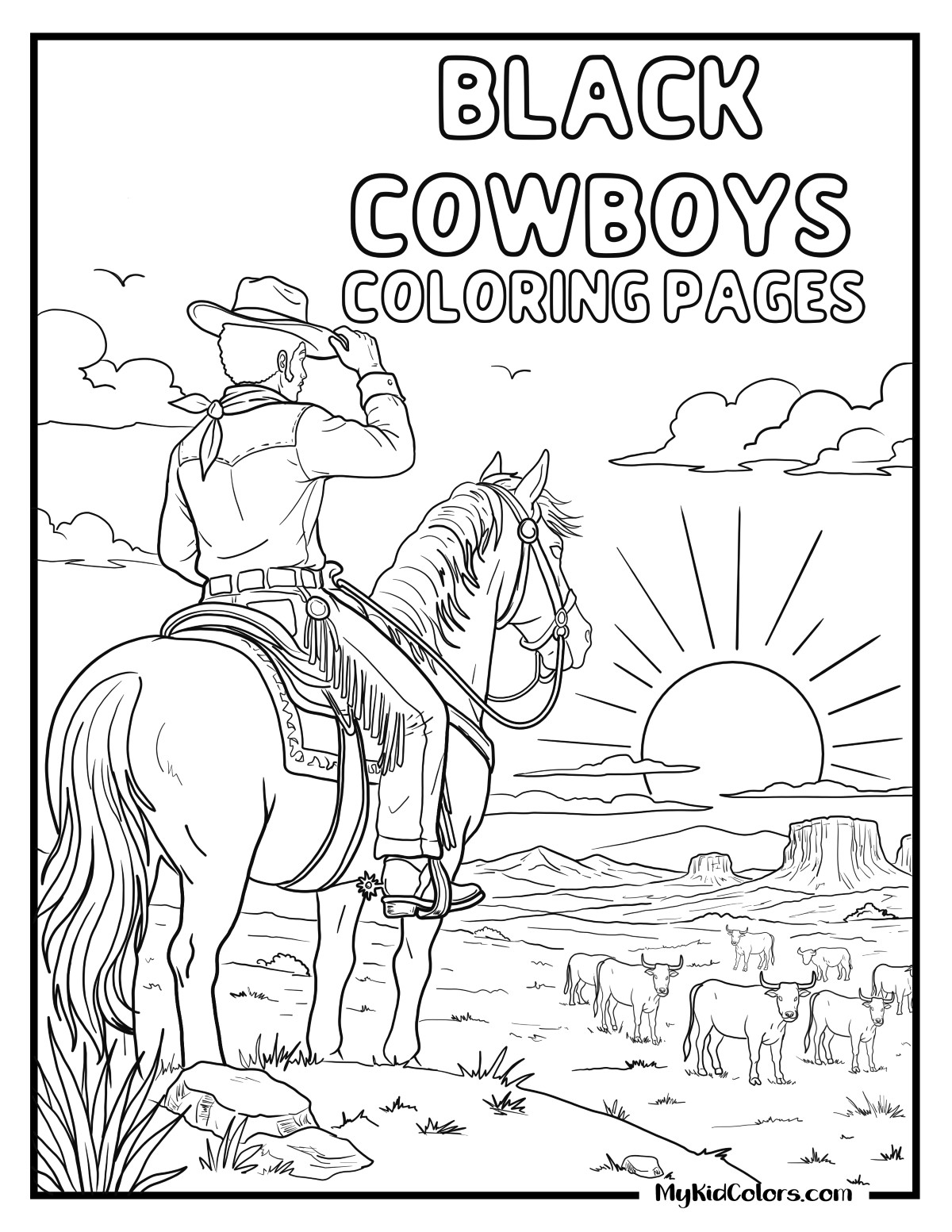
- Pages 14 & 15: Riders pass brick rowhouses as neighbors wave and a dog runs alongside. The title page closes with a mounted cowboy overlooking grazing cattle and a low sun beneath the words “Black Cowboys Coloring Pages.”


Save any page above free as a JPG. Want the full set in one easy download? Get all 15 hand-drawn pages in the complete PDF pack for $4.99.
Perfect for Homeschool, Classrooms, and More
- Meet a person behind the history. Pair Page 11 with a short account of cattle-trail cowboy Bose Ikard, or use Page 9 alongside a biography of Bass Reeves. Explain that Reeves was a deputy U.S. marshal and that the pictured lawman is an imagined figure. Our African American history coloring pages offer a broader companion collection.
- Compare two rodeo events. Look at Page 7’s rope and calf, then the barrel on Page 13. Have children draw one object that helps identify each event. Bill Pickett’s bulldogging belongs to a different event, steer wrestling; the roping picture should not be labeled as a demonstration of his technique.
- Find a present-day riding community. Beside Page 14, explore the Fletcher Street Urban Riding Club’s website with your child. The Philadelphia organization describes its horsemanship work and Black urban riding tradition. The illustration is not a portrait of its members or a map of its streets.
- Make a horse-care picture list. Use Pages 8 and 12 to notice a brush, tack, and the people caring for a horse. Draw the objects you can recognize on a separate sheet. Our farm animals coloring pages can extend an animal-themed activity.
- Draw a skill you learned from someone else. After coloring Page 12, invite your child to draw themselves beside a person who has taught them something. They can label the skill or dictate a caption. You can continue the family connection with our grandparents coloring pages.
The horse-handling and riding pictures are illustrations, not instructions for feeding, roping, mounting, or riding a horse. For a real visit or lesson, follow the qualified instructor’s directions.
Hand-Drawn Riders With Different Stories to Tell
A rocking horse and a working cattle drive belong to very different kinds of cowboy stories. Our human illustrators give both room in this collection, along with the barn work and city riding that happen beyond the rodeo arena.
These pages are hand-drawn human illustrator. Simple silhouettes and open backgrounds in the early pages give way to more crowded landscapes, tack, timber, and spectators in the detailed group. Choose the level of detail that suits the coloring session you want to share.
Frequently Asked Questions
Why don’t most cowboy movies and books show Black cowboys?
Historians estimate that roughly one in four cowboys in the real American West was Black, but early Wild West films and books largely left that history out. This collection is meant to help correct that gap for kids from an early age, giving them the fuller picture alongside the coloring fun.
Can I use these pages to teach a lesson on real historical Black cowboys?
Yes. Pages 9 and 11 pair especially well with a short read-aloud or video about figures like Bass Reeves, Nat Love, or Bill Pickett, letting kids color a cowboy scene right after hearing a real story about someone who lived it.
Are there modern connections I can make for kids who think cowboys are only from the past?
Definitely. Page 14’s city street scene is inspired by real, present-day Black horseback riding communities in cities like Philadelphia and Compton, which is a great way to show kids that this culture is alive and thriving today, not just something from old photographs.
Download Your Black Cowboys Coloring Pages
Maybe your child comes for the horse, the boots, or the big loop of a lasso. Stay beside them long enough for the next question: who is this rider, what are they learning, and where could we learn more? A finished page can be the start of a story you explore together.
Save your favorites as free JPGs, or get all 15 hand-drawn pages together in the complete PDF for $4.99. Your purchase helps support our human illustrators and the work of creating more collections that include Black history and everyday life.
I’d love to see your colors, whether you’re five or fifty. Email us a photo of your finished page, and share this post with someone who would enjoy it. Every purchase and share helps our small team keep drawing.
You might also like:
- 15 African American History Coloring Pages (PDF Printable)
- 15 Free Farm Animals Coloring Pages (Free PDF Printables)
- 15 Free Kentucky Derby Coloring Pages (Inclusive & Hand-Drawn)
- 15 Free Grandparents Coloring Pages for Every Kind of Family

