
15 Free Bronzeville Coloring Pages Exploring Chicago and the Great Migration
A suitcase beside the door. A train ticket held in small hands. A letter keeping family connected across the miles. These 15 hand-drawn Bronzeville coloring pages introduce Chicago’s Black history through details children can notice and talk about.
The collection moves between travel, work, family photographs, neighborhood streets, and gatherings. Five simple, five medium, and five detailed scenes offer different ways into a Great Migration lesson or a conversation about home.
Pair the pictures with a short historical account. They celebrate families and community while opening questions about why people moved, what they carried with them, and the barriers they faced.
All 15 pages. One easy download. Get the complete human-drawn, ready-to-print PDF for $1.99, available instantly with a download link emailed to you for easy access anytime.
Prefer free JPGs? Right-click any coloring page and select “Save image as,” or press and hold the image on your phone to save it.
The PDF pages are US Letter size. Select “Fit” in your print settings if needed.

Less searching. More MEANINGFUL moments.
When kids recognize themselves on the page, coloring changes.
The Inclusive Family Coloring Collection includes 25 human-drawn illustrations centered on everyday moments — designed to make inclusion feel normal, joyful, and intentional.
Because representation shouldn’t be reserved for one month.
A Note from Louisa (Founder of MyKidColors)
When people ask where my accent is from, I sometimes joke that it’s from Wyoming. I was born and raised in Nigeria, attended college in Wyoming, studied abroad in France, and lived in Alaska, but Nigeria remains part of my everyday life, including most of the food I cook at home.
The photographs and letter-writing scenes give me a personal way into this collection: thinking about what we carry from one place into another. For your family, that might be a recipe, a language, or a person you keep calling.
As you learn Bronzeville’s particular history together, I hope you’ll also make time to ask about the places and people connected to your own family.
Conversation Corner: 3 Questions to Ask While Coloring
Choose one question for the page your child is coloring. They can answer with words, pointing, drawing, signs, or their usual communication device.
- For “The Suitcase” (Page 1): “What would you put in a bag for a long journey?”
- For “Family Photographs” (Page 9): “Whose picture would you like to put on a shelf at home?”
- For “Welcome to the Neighborhood” (Page 14): “What could we do to welcome someone new?”
For a younger child, offer a choice between two familiar objects or point out the suitcase, ticket, and basket together.
The Collection: 15 Free Bronzeville Coloring Pages
This collection focuses on Bronzeville on Chicago’s South Side, a major center of Black business, culture, and community life. Its history includes the Great Migration, when approximately six million Black people moved from the American South to Northern, Midwestern, and Western states from the 1910s into the 1970s.
People moved to escape racial violence and Jim Crow oppression and to seek work, education, and other opportunities. Racism and discrimination also shaped life after arrival. Bronzeville’s community building belongs within that fuller history.
These are imagined scenes inspired by those themes, with contemporary inclusive details alongside period-style settings. They do not document one particular family, a precise train journey, or exact historical buildings.
For adult lesson preparation, see the National Archives’ Great Migration overview and the National Park Service’s Chicago Black Metropolis lesson.
For Little Hands: Suitcases, Tickets, and Windows (Pages 1–5)
The simpler pages focus on one child and a few objects. Broad outlines leave room for crayons, with small details such as suitcase corners and ticket lettering to notice.
- Page 1: A boy stands beside a suitcase with one hand on its handle. The room stays mostly open around him, keeping attention on the child and luggage.
- Pages 2 & 3: A girl with puffs waves through a curtained window. A boy with cornrows then holds a ticket marked “TICKET” and examines it closely.
- Pages 4 & 5: A girl wearing glasses rests her chin on her hands beside a train window. A younger child carries a basket along a path toward a waiting adult.


All 15 pages. One easy download. Get the complete human-drawn, ready-to-print PDF for $1.99, available instantly with a download link emailed to you for easy access anytime.
Prefer free JPGs? Right-click any coloring page and select “Save image as,” or press and hold the image on your phone to save it.
Travel, Work, and a Place to Settle (Pages 6–10)
These medium scenes add family groups, machinery, and rooms around the main figures. They can accompany questions about travel and everyday life without treating the pictures as a record of a specific journey.
- Page 6: A family stands on a platform beside a steam locomotive, with luggage and other people nearby. The waving figures give you something to notice without needing to decide exactly who is leaving or staying.
- Pages 7 & 8: A family walks along a station platform with tall buildings beyond it. An industrial workplace follows, showing a man carrying a handled pail as he speaks with another worker among pipes and equipment.
- Pages 9 & 10: A woman arranges framed photographs beside an open box. A traveler using a wheelchair then receives assistance on a ramp beside a train, with family members and a railway worker around him.


All 15 pages. One easy download. Get the complete human-drawn, ready-to-print PDF for $1.99, available instantly with a download link emailed to you for easy access anytime.
Prefer free JPGs? Right-click any coloring page and select “Save image as,” or press and hold the image on your phone to save it.
Neighborhood Life and Connections to Home (Pages 11–15)
The detailed group adds more people and objects: luggage, shops, letters, shared food, and a room with a view of the city.
- Page 11: A busy platform includes travelers, suitcases, a ticket check, a vendor cart, and a dog on a leash. Children can follow the people through the picture before choosing an area to color.
- Pages 12 & 13: A neighborhood street brings together a theater-style marquee, a church, and a book or newspaper display. An older woman then writes beside family photographs and maps, with a cat asleep on the windowsill.
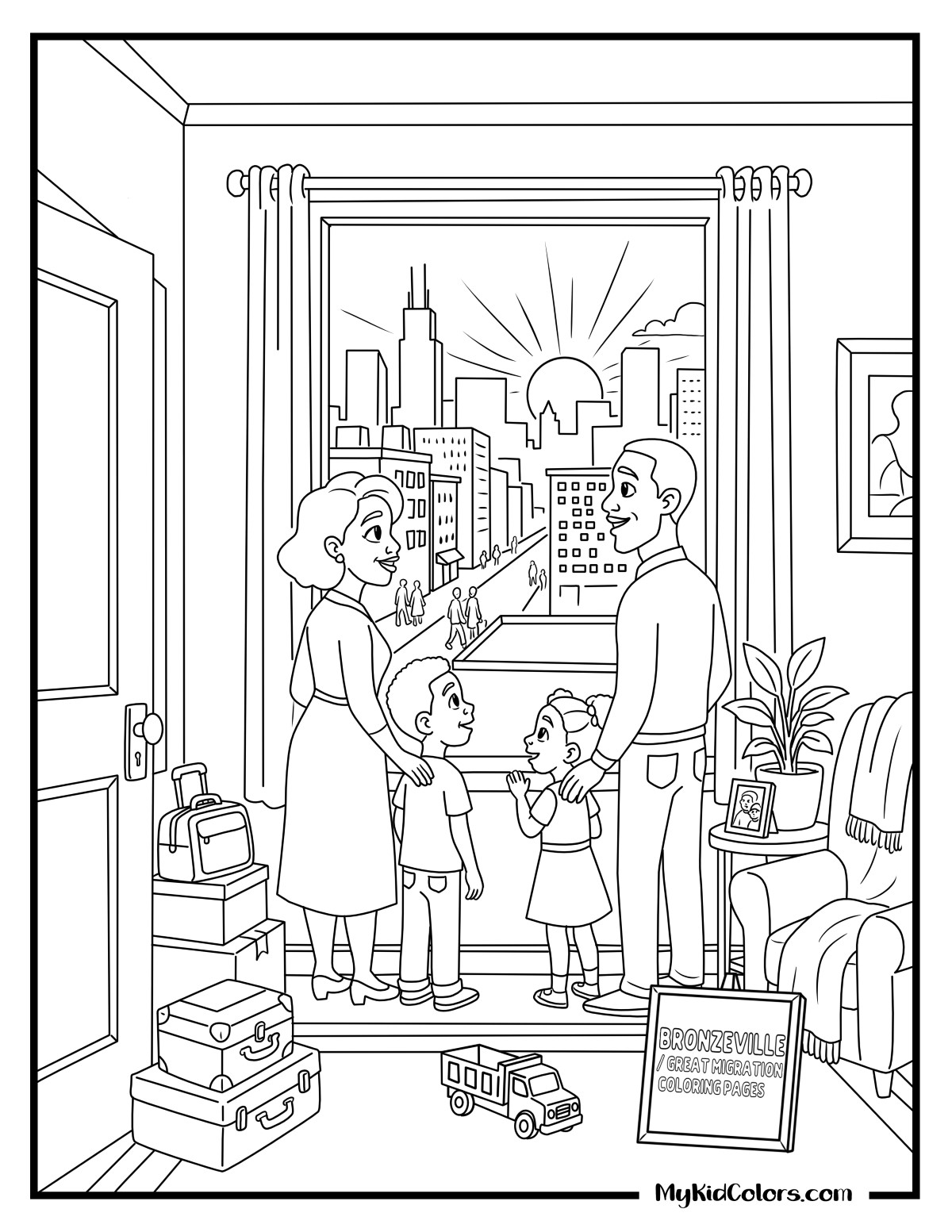
- Pages 14 & 15: Neighbors greet one another around food tables while children and a dog play nearby. The final page shows a family beside an apartment window, with a city skyline, luggage, toys, photographs, and the collection title on a sign in the room.


All 15 pages. One easy download. Get the complete human-drawn, ready-to-print PDF for $1.99, available instantly with a download link emailed to you for easy access anytime.
Prefer free JPGs? Right-click any coloring page and select “Save image as,” or press and hold the image on your phone to save it.
Perfect for Black History Month and American History Lessons
- Compare departure and arrival. Put Pages 6 and 7 beside an age-appropriate Great Migration account. Ask children to notice the luggage, buildings, and people. Explain that the images suggest different parts of travel rather than documenting the same family before and after.
- Make a simple route map. On a separate, accurate US map, mark Chicago and one documented Southern starting place from the account you are reading. Label the places and draw a line between them. Explain that this is one example, not the route taken by every family. Our African American history coloring pages can accompany a broader unit.
- Look up a real Bronzeville place. Use Page 12 beside a historical photograph of the Chicago Bee Building, a site discussed in the National Park Service lesson. Name one difference between the photograph and the imagined street. Do not label a generic building in the coloring page as that landmark.
- Record a family memory with permission. Beside Page 13, ask a willing relative or trusted adult about a place they have lived. Write down their name, the place, and one detail they choose to share. Keep their actual account separate from the history in the lesson. Our family coloring pages offer more everyday scenes to share.
- Plan a welcome. After coloring Page 14, draw a card for a new classmate or neighbor. Children can choose a greeting, a picture, or an invitation to a game. Our community helpers coloring pages offer another way to discuss how people contribute to a neighborhood.
Children can also write a pretend letter from an imagined traveler. Label it as fiction, and keep any historical facts grounded in the sources you use.
The Real People Behind Our Coloring Pages
The Great Migration is usually taught through maps and statistics, arrows pointing north, population numbers, dates on a timeline. It’s easy to lose the actual people inside all of that data.
We wanted an illustrator who would draw the human moments instead, a boy holding his own suitcase, a grandmother writing a letter, a whole block welcoming someone new, so kids could feel the history instead of just memorizing it.
At My Kid Colors, every page is made by a real human illustrator who thinks about dignity, cultural detail, and emotional truth before a single line gets drawn, so this history looks like real people, not a textbook illustration.
Frequently Asked Questions
How can I introduce the Great Migration to a young child without making it feel too heavy?
Focus on the idea of a “big move” and a “new home” rather than the full historical context at first. Page 1 (the suitcase) and Page 15 (the family at the new skyline) work well as a simple beginning and ending to the story, a family who left one place and built a new life somewhere else. You can add more historical detail as your child gets older.
My own family has a migration story. How can I use these pages to talk about it?
Page 13 (the letter home) and Page 14 (the community gathering) are good starting points. While your child colors, ask an older relative to share where their family came from and what the move was like. It turns a coloring page into a real piece of family history your child gets to hold onto.
Can these be used for a Black History Month lesson beyond just Bronzeville specifically?
Yes. The set works well as a broader introduction to the Great Migration as a whole, not just Chicago. Pages 6, 7, and 11 (the train and platform scenes) can anchor a lesson on migration to any Northern city, with Bronzeville serving as one detailed, well-documented example for students to explore further.
Download Your Bronzeville Coloring Pages
A photograph on a shelf or a letter sent home can hold a connection that distance does not erase. Color beside your child, learn a little of Bronzeville’s history, and ask about one person or place your family wants to remember. Write the answer down if they would like you to keep it.
Save your favorite pages as free JPGs, or get all 15 hand-drawn pages together in the complete PDF for $1.99. Your purchase helps support our human illustrators and the work of creating more collections that make room for Black history and everyday family life.
All 15 pages. One easy download. Get the complete human-drawn, ready-to-print PDF for $1.99, available instantly with a download link emailed to you for easy access anytime.
Prefer free JPGs? Right-click any coloring page and select “Save image as,” or press and hold the image on your phone to save it.
Share this post with a parent, teacher, or relative who would use it. Every purchase and share helps our small team keep drawing.
You might also like:
- 15 Free Family Coloring Pages Kids See Themselves In (PDF)
- 15 Free Community Helpers Coloring Pages (Printable PDF)
- 15 Free African American History Coloring Pages (Printable PDF)

