

30 Women in STEM Coloring Pages — 15 Free Hidden Figures Printables for Kids
Everyone knows Katherine Johnson. Dorothy Vaughan. Mary Jackson. Those three women changed NASA — and they changed what children believed was possible for them.
But there are 27 more women in our collection who did the same kind of world-altering work, and most kids have never heard their names. Gladys West’s math is inside every GPS on the planet. Alice Ball cured a disease before she was 24. Wangari Maathai planted 51 million trees. These pages exist because your child should know them too — not just in February.
Below you’ll find 15 free portrait-style hidden figures coloring pages from Set 2. Our expanded set 1 (15 more women including Katherine, Dorothy, and Mary) is available as a paid download and is linked throughout this post. Thanks for supporting our team of human illustrators.
A Note from Louisa (Founder of MyKidColors)
Growing up, I did not often see women shown as engineers, mathematicians, or scientists. Even female doctors could be mistaken for nurses because people were so used to seeing men in certain roles.

Less searching. More MEANINGFUL moments.
When kids recognize themselves on the page, coloring changes.
The Inclusive Family Coloring Collection includes 25 human-drawn illustrations centered on everyday moments — designed to make inclusion feel normal, joyful, and intentional.
Because representation shouldn’t be reserved for one month.
But I also remember watching Professor Dora Akunyili on the 9 p.m. news in Nigeria as she fought counterfeit drugs with courage and conviction. Years later, in pharmacy school, her name came back to me.
That memory stayed with me because children notice who gets shown as capable. These pages are my small way of helping kids see Black and brown girls as thinkers, problem-solvers, scientists, and leaders from the very beginning.

Conversation Corner: 3 Questions to Ask While Coloring
Turn this activity into a bonding moment. While your child colors, try asking these questions:
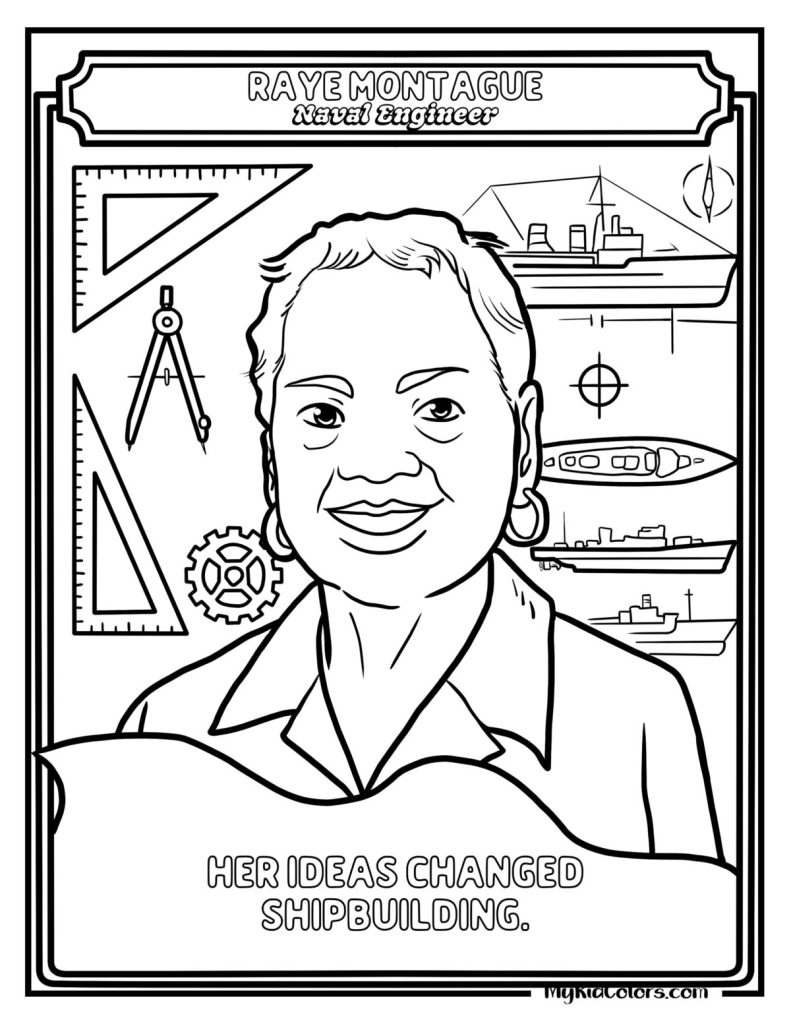
- For “Raye Montague” (Page 1): “Raye used engineering and computers to design powerful ships. What kind of invention or machine would you love to create to help people someday?”
- For “Jeanette Epps” (Page 11): “Jeanette trained hard to explore space and study Earth from above. If you could visit any planet or galaxy, where would you go and what would you hope to discover?”
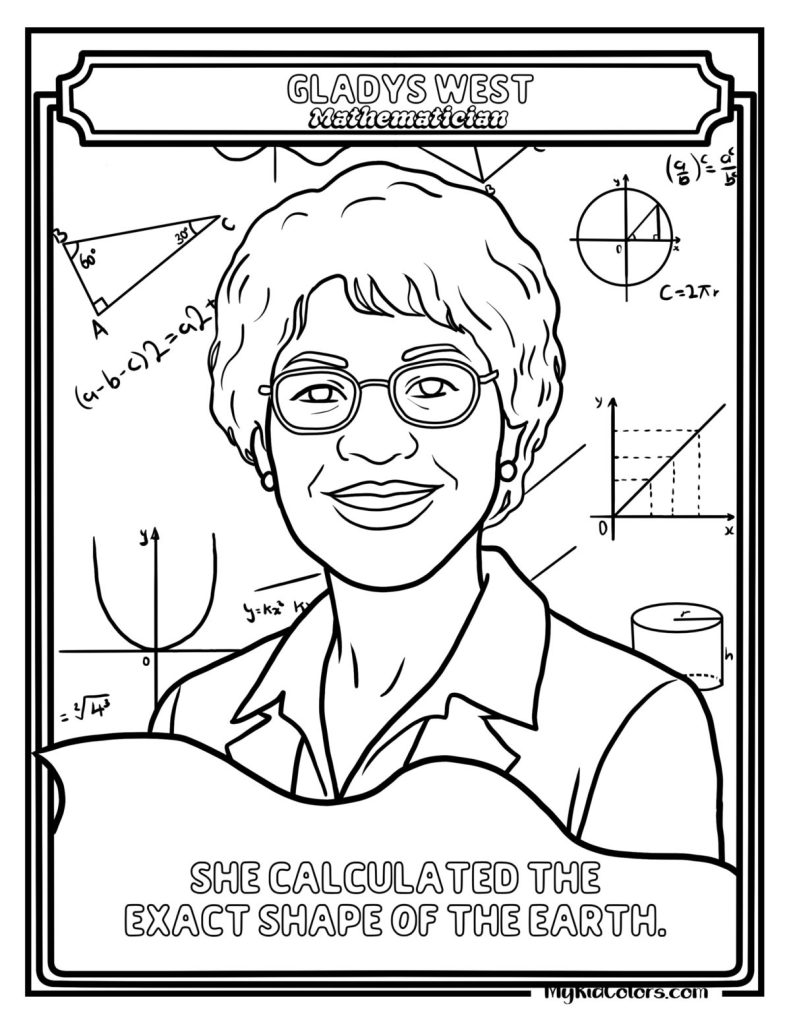
- For “Gladys West” (Page 14): “Gladys West’s math helped create GPS technology that people use every day. Can you think of a piece of technology that makes life easier for your family or community?”
The Collection: 15 Free Hidden Figures Coloring Pages
We organized these pages into three sets to help children explore STEM careers—from discovering how science works to imagining themselves changing the world someday.
For Little Hands: STEM Trailblazers (Pages 1–5)
Best for toddlers and preschoolers. These pages focus on simple portraits, recognizable STEM tools, and encouraging messages about problem-solving and creativity.
Set 2 is free — fifteen pages, one woman per page. Each portrait names her field right below her image so the conversation starts while you’re still at the table.
- Page 1: features a Raye Montague coloring page with ship blueprints and engineering tools, making it a wonderful introduction to women engineers coloring pages.
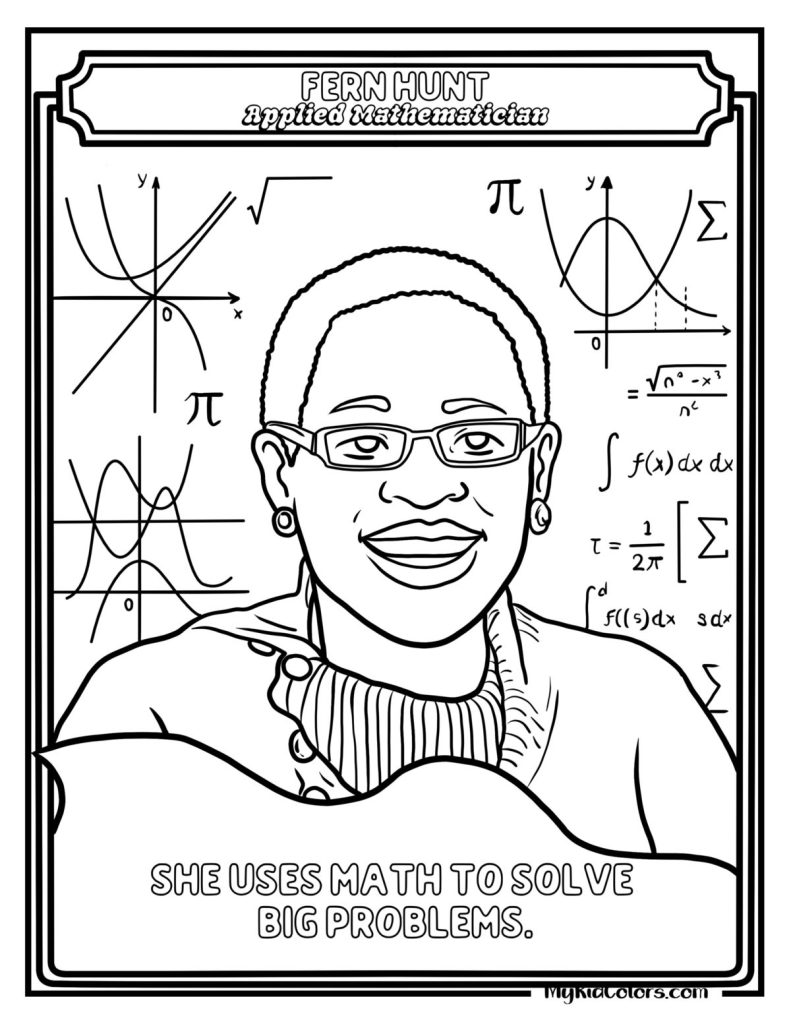
- Pages 2 and 3: include Fern Hunt and Evelyn Boyd Granville, introducing kids to a mathematician coloring page and a computer scientist coloring page in a simple, approachable way.
- Pages 4 and 5: spotlight Marie Maynard Daly and Valerie Thomas through a biochemist coloring page and inventor coloring page that celebrate science and innovation.


Big Ideas & Big Dreams (Pages 6–10)
Perfect for elementary kids. These pages explore teamwork, discovery, invention, and care for the world around us.
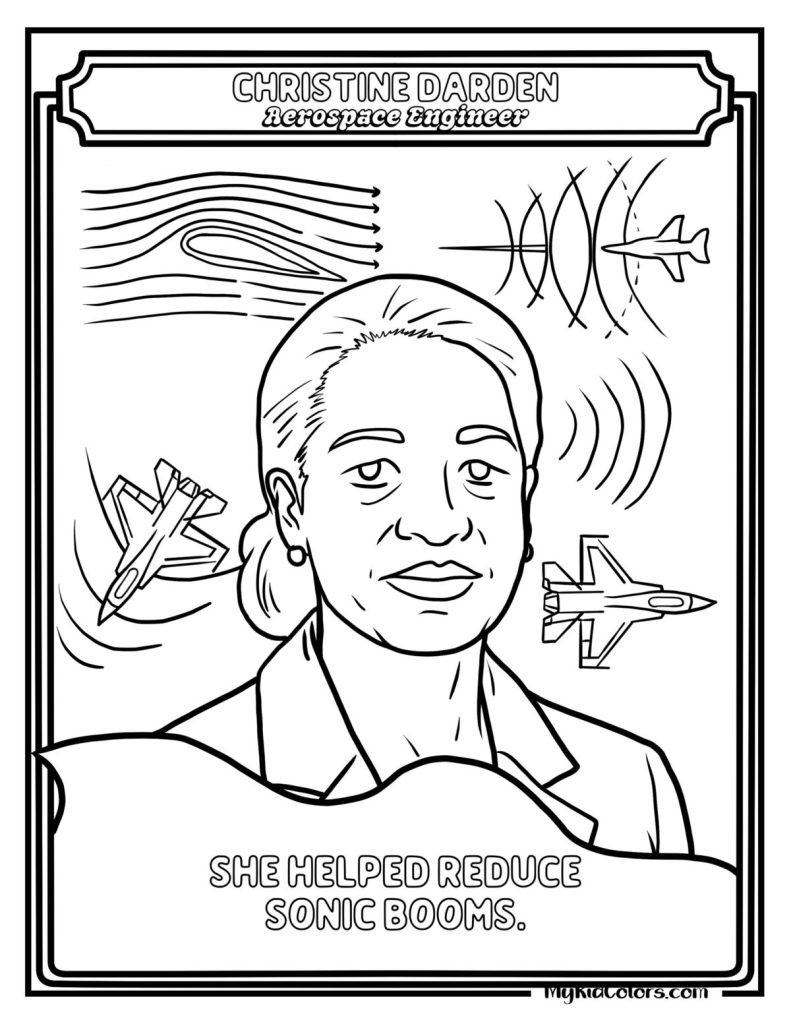
- Page 6: introduces Christine Darden through an aerospace engineer coloring page inspired by NASA research and sound-wave science.
- Pages 7 and 8: feature Ayanna Howard and Aisha Bowe with a robotics engineer coloring page and a space engineer coloring page that inspire curiosity about coding, robotics, and space technology.
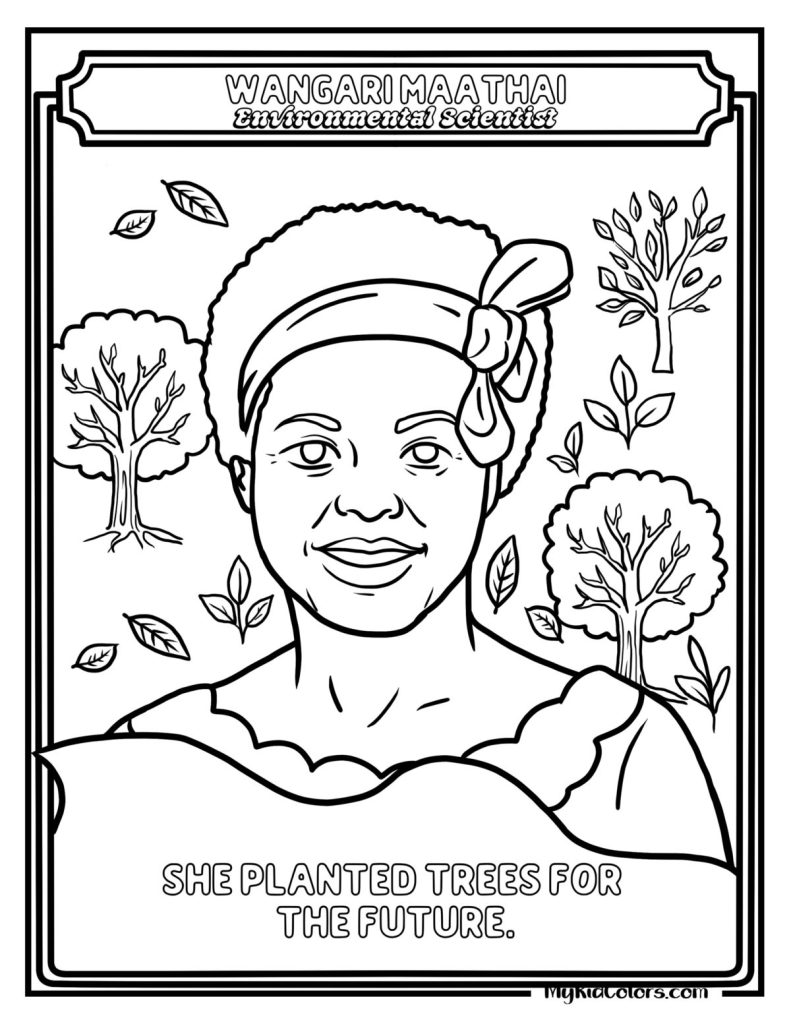
- Pages 9 and 10: celebrate Wangari Maathai and Jessie Isabelle Price through an environmental scientist coloring page and chemist coloring page focused on caring for people and the planet.



The Full Story & Application (Pages 11–15)
Designed for older kids and thoughtful conversations, these pages contain more detailed backgrounds and advanced STEM concepts.
- Page 11: features astronaut Jeanette Epps in one of our favorite astronaut STEM coloring pages and women astronauts coloring pages.
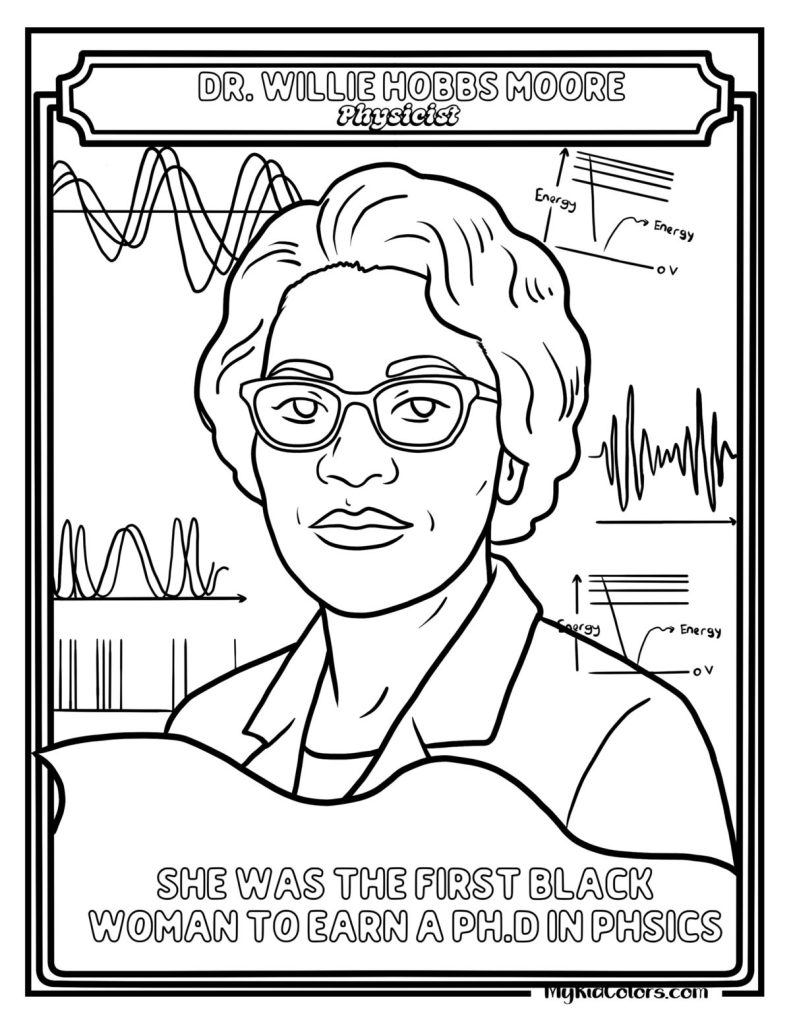
- Pages 12 and 13: include Hattie Scott Peterson and Dr. Willie Hobbs Moore through a civil engineer coloring page and physicist coloring page that showcase groundbreaking achievements in engineering and physics.
- Pages 14 and 15: spotlight Gladys West and Alice Augusta Ball with a mathematician printable coloring page, GPS inventor coloring page, and chemist coloring page printable connected to real-world scientific breakthroughs.



Want Even More Women in STEM? Meet Set 1
Set 1 is a paid companion set with fifteen additional portraits — including Katherine Johnson, Dorothy Vaughan, Mary Jackson, Mae Jemison, Kizzmekia Corbett, and more. Same hand-drawn style, same name and role labels, same age-friendly difficulty tiers.
If your household has a space obsession, a science table, or a kid who wants to color every single one, Set 1 and Set 2 together give you thirty women to work through.
A Few Faces From Set 1
- Katherine Johnson — NASA Mathematician
- Mae Jemison — Astronaut and Doctor
- Kizzmekia Corbett — Immunologist
- Annie Easley — Computer Scientist
- Ellen Ochoa — First Latina in Space
…and ten more.
For Classrooms and Homeschool Families
Teachers and parents love using these women in STEM printables as quiet-time activities, homeschool worksheets, STEM lesson extensions, and Black History Month projects. Here are a few ways to extend the learning:
- STEM Career Match-Up: After coloring, invite children to match each scientist with the tools they might use every day. Pair the astronaut coloring page with rockets and satellites, the robot scientist coloring page with coding symbols and machines, or the nutrition scientist printable with healthy foods and science lab tools.
- Story Sequencing: Use pages featuring Raye Montague, Christine Darden, Aisha Bowe, and Jeanette Epps to help children see how innovation grows over time—from designing ships and studying airplanes to building space technology and preparing for missions beyond Earth.
- Create a STEM Dream Wall: Display completed coloring pages on a wall, refrigerator, or classroom bulletin board and encourage children to write their future dream careers underneath each picture. This activity works especially well with Black scientist coloring pages and famous Black women scientists coloring pages because it helps kids connect representation with possibility.
Why Every MKC Page is Hand-Drawn by a Human Artist
At MyKidColors, we work with real human illustrators — not generation tools. That conviction comes from a simple belief: the children in these pages are real people with real legacies. We wanted artists who understood that weight.
Our illustrators bring cultural nuance to skin tone, hair texture, and expression that cannot be templated. When a child colors Ayanna Howard’s natural curls or Wangari Maathai’s strong posture, those details exist because a person drew them with intention.
The result is pages that feel like portraits, not placeholders.
Full List: All 15 Women in Set 2
| Name | Field / Role | Difficulty | Why She Matters (Kid-Friendly) |
| Raye Montague | Naval Engineer | Easy | She designed ships using computers — a first in her field. |
| Fern Hunt | Mathematician | Easy | She uses patterns and numbers to explain how the world works. |
| Evelyn Boyd Granville | Computer Scientist | Easy | Her math helped early space missions get off the ground. |
| Marie Maynard Daly | Biochemist | Easy | She discovered how diet affects heart health. |
| Valerie Thomas | Inventor | Easy | She invented illusion transmitter technology that changed imaging. |
| Christine Darden | Aerospace Engineer | Medium | Her work on sonic booms made planes quieter. |
| Ayanna Howard | Robotics Engineer | Medium | She builds robots designed to help people. |
| Aisha Bowe | Space Systems Engineer | Medium | She builds and supports technology for space missions. |
| Wangari Maathai | Environmental Scientist | Medium | She planted millions of trees across Africa. |
| Jessie Isabelle Price | Chemist and Nutrition Scientist | Medium | She used chemistry to understand how food supports health. |
| Jeanette Epps | Astronaut | Complex | She trained for space and studies Earth from above. |
| Hattie Scott Peterson | Civil Engineer | Complex | First Black woman to earn a civil engineering degree in the US. |
| Dr. Willie Hobbs Moore | Physicist | Complex | First Black woman to earn a PhD in Physics in the US. |
| Gladys West | Mathematician | Complex | Her calculations became the mathematical foundation for GPS. |
| Alice Augusta Ball | Chemist | Complex | She developed the first effective treatment for leprosy. |
Frequently Asked Questions
My daughter is really into Katherine Johnson after watching Hidden Figures. Is she in these pages?
Katherine Johnson, Dorothy Vaughan, and Mary Jackson are all in Set 1 — the paid companion collection. Set 2 (the free download on this page) features 15 other women whose stories are just as important but far less known. If your daughter is drawn in by Katherine Johnson, Set 1 is the right starting point. You can find it linked above.
My child has never heard of any of these women. Will he/she care?
Probably not at first — and that is fine. Children do not need prior context to engage with a coloring page. They need a page that is interesting enough to sit with. What usually happens: a child asks a question about what is in the background (why is there a tree? why is there a satellite?), a parent answers, and the name gets attached to a feeling. That is how it starts. You are not trying to teach a biography. You are opening a door.
Are these pages appropriate for children who are not Black?
Yes, completely. Representation in educational materials matters for all children — not only for children who share the identity of the person depicted. White children, Asian children, and children from every background grow up in a world shaped by the work of Black women scientists. These pages are an honest reflection of that. Diversity in who we celebrate teaches all children what the world actually looks like.
My son’s teacher only uses these during Black History Month. Can I push back on that?
You can, gently. The argument is simple: these women’s contributions to GPS, vaccines, aerospace, robotics, and environmental science are not seasonal topics. Gladys West’s math is in your phone in July. Alice Ball’s chemistry changed medicine in 1915. The work is not February work — it’s year-round work. If you want a phrase to use: “These pages connect to our STEM curriculum, not just our history curriculum.”
What is the difference between Set 1 and Set 2?
Set 2 is the free download on this page — 15 women, many of them lesser-known, including Gladys West, Alice Ball, Wangari Maathai, Christine Darden, and Ayanna Howard.
Set 1 is a paid download featuring 15 more women including Katherine Johnson, Dorothy Vaughan, Mary Jackson, Mae Jemison, and Kizzmekia Corbett.
Both sets use the same portrait-style illustration format with name and role labels, and both have pages in three difficulty tiers (Easy, Medium, Challenge).
Set 1 was illustrated by our lead illustrator, Madaki. And set 2 (the free download on this page) was illustrated by Temidayo.
The Reason These Names Belong on Your Wall
Katherine Johnson, Dorothy Vaughan, and Mary Jackson had to fight to be in the room. The women in Set 2 — Raye Montague, Willie Hobbs Moore, Hattie Scott Peterson, Alice Ball — did the same thing. The common thread is not hardship. It is the refusal to be invisible.
A child who grows up seeing these women on their walls, in their coloring books, in their conversation — that child builds a wider picture of what is possible. Not just for girls who look like them. For any child who is told, in some way, that certain rooms are not for them.
These pages are a small thing. Coloring is a small thing. But small things repeated become the landscape a child grows up inside.
You Might Also Like
- 20 Free Black History Coloring Pages for Kids That Celebrate Joy, Belonging, and Leadership
- 15 Women’s History Month Coloring Pages That Teach Kids Confidence & Courage
- 15 Juneteenth Coloring Pages That Celebrate Freedom, Resilience, and Black Joy
- 15 Free African Coloring Pages for Kids (Free PDF Printable)
- 15 Nigerian Women Leaders Coloring Pages


