
15 Free Black Inventors Coloring Pages for Kids
If your child loves asking how things work, these Black inventors coloring pages give you a way to explore that curiosity together. A traffic signal, a bedside lamp, and a school project become starting points for learning about people whose ideas helped change everyday life.
The 15 hand-drawn pages feature Black children and families in familiar settings, from pretend play to a classroom presentation. Pair the scenes with the short inventor facts below to introduce contributions by Garrett Morgan, Lewis Latimer, Sarah Boone, and others, along with Madam C. J. Walker’s work in hair care and business.
Save the individual JPG pages below free and print your favorites. Open an image, save it to your device, and use your printer’s fit-to-page setting. The complete 15-page PDF pack, formatted for US Letter paper (8.5 × 11 inches), is available separately for $4.99, which supports our team of human artists.
A Note from Louisa (Founder of MyKidColors)
As a child in Nigeria, I watched the 9 p.m. news and saw counterfeit medicines being destroyed under Dora Akunyili’s leadership. I remember being in awe of her, a Nigerian woman doing work that affected people’s health.

Less searching. More MEANINGFUL moments.
When kids recognize themselves on the page, coloring changes.
The Inclusive Family Coloring Collection includes 25 human-drawn illustrations centered on everyday moments — designed to make inclusion feel normal, joyful, and intentional.
Because representation shouldn’t be reserved for one month.
Years later in pharmacy school, her name came back to me as I learned more about counterfeit medicines. That memory reminds me how a real person can give a child a starting point for understanding a complicated subject.
With these pages, I want my children to meet some of the people behind the things around them, then have room to ask their own questions about what could work better.
Conversation Corner with 3 Questions to Ask While Coloring
Choose one question for the page your child is coloring. They can answer aloud, point, draw, or show you what they mean.
- For “Pretend Traffic Signal,” Page 1: “What helps people cross a road safely?” Notice the signal and crossing stripes together. This can lead into Garrett Morgan’s work on improving traffic signals.
- For “Lightbulb Project,” Page 7: “What is something you would like to make work better?” Offer a familiar example, such as a bag that is easier to carry, if your child needs a starting point.
- For “Sharing an Inventions Poster,” Page 10: “Which picture would you like to learn more about?” Your child can choose the signal, ironing board, or lightbulb without needing to name an inventor first.
The Collection of 15 Black Inventors Coloring Pages
These are contemporary, imaginative scenes for starting conversations about invention. A modern traffic signal or lamp in a picture is not an exact drawing of an inventor’s original design.
The historical connections are explained in the activities section so you can distinguish an invention, an improvement, and a broader theme.ors behind them.
For Little Hands and Everyday Discoveries, Pages 1-5
The first five pages focus on one familiar activity at a time, with fewer background details than the later scenes. Start here if your child prefers larger spaces to color.
- Page 1: A boy presses a switch beside a traffic signal in a pretend street-crossing scene. The lights and crossing stripes offer simple shapes for introducing road safety and Morgan’s traffic-signal improvement.
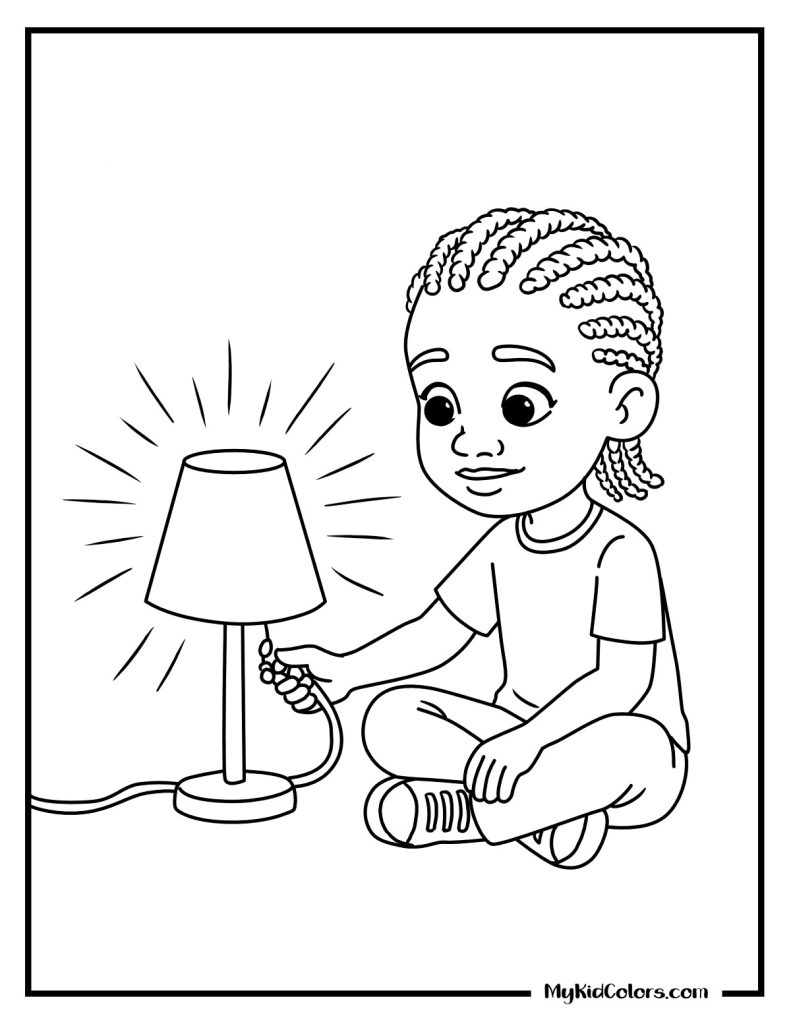
- Pages 2 and 3: A girl brushes a doll’s hair at a small vanity with product bottles nearby. On the next page, a child with cornrows sits beside a lamp and holds its pull cord. These scenes can introduce hair-care entrepreneurship and the development of electric lighting.
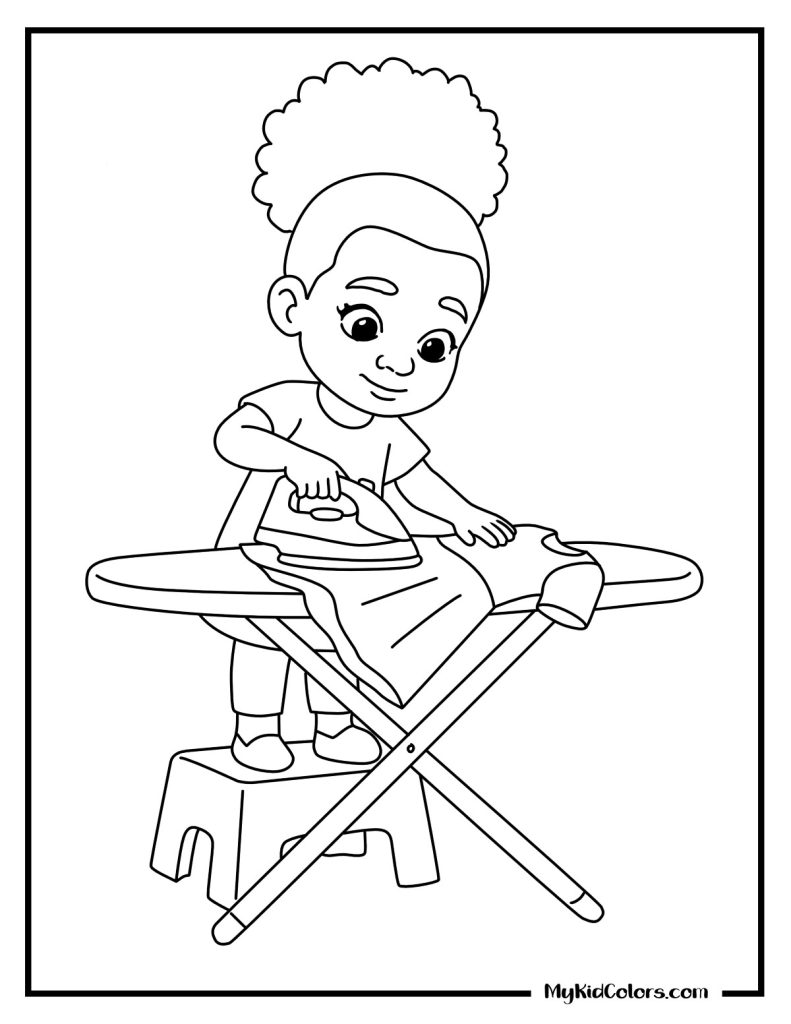
- Pages 4 and 5: A girl stands on a stool in a pretend ironing scene, followed by a child wearing glasses looking through a door viewer beside an adult. Use the scenes to begin talking about Sarah Boone’s improved ironing board and Marie Van Brittan Brown’s work on home security.



Save any page above free as a JPG. Want the full set in one easy download? Get all 15 hand-drawn pages in the complete PDF pack for $4.99.
Inventor Connections at Home and School, Pages 6-10
This group adds family members and school-project details. The illustrations give children something familiar to notice before you introduce the names and facts.
- Page 6: A mother and son cross at a pedestrian signal, with the boy carrying a report. Pair this modern crossing scene with Morgan’s story and notice how the signal helps people take turns.
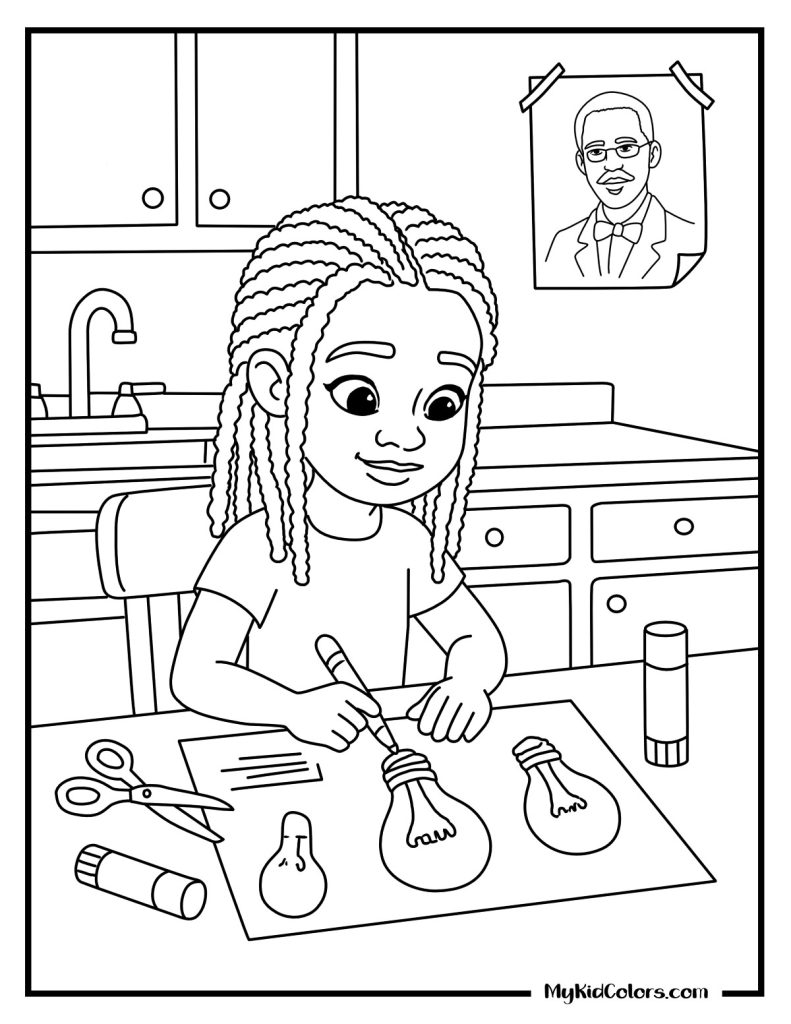
- Pages 7 and 8: A girl with braids works on a lightbulb-themed paper project beneath an inventor sketch. Then a mother styles her daughter’s hair in a kitchen with a framed portrait and bottles nearby. These pages are intended to accompany learning about Latimer and Walker, with the lightbulb shapes and hair-care setting providing the connection.
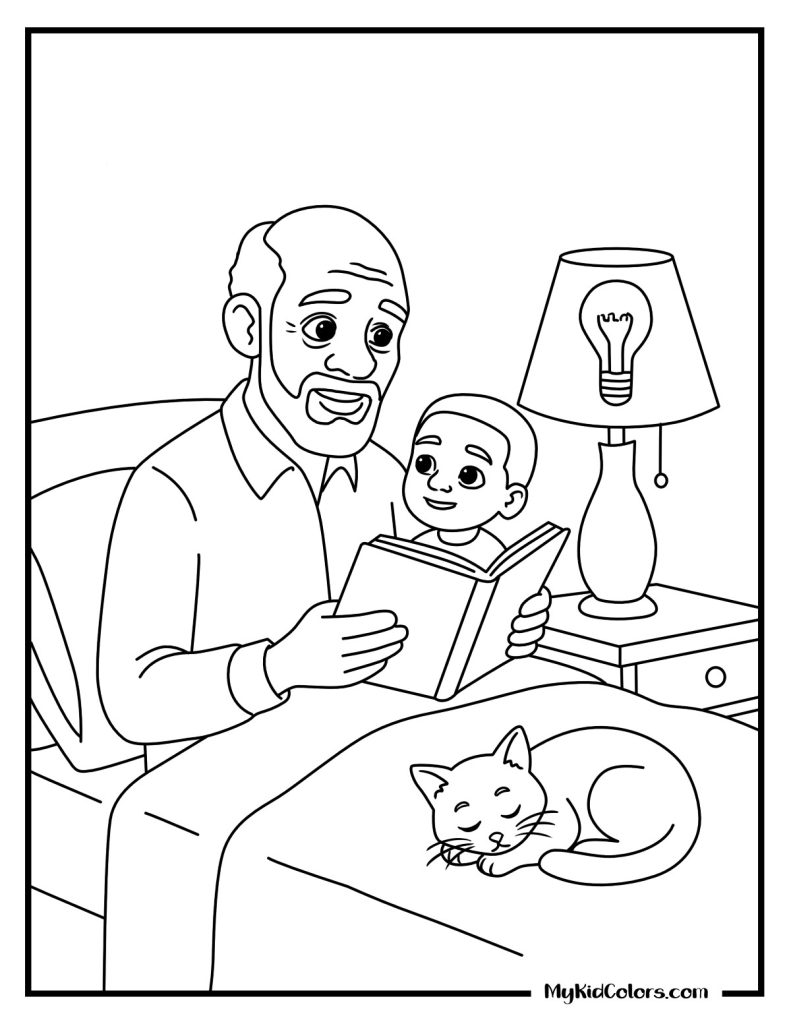
- Pages 9 and 10: A grandfather reads with his grandchild beside a lamp while a cat sleeps on the bed. The next page shows a boy using a wheelchair presenting a poster with pictures of a signal, ironing board, and bulb. Children can choose one picture to research rather than tackling every name at once.



Save any page above free as a JPG. Want the full set in one easy download? Get all 15 hand-drawn pages in the complete PDF pack for $4.99.
Community, Questions, and Shared Ideas, Pages 11-15
The final group has fuller backgrounds and more people. These scenes invite broader conversations about how ideas are shared, developed, and used.
- Page 11: A father stands beside an ice-filled cooler at a porch gathering while children play near a sprinkler. This scene can introduce a discussion of keeping food cold and lead into Jones’s work on refrigerated transportation.
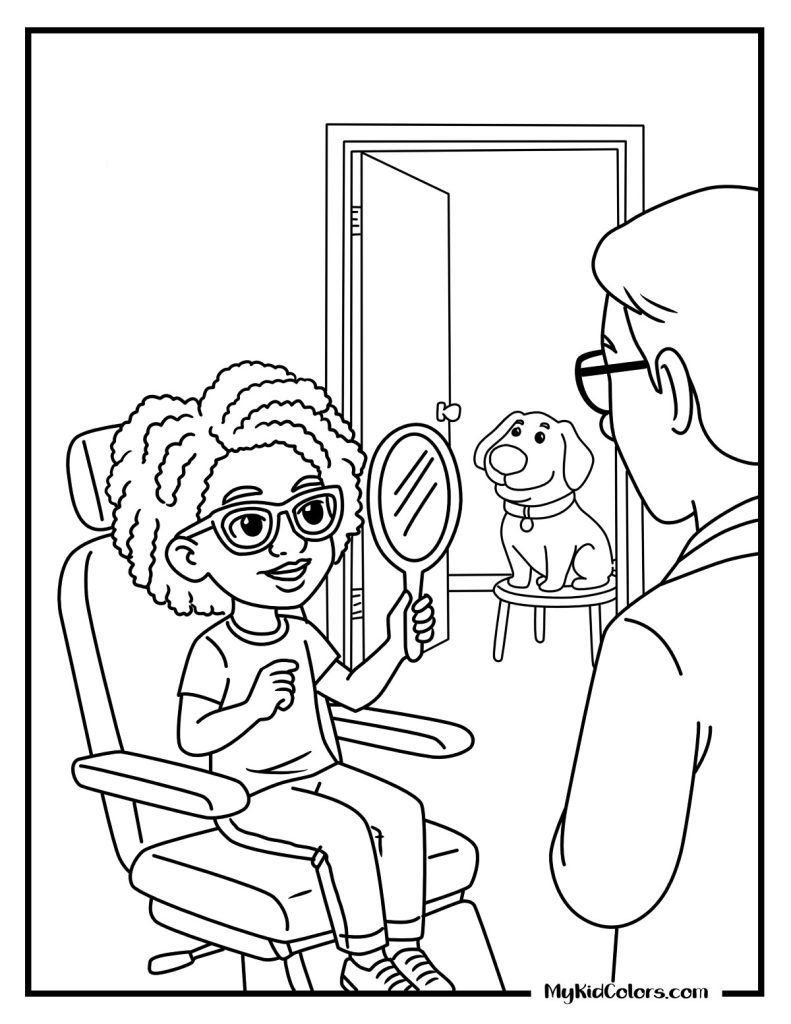
- Pages 12 and 13: A girl tries on glasses and looks in a mirror during an eye-care visit, with a dog waiting nearby. Then a teacher points to portraits and invention pictures on a classroom board, with a wheelchair user among the students. The eye-care scene offers a starting point for learning about Patricia Bath and her work in eye surgery.
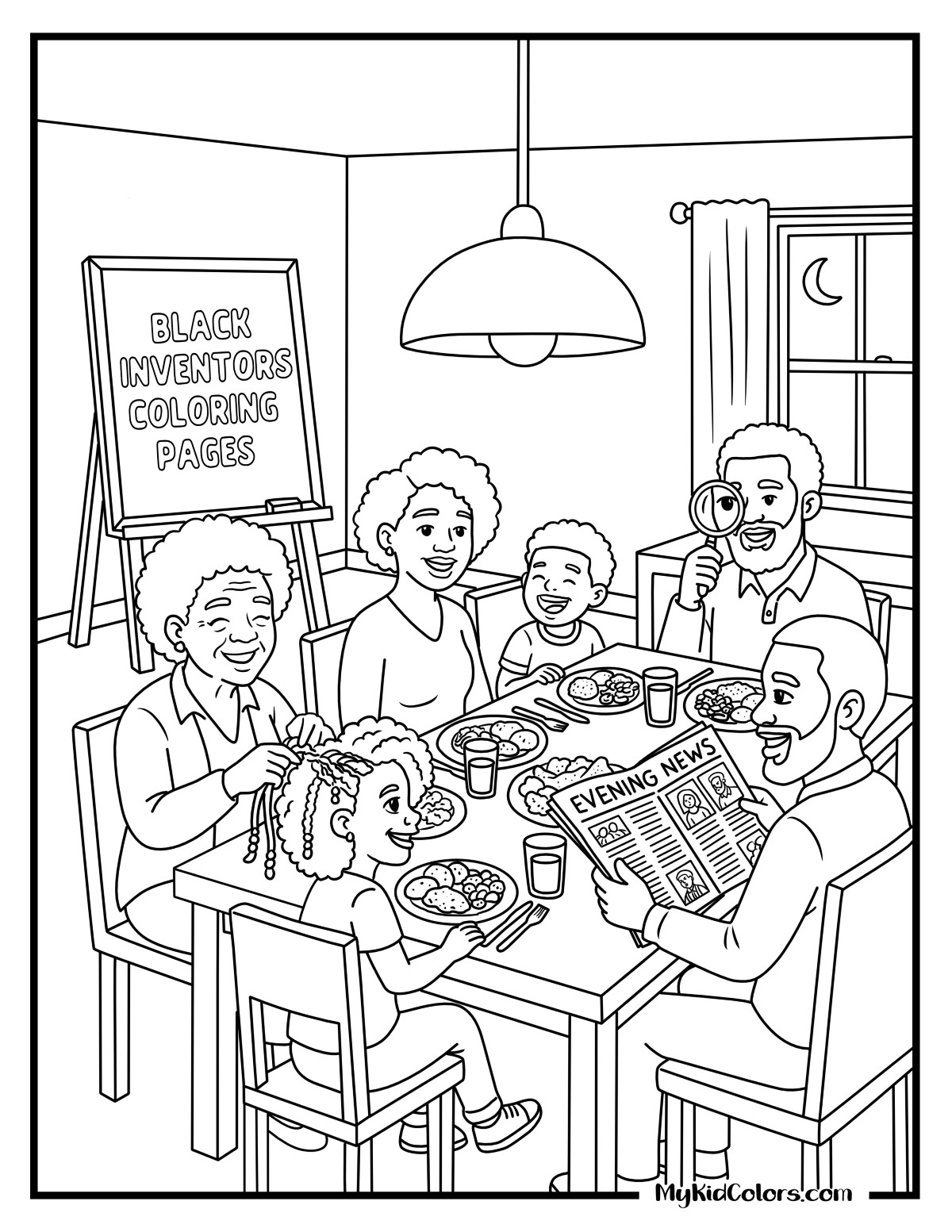
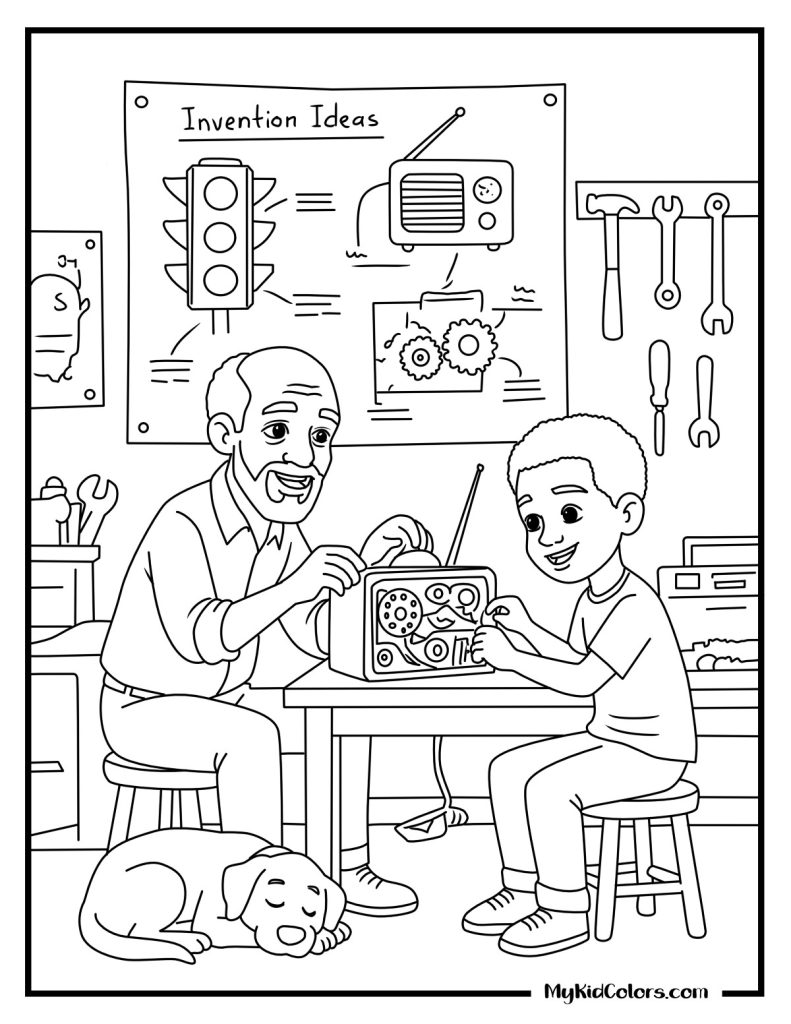
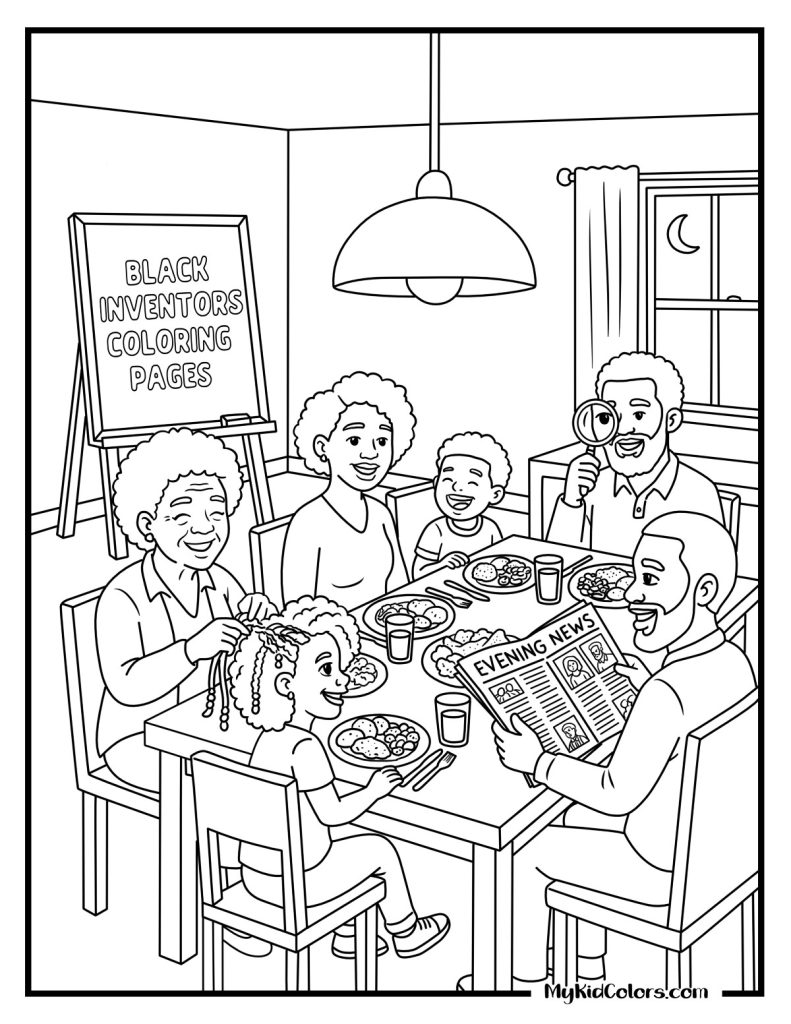
- Pages 14 and 15: A grandfather and child examine an open radio at a workbench, with tools, diagrams, and a resting dog around them. The collection ends with a family at dinner beneath a hanging lamp and a board reading “Black Inventors Coloring Pages.” The workbench gives children a close-up of tinkering, while the dinner scene brings the collection back to familiar family life.


Black Inventors Activities for Home and the Classroom
Match a Scene to a Real Contribution
Choose one person and page pair, then read the fact together. Some connections are direct topics; others are starting points for a wider conversation.
| Person | Contribution to introduce | Pages to pair |
|---|---|---|
| Garrett Morgan | Patented a three-position mechanical traffic signal in 1923, including an all-stop interval between changes. He did not invent the first traffic light. | 1 and 6, modern signal scenes |
| Lewis Latimer | Developed a method for producing more durable carbon filaments for incandescent bulbs. He did not invent electric light itself. | 3, 7, and 9 |
| Sarah Boone | Patented an improved ironing board in 1892, shaped to help with sleeves and fitted garments. | 4 |
| Marie Van Brittan Brown and Albert L. Brown | Co-invented a home security system using video, audio communication, and a remotely controlled lock. Their patent was granted in 1969. | 5, as a home-security conversation starter |
| Madam C. J. Walker | Developed hair-care products and built a business that trained women as sales agents. She did not invent the hot comb or hair braiding. | 2 and 8 |
| Frederick McKinley Jones | Developed successful mobile refrigeration equipment for transporting perishable goods. He did not invent the picnic cooler shown here. | 11, as a food-cooling conversation starter |
| Patricia Bath | Invented the Laserphaco device and technique for removing cataracts, a condition that clouds the eye’s lens. She did not invent eyeglasses. | 12, as an eye-care conversation starter |
For sources you can explore together, see Morgan’s traffic-signal story, Latimer’s work on filaments, and Bath’s cataract-surgery invention.
Make a Small Black Inventors Project
- Build a fact card. Choose Page 7 or Page 10 and one person from the table. On a separate sheet, add their name, one verified contribution, and a drawing. An adult can write while a younger child dictates or points.
- Try an improvement sketch. After Page 14, choose an everyday problem, such as crayons rolling off a table. Draw an idea that could help, then draw a second version with one change. No working device is needed.
- Create a picture match. Draw a signal, a bulb, and an ironing board on three cards. Match them with Morgan, Latimer, and Boone, using the contribution wording above rather than saying each invented the whole object.
For a wider history lesson, explore our African American history coloring pages. Our Hidden Figures coloring pages offer another way to introduce Black women’s contributions to STEM. These figures’ roles differ, so use each person’s actual work when discussing them.
Why We Put Human Artists Behind These Ideas
We want Black children to see curiosity as something they can act on: asking a question, drawing a plan, or standing up to share an idea. That’s why these pages show children learning and experimenting alongside the historical people you can introduce.
We work with human artists of color to illustrate these coloring pages (never AI artwork). Our investment is in their skills and in scenes that connect learning with family life, from a grandfather at a workbench to a child presenting a project.
Children with disabilities belong in that picture too. On Page 10, the wheelchair user is the presenter; on Page 13, another joins the class. Your purchase supports human artists and a collection where Black children can picture themselves asking the next question.
Frequently Asked Questions
Are these Black inventors coloring pages free?
The individual JPG images in this post are free to save and print. The complete 15-page PDF pack costs $4.99 if you prefer one download. You do not have to buy the PDF to use the individual images.
Does every page show a named inventor or their original invention?
No. Most pages show present-day children and families, with a few portrait-style drawings and classroom displays. Use the fact table to connect each scene to a verified contribution. The drawings are not technical diagrams or a complete set of labeled historical portraits.
Can I use these as an African American inventors worksheet or research project?
Use Page 10 as inspiration for a separate research sheet with three spaces: the person’s name, what they contributed, and the source of the fact. Page 7 also pairs with a short Latimer fact card. For a broader Black history unit, include other achievers while explaining their different roles; an aviator or astronaut is not automatically an inventor.
Download Your PDF Set
The traffic light you stopped at today, the lamp lighting this page, someone had to invent that first, and it’s worth knowing who. Print all 15 pages and let your child move through the set at their own pace, one inventor and one everyday moment at a time.
Save individual Black inventors coloring pages above free as JPGs, or get all 15 hand-drawn pages together in the $4.99 PDF pack.
You might also like:
- 30 Women in STEM Coloring Pages — 15 Free Hidden Figures Printables for Kids
- 15 Free African American Coloring Pages Celebrating Natural Hair
- 15 African American History Coloring Pages That Teach Kids Cultural Pride, Community, and History
- 15 Harriet Tubman Coloring Pages That Teach Kids Courage and Leadership

