

15 Free African American Coloring Pages Celebrating Natural Hair
Nobody told us that a coloring page could make a little girl cry — happy tears — because she finally saw her afro drawn with care. But that’s exactly what these pages do.
This collection of 15 free, hand-drawn African American coloring pages celebrates Black hair, Black joy, and Black excellence in the most ordinary, beautiful moments: a mother braiding her daughter’s hair on a rainy afternoon, a boy with locs at the basketball court, a scientist with afro puffs standing outside a solar facility she helped build. No stereotypes. No costumes. Just life, rendered with dignity.
A Note from Louisa (Founder of MyKidColors)
My hair is one of my strongest connections to home — I had my microlocks done in Nigeria, and I still think about that chair, that day, that place.
Growing up, I don’t remember seeing many Black children in the coloring books I had. The exceptions were Nigerian-authored books like Simbi Goes to School, where kids looked like me.

Less searching. More MEANINGFUL moments.
When kids recognize themselves on the page, coloring changes.
The Inclusive Family Coloring Collection includes 25 human-drawn illustrations centered on everyday moments — designed to make inclusion feel normal, joyful, and intentional.
Because representation shouldn’t be reserved for one month.
I wanted these African American coloring pages to hold that same feeling — braids being done at the kitchen table, hands in an afro, a hair ritual that’s really about love. Not a history lesson. Just an ordinary Tuesday, worth coloring in.
Conversation Corner: 3 Questions to Ask While Coloring
Turn this activity into a bonding moment. While your child colors, try asking these questions:
- For “Mother and Daughter Hair Braiding” (Page 3): “Who taught you something about taking care of yourself — and how did it feel to learn it from them?”
- For “Black Woman in Space” (Page 10): “If your hair could tell a story about who you are, what would it say?”
- For “Young Engineer at Solar Facility” (Page 15): “What’s something you’re really good at that the world needs more of?”
The Collection: 15 Free African American Coloring Pages
We’ve organized these into three sets — from everyday self-love to cultural pride to Black excellence in full bloom.
For Little Hands: Hair, Mirrors & Me (Pages 1–5)
Best for toddlers and preschoolers. These pages focus on self-recognition, natural hair pride, and the warm rituals of everyday Black childhood.
- Page 1 — A joyful group of Black children and teens celebrate their unique natural hairstyles in front of a large mirror. A perfect first page for the question: “What do you love about the way you look?”
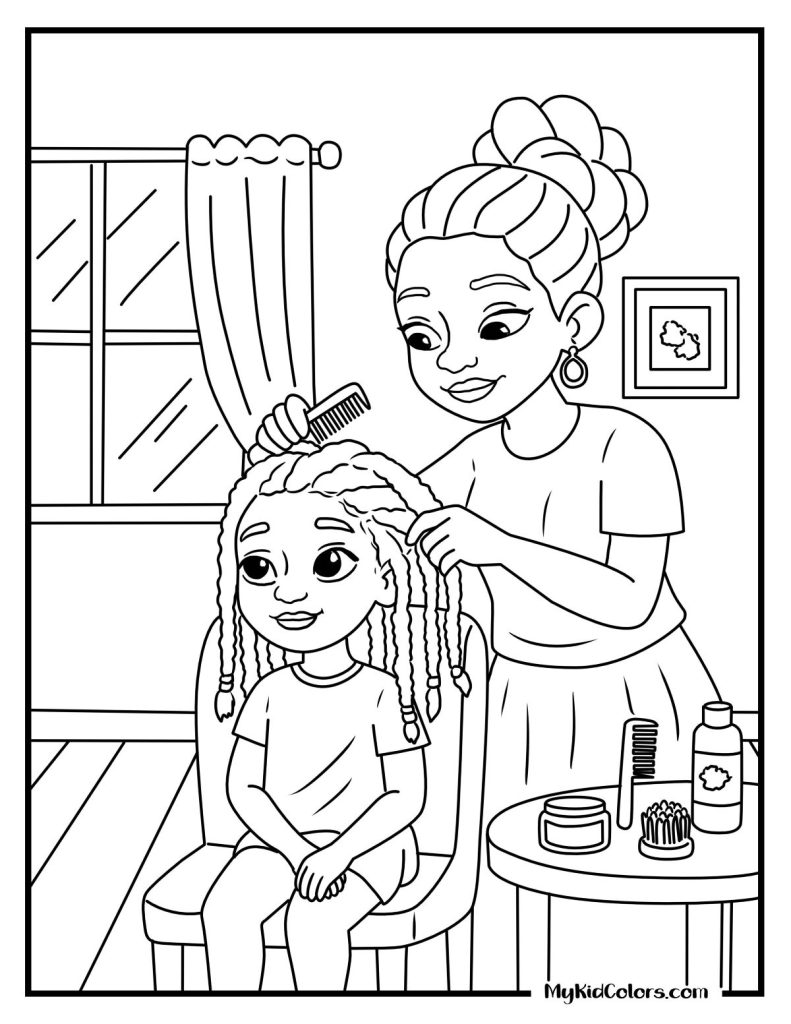
- Pages 2 & 3 — A happy young girl smiles at her reflection wearing clips in her voluminous afro, and a loving mother combs and braids her daughter’s hair in a cozy bedroom. These two pages together are a love letter to the hair-care ritual so many Black families know by heart.
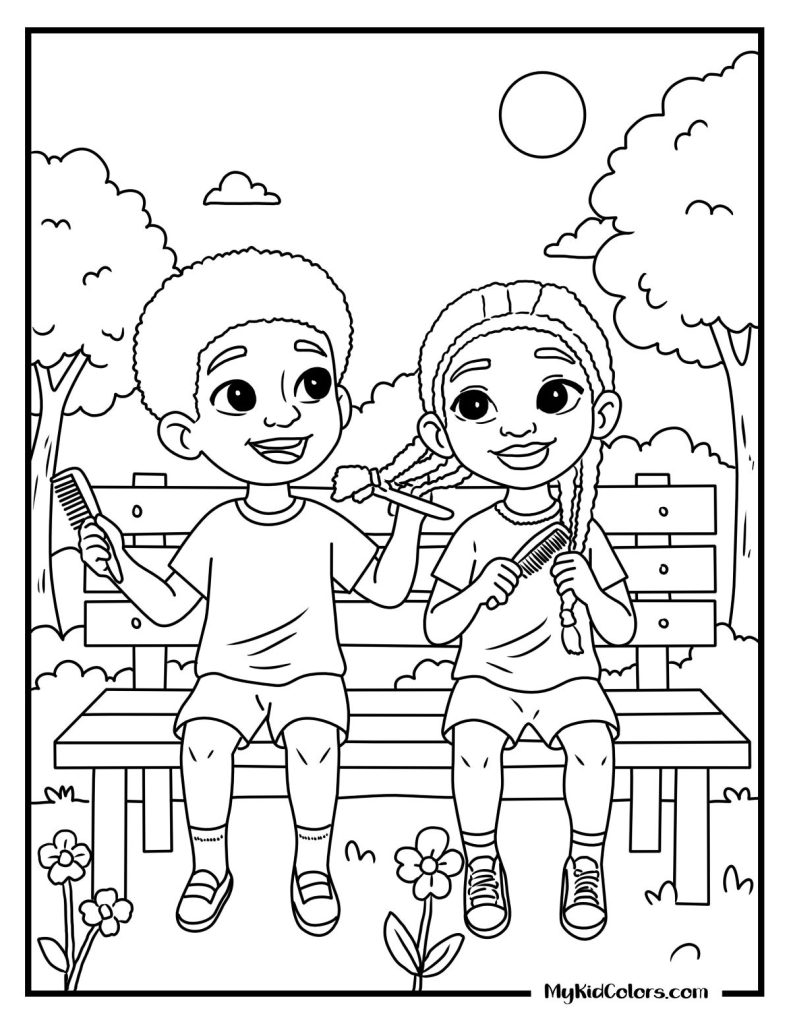
- Pages 4 & 5 — Two kids style each other’s hair on a park bench, and a young girl proudly shapes her large afro in front of a window full of houseplants. Simple, joyful, and full of personality.



Growing Into Yourself: Confidence & Culture (Pages 6–10)
Perfect for elementary kids. These pages visualize identity, style, and the quiet power of knowing exactly who you are.
- Page 6 — A smiling boy with locs sits in a wheelchair holding a comb next to a basketball hoop and soccer ball. Disability representation in the most ordinary, confident setting.
- Pages 7 & 8 — A stylish young woman admires her headwrap and tall locs at a vanity mirror, and a girl with curly hair sits peacefully in a blooming field braiding her own hair. Both pages are stunning on their own — together they’re a mood board for natural hair beauty.
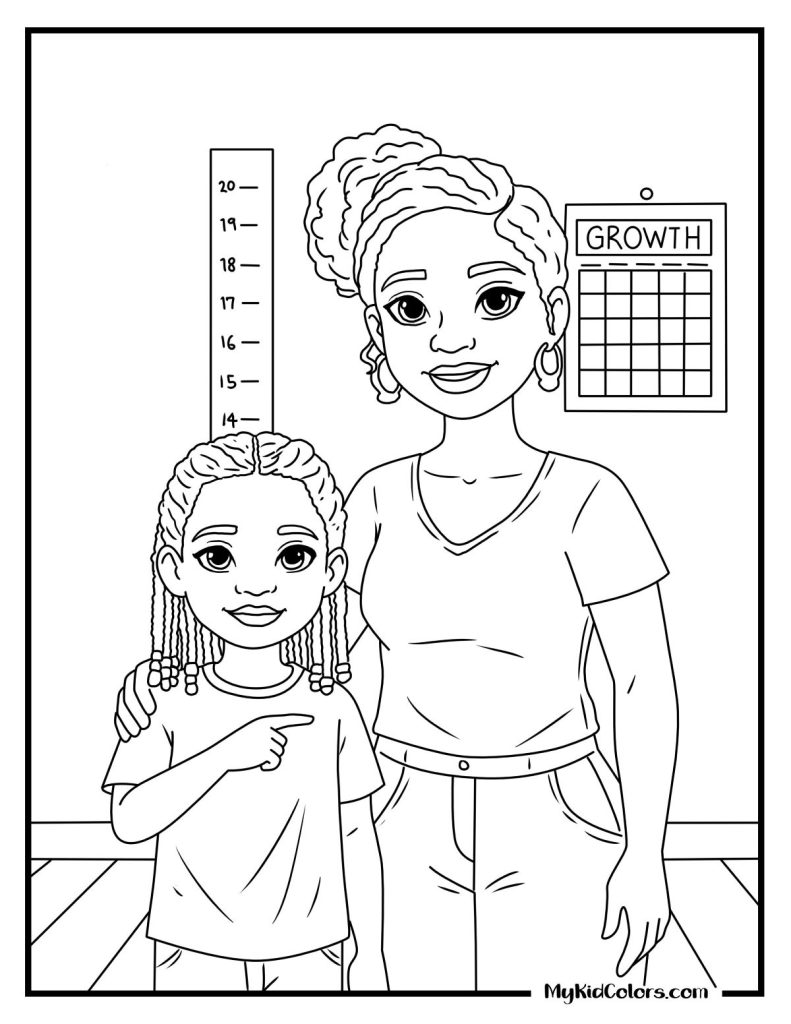
- Pages 9 & 10 — A proud mother measures her braided daughter’s height against a wall growth chart, and a powerful Black woman with geometric hair patterns stands against a starry space backdrop. Page 10 is the most striking in the collection — give kids metallic or glitter pencils for the stars.




Black Excellence in Full Bloom (Pages 11–15)
Designed for older kids, teens, or quiet reflection. These scenes show Black culture, community, and ambition in full, vivid detail.
- Page 11 — A fashionable woman poses in a traditional dashiki top and flared jeans under a bright sun. A beautiful entry point for conversations about African heritage and Afrocentric style.
- Pages 12 & 13 — A bustling hair salon shows stylists and barbers braiding, cutting, and styling Black hair, and a mother and daughter share a warm rainy-day braiding moment. Page 12 is especially rich for group observation — who’s in the room, what’s happening, what does this space mean to the community?
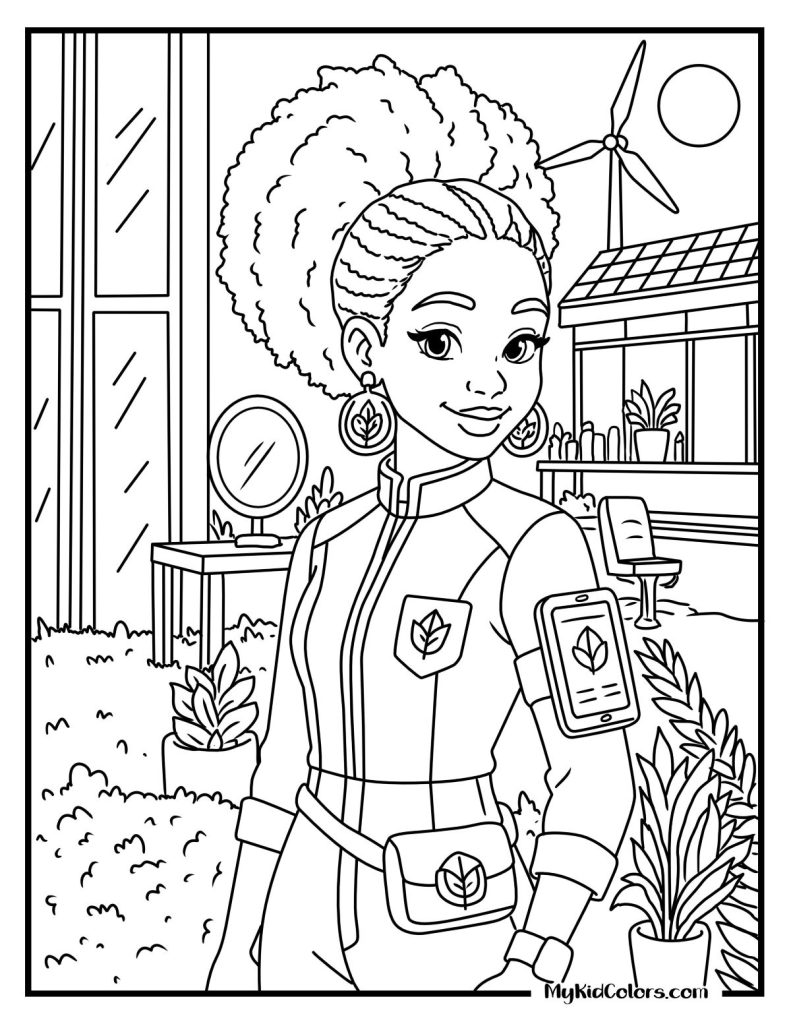
- Pages 14 & 15 — A trendy girl with space buns and braids poses near a vintage boombox, and a young Black female engineer with afro puffs stands confidently outside a solar facility. End the collection here and ask: “Which of these women would you want to have a conversation with — and what would you ask her?”



Perfect for Homeschool, Classrooms & Cultural Celebrations
Parents and educators love using these as Black culture coloring pages, Black History Month activities, and melanin coloring pages for cultural appreciation units. Here’s exactly who each set was made for:
- Parents of toddlers and early readers (ages 2–8) who want a coloring activity that connects to their child’s everyday experience — Pages 1, 2, 3, 4, and 5 are rooted in the hair-care rituals, mirrors, and self-recognition moments that are already part of Black childhood at home.
- Homeschool families running a Black history, African heritage, or identity unit — Pages 7 (headwrap and locs), 10 (celestial Black woman), and 11 (dashiki and Afrocentric fashion) anchor natural conversations about cultural pride, African roots, and what it means to wear your heritage with joy.
- Elementary teachers and after-school educators incorporating diversity, community, or SEL themes — the hair salon scene (Page 12) is especially strong for group observation and discussion: who is in the room, what relationships exist between the people, and what does this kind of community space mean in Black culture?
- Art teachers, school counselors, and SEL facilitators — Page 6 (boy with locs in a wheelchair at the basketball court), Page 10 (celestial Black woman), and Page 15 (young engineer with afro puffs) offer images of Black identity and excellence that center dignity, ambition, and joy — not struggle.
Why We Choose Hand-Drawn Coloring Pages
Hair like this can’t be templated. A human illustrator has to decide how a coil bends, how a loc catches light, how twists sit differently on every head — that’s not something you fake with a filter. It takes an artist who’s looked closely at real hair, on real kids.
Our human illustrator drew every curl pattern, every braid part, every proud look in the mirror by hand, page by page. When a child sees their exact hair texture drawn with that kind of care, they know someone paid attention. That’s the whole point.
Frequently Asked Questions
Can I use these pages for a Black History Month unit that goes beyond the usual figures and timelines?
Yes — and that’s exactly what they were designed for. These pages center everyday Black joy, not just historical milestones. Pages 12 (hair salon) and 3 (mother braiding daughter’s hair) are particularly powerful for conversations about community and cultural tradition. Pair Page 15 (young Black engineer) with a lesson on Black innovators in STEM for a natural bridge between past and present.
Are there pages that work specifically for a natural hair celebration or “Wear Your Crown” school event?
Pages 1, 2, 5, 7, and 8 are your core set for this. Page 1 (group of kids celebrating their hairstyles in a mirror) works beautifully as a whole-class coloring activity, while Page 5 and Page 8 are stunning individual portrait pages kids can take home. Add gold or copper metallic pencils for the hair and you’ve got a wall-worthy finished piece.
My students include children who are not Black — how do I use these pages in a diverse classroom without it feeling performative?
Frame it around the universal before the specific. Start with the question: “What’s something about the way you look that you’re proud of?” Then introduce the pages as a window into someone else’s experience of that same feeling. The goal isn’t for every child to see themselves in every page, but for every child to learn to see and celebrate someone else.
Download Your Free Set
Hair day, salon day, or just a regular Tuesday — these 15 African American coloring pages are ready whenever you are.
Download the free set below, and if your child sees a coil or a curl that looks a little like theirs, that’s exactly the point.
You might also like:
- 20 Free Black History Coloring Pages for Kids That Celebrate Joy, Belonging, and Leadership
- 15 Juneteenth Coloring Pages That Celebrate Freedom, Resilience, and Black Joy
- 15 All About Me Coloring Pages That Help Kids Build Confidence and Identity
- 15 Crazy Hair Day Coloring Pages That Celebrate Self-Expression and Creativity
- 15 Free Hispanic Heritage Coloring Pages That Don’t Flatten 500 Million People Into One

