
15 Free Black Power Coloring Pages About Pride and Community
When your child notices a raised fist or a protest sign, you may want to give them an answer that is honest and small enough to begin with. These Black Power coloring pages give you pictures to look at together, from people standing side by side to a child learning something new.
The 15 hand-drawn designs include a bold fist, natural hair portraits, blank signs, family connections, and scenes inspired by Black history.
Choose one picture, notice its details, and let the conversation grow from there. A short explanation and a question can be enough for today.
All 15 pages. One easy download. Get the complete human-drawn, ready-to-print PDF for $1.99, available instantly with a download link emailed to you for easy access anytime.
Prefer free JPGs? Right-click any coloring page and select “Save image as,” or press and hold the image on your phone to save it.
The PDF pages are US Letter size. Select “Fit” in your print settings if needed.

Less searching. More MEANINGFUL moments.
When kids recognize themselves on the page, coloring changes.
The Inclusive Family Coloring Collection includes 25 human-drawn illustrations centered on everyday moments — designed to make inclusion feel normal, joyful, and intentional.
Because representation shouldn’t be reserved for one month.
A Note from Louisa (Founder of MyKidColors)
I was proud of my pharmacy degree. Getting into a doctor of pharmacy program took work, and getting through it took even more. My parents were proud of me, and I was proud of myself.
Later, I listed some of my qualifications in my social media bio. A man of a different race took the time to send me a DM dismissing what I had achieved. I remember wondering why someone couldn’t simply let another person celebrate.
As a Black woman and a mother, I think about that when I consider what children hear about themselves. I want them to have room to be pleased with their efforts, and people around them who can share in that happiness.
Perhaps you want that for a child in your life, too. Whether they’re learning a new word or finishing something difficult, we can notice the effort. They can be proud without needing everyone’s approval.
Conversation Corner: 3 Questions to Ask While Coloring
Choose one question at a time. Children can speak, point, sign, draw, or use a communication device. They can also keep coloring while you share a short thought.
- Learning and Exploring (Page 11): “What is something you would like to learn?”
- People Standing Together (Page 3): “Who helps you when something is difficult?”
- Family Portrait (Page 13): “What is something someone in your family has taught you?”
For a child who prefers a choice, point to the map and model on Page 11 and ask which they would like to explore. Avoid making every picture a test of what a child knows.
The Collection of 15 Black Power Coloring Pages
In U.S. history, Black Power developed as a movement concerned with Black pride, political influence, community organization, and greater control over Black people’s lives. It included different organizations and viewpoints. The Smithsonian American Art Museum’s history glossary offers background for adults preparing a discussion.
This collection combines references to that history with contemporary scenes of learning, family, achievement, and community. The drawings can start a conversation; they do not tell the movement’s whole history. Page 12 specifically refers to the Black Panther Party, while some other pictures use broader symbols or imagined scenes.
Choose by the subject and amount of detail that fit your child or lesson. A simple outline can still need an adult’s explanation, and a detailed picture does not automatically require a difficult conversation.
Bold Symbols, Strength, and Natural Hair (Pages 1-5)
Page 1 has the broadest shapes. The following portraits and group scenes add faces, hair, clothing, and smaller spaces.
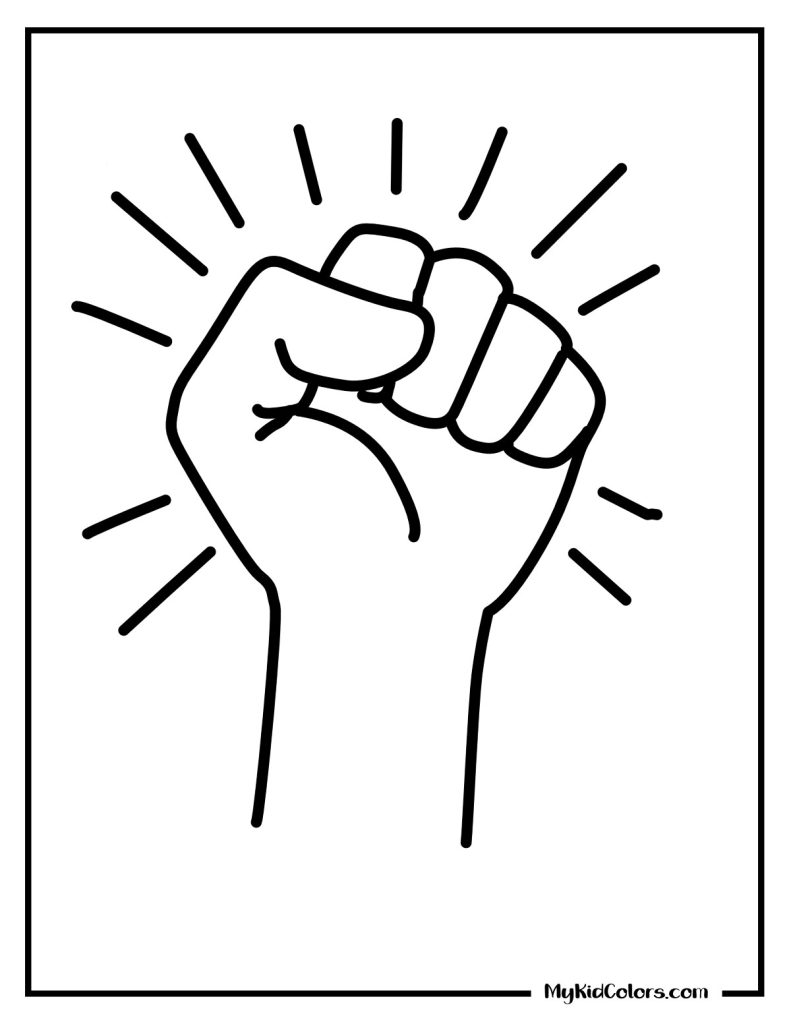
- Page 1: Raised Fist. A large fist sits at the center of radiating lines. It offers open areas for broad strokes and a place to begin talking about how people use symbols to express solidarity, or standing together.
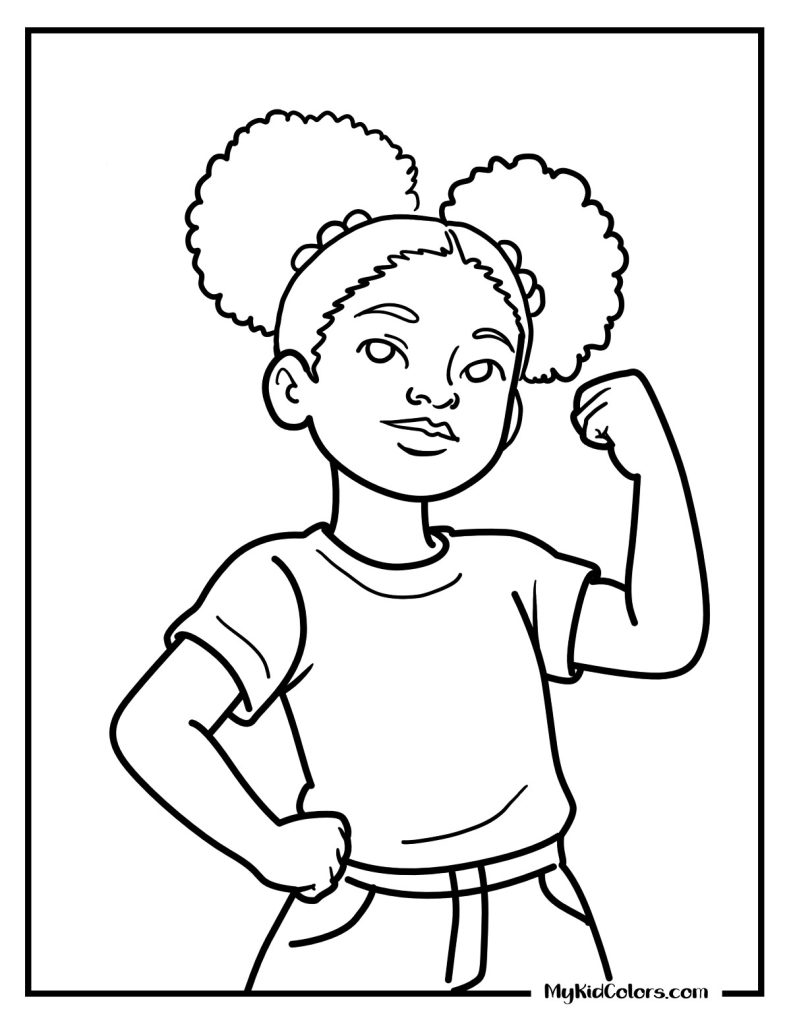
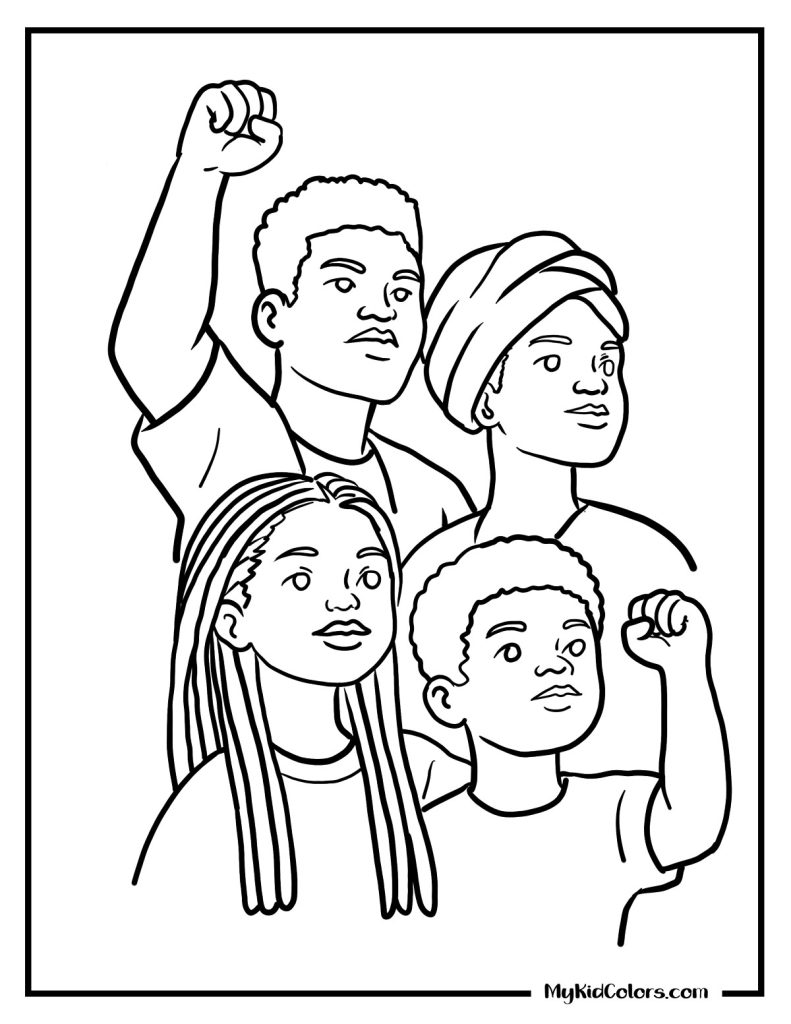
- Pages 2 and 3: Strength and Standing Together. A girl with two hair puffs flexes one arm, followed by a group of four people, two with raised fists. Children can notice both the individual pose and the shared gesture without assuming strength always looks the same.
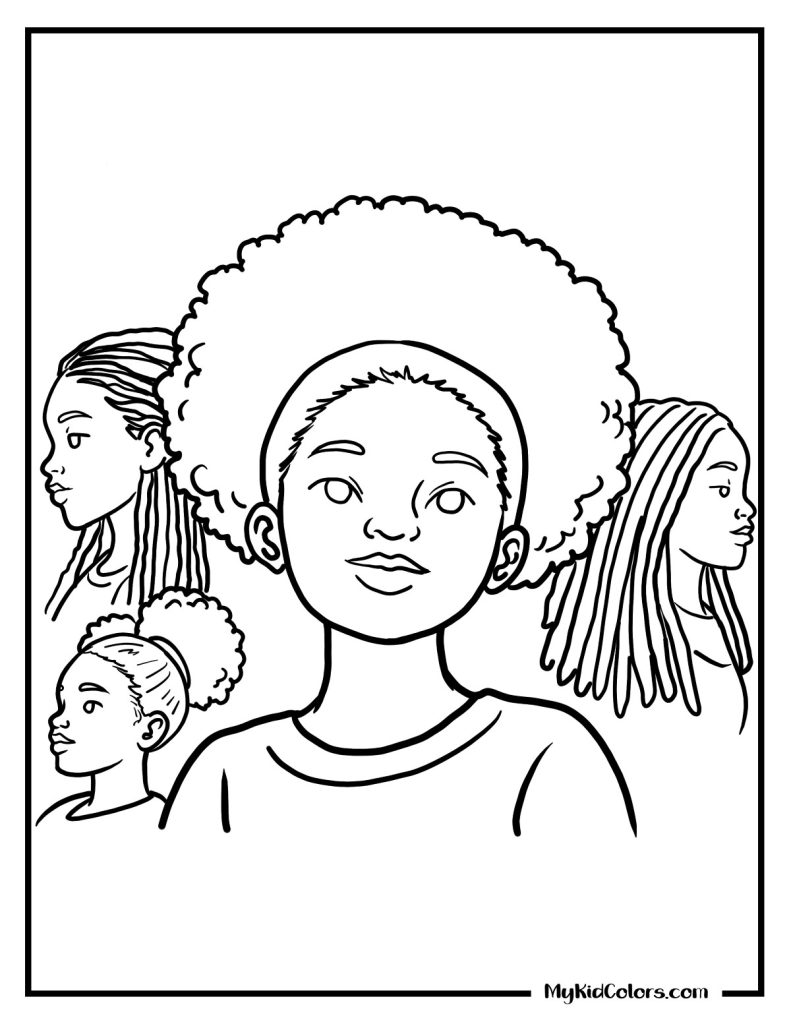
- Pages 4 and 5: Celebrating an Achievement and Hair Portraits. Three children wear medals on a winners’ podium, with a trophy held above them. Next, a large afro portrait is surrounded by smaller views of other hairstyles. Color the hair in layers or use broad areas of color, according to your child’s interest.

All 15 pages. One easy download. Get the complete human-drawn, ready-to-print PDF for $1.99, available instantly with a download link emailed to you for easy access anytime.
Prefer free JPGs? Right-click any coloring page and select “Save image as,” or press and hold the image on your phone to save it.
Signs, Community Roles, and Sharing Ideas (Pages 6-10)
These scenes include blank areas for words or drawings. Children can dictate a caption or choose a symbol if they do not want to write.
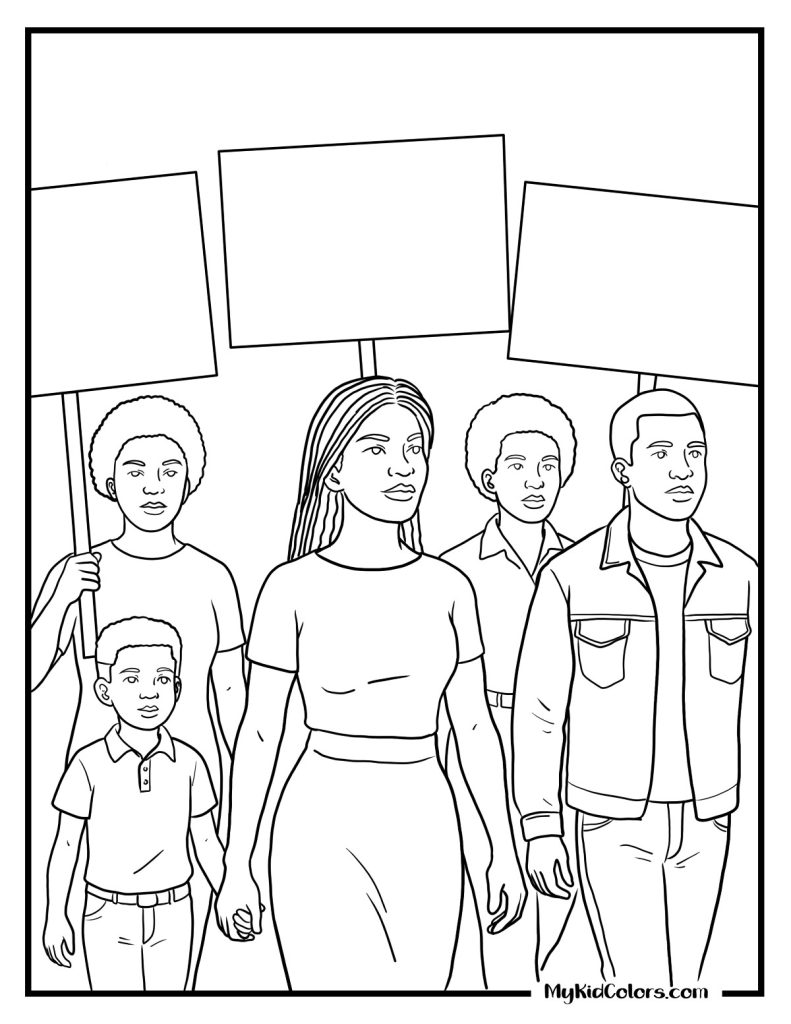
- Page 6: A Group With Blank Signs. Adults and a child stand together beneath three empty placards. The spaces can hold a question, a picture, or a message about something the child thinks would help their community.
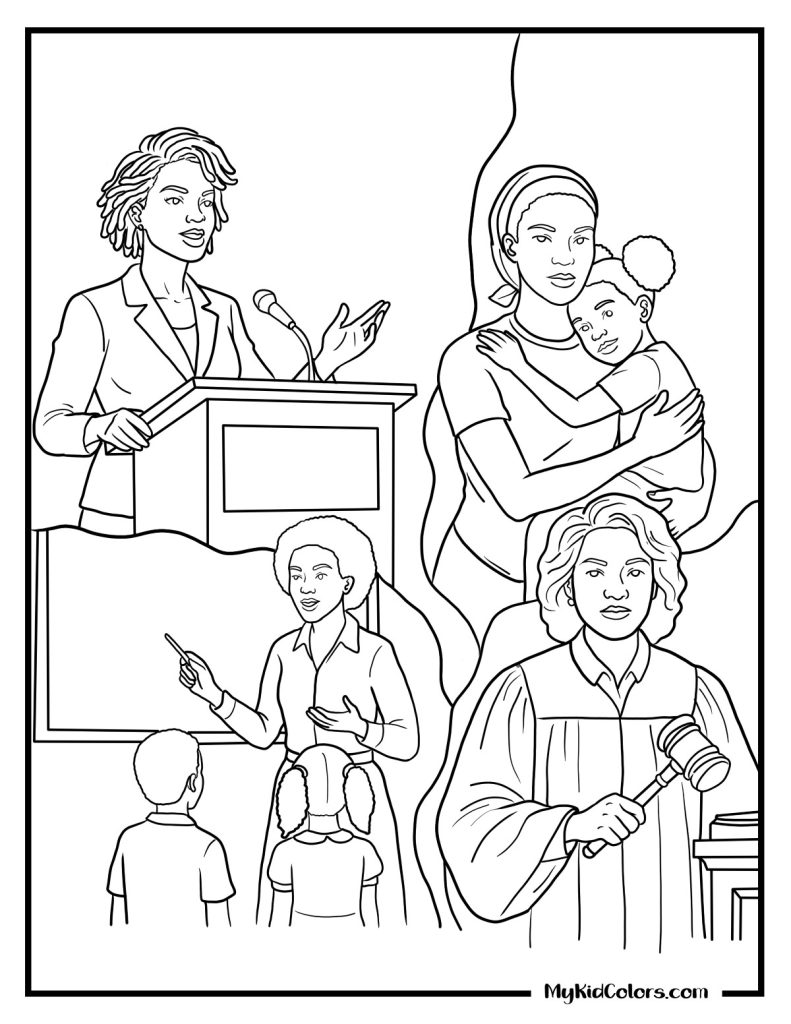
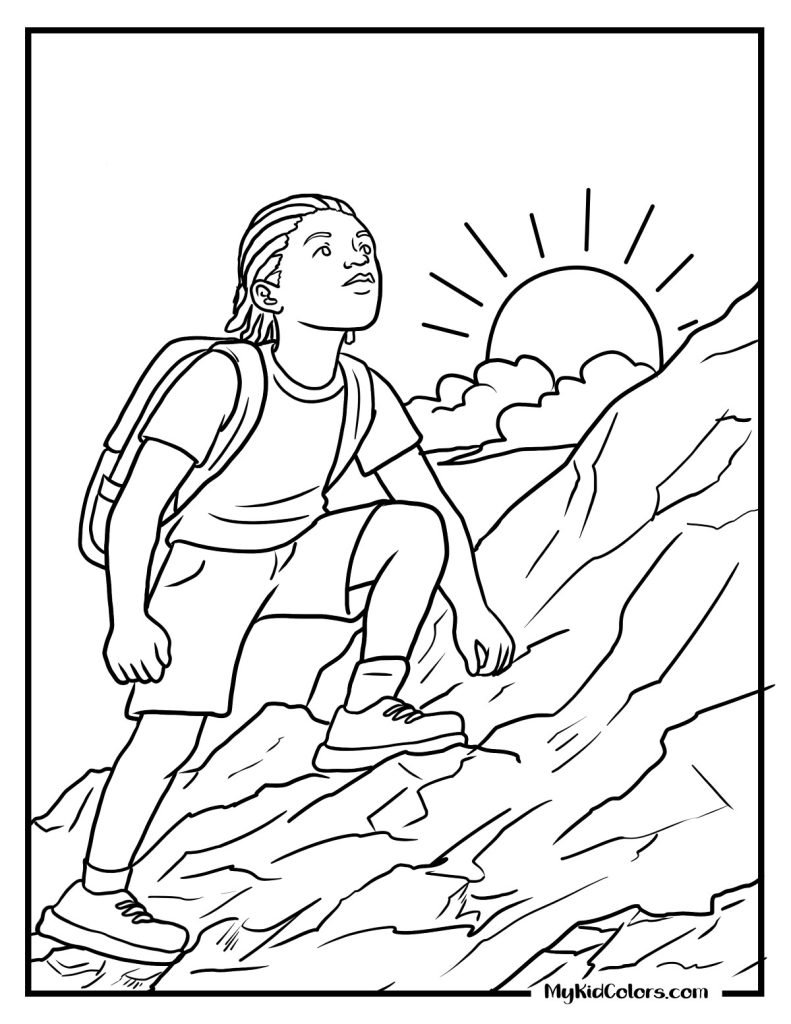
- Pages 7 and 8: Different Kinds of Contribution and a Climb. A collage shows a speaker, a caregiver holding a child, a teacher with pupils, and a judge holding a gavel. A separate hiking scene follows, with a backpack-wearing young person stepping up a rocky slope toward the sun.
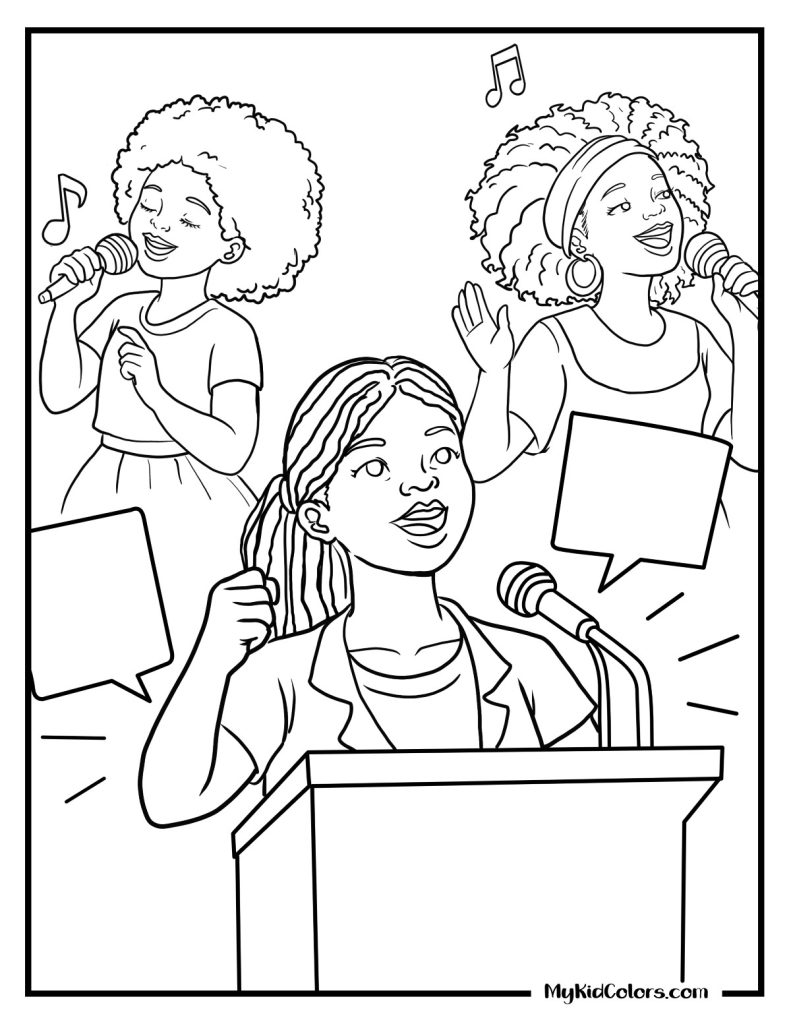
- Pages 9 and 10: Music, Speaking, and Portraits. Singers and a speaker at a lectern appear with empty speech bubbles. The next page places four larger portraits above people holding a megaphone and blank sign. The portraits are not labeled, so pair this page with a verified history resource rather than asking children to guess who each person is.

All 15 pages. One easy download. Get the complete human-drawn, ready-to-print PDF for $1.99, available instantly with a download link emailed to you for easy access anytime.
Prefer free JPGs? Right-click any coloring page and select “Save image as,” or press and hold the image on your phone to save it.
Learning, Movement History, Family, and Connections (Pages 11-15)
These pages combine several scenes or people. Pages 12 and 14 need particular context about what the historical references and map arrows do, and do not, represent.
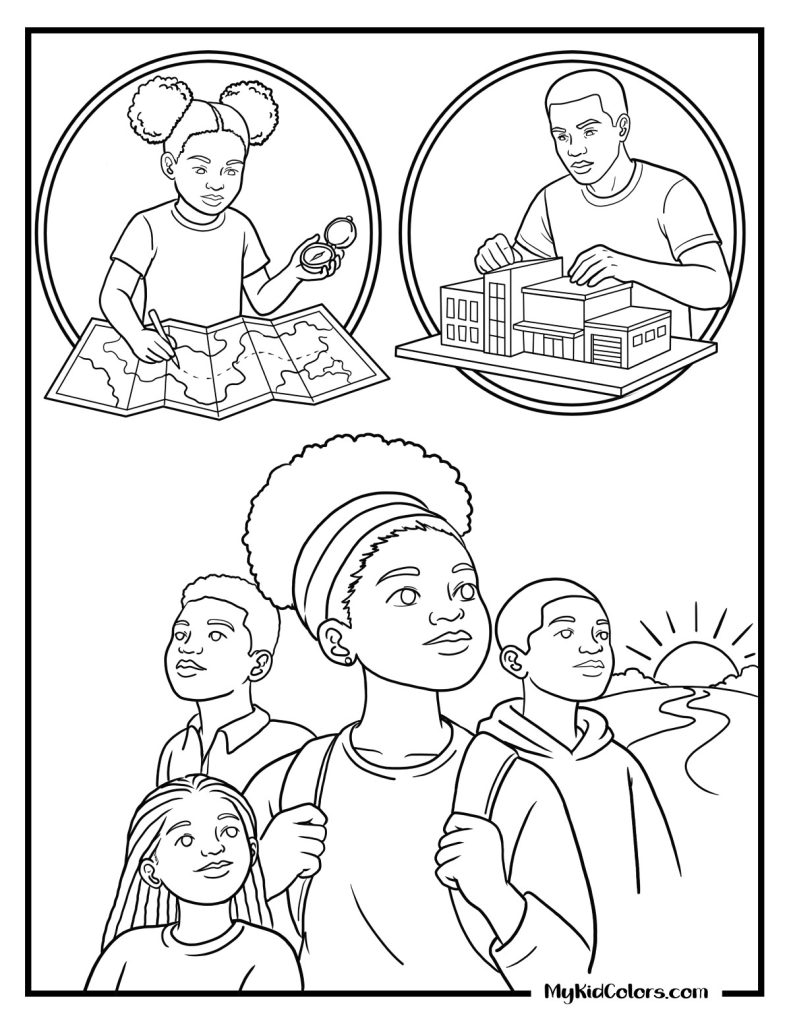
- Page 11: Learning and Exploring. Two circular scenes show a child using a magnifying glass over a map and a person working on a model building. Below them, a group with backpacks looks ahead in an outdoor setting. This is a useful choice for children interested in places, making things, or learning something new.
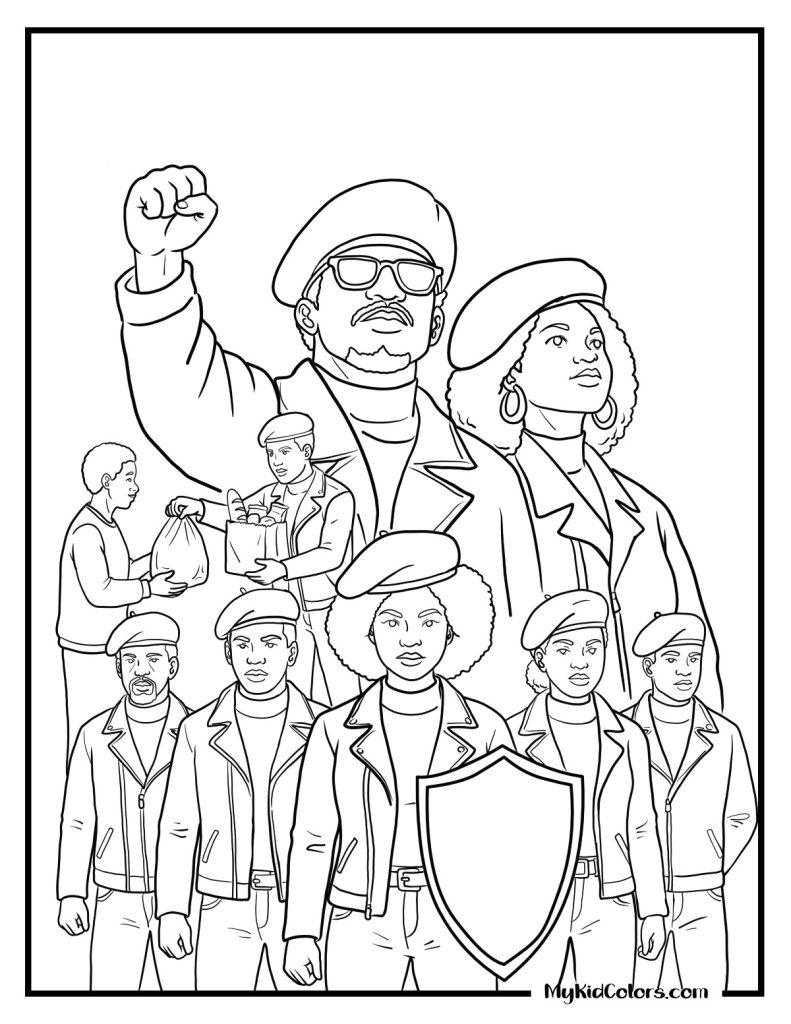
- Pages 12 and 13: A Movement Reference and a Family Portrait. A Black Panther Party-inspired collage includes berets, jackets, a raised fist, a food handover, and a shield motif. The following page brings together an older woman, an adult woman, and two younger girls with different hairstyles. Their exact family relationships are open to storytelling rather than established by the picture.
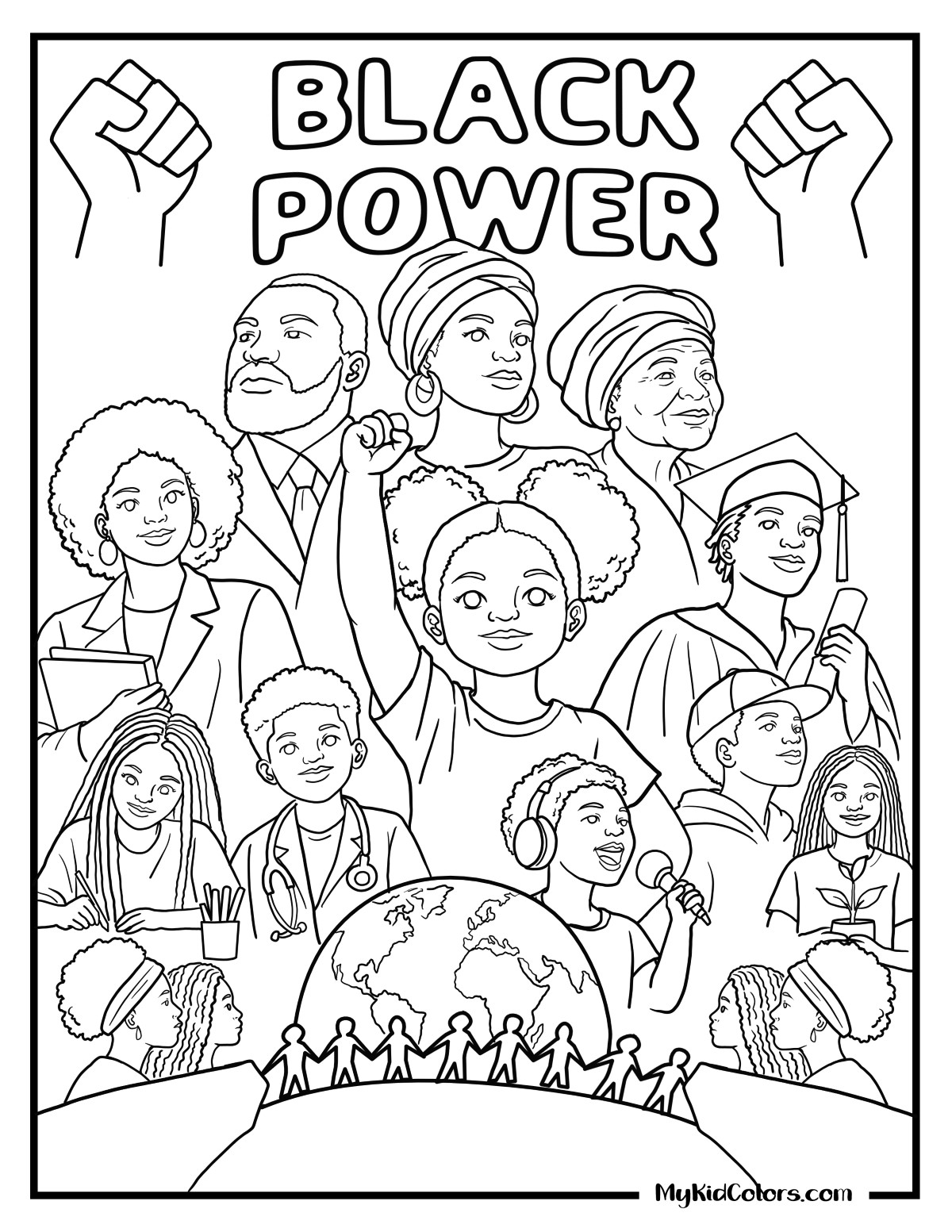
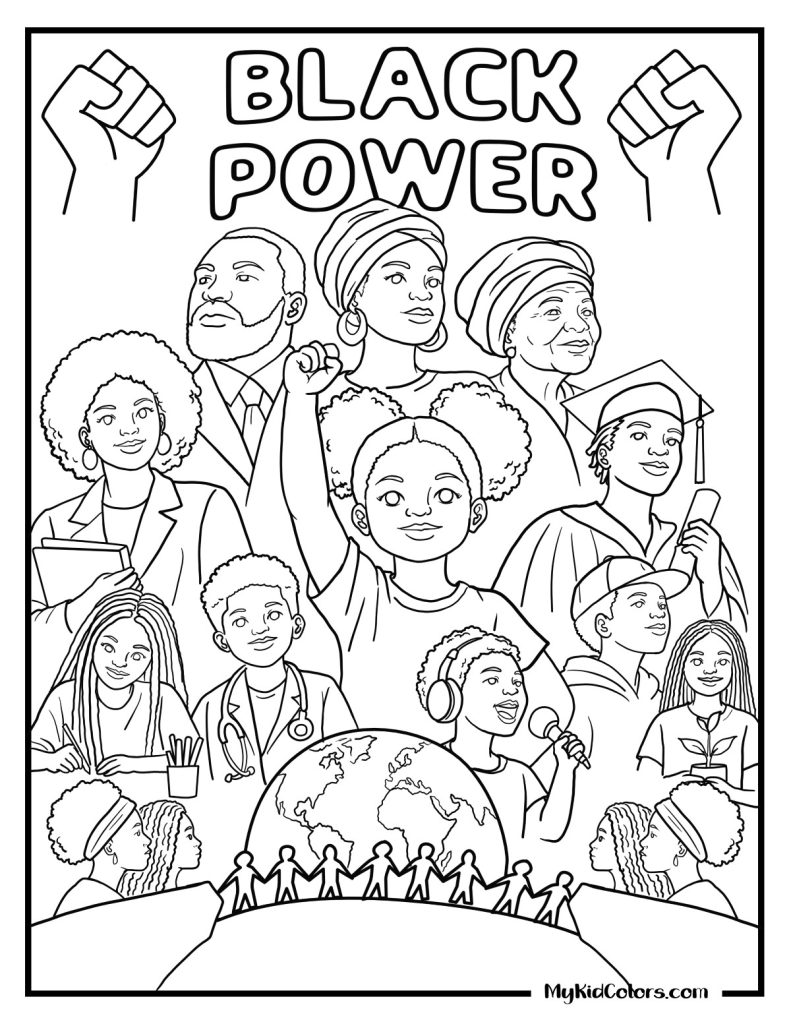
- Pages 14 and 15: Connections Across Places and the Cover Collage. Five framed portraits surround a partial world map with arrows. The final page combines “BLACK POWER” lettering, fists, people learning and working, a graduate, a singer, and a globe with linked figures. The map arrows are illustrative connections, not verified historical migration routes.


All 15 pages. One easy download. Get the complete human-drawn, ready-to-print PDF for $1.99, available instantly with a download link emailed to you for easy access anytime.
Prefer free JPGs? Right-click any coloring page and select “Save image as,” or press and hold the image on your phone to save it.
Ways to Use the Pages at Home, in Classrooms, and in Youth Programs
Start with one picture and a short activity. Children do not have to make a public statement or share a difficult personal experience to take part.
- Notice effort with Page 4 or 11. After coloring, invite the child to draw or dictate something they are practicing. An adult can share a skill they are still learning, too. A podium is one way of celebrating achievement; the learning page gives another starting point.
- Make a community-ideas page with Page 6. Ask what could make a shared place more welcoming or useful. Children might draw a place to sit, a shared book box, or a play space. Leave the choice with the child, and help write their own words if asked.
- Explore a way to communicate with Page 9. Add a short song lyric of the child’s own invention, an idea, or a drawing to a speech bubble. They can point, sign, write, or use their communication device to share it. A person does not have to speak into a microphone to contribute.
- Collect a family memory with Page 13. Invite a family member or trusted adult to share something they learned growing up. Write one sentence on the back of the colored picture. Children can invent a story instead of sharing personal family information.
- Pair a historical image with a source. For Page 12, an adult can use the National Museum of African American History and Culture’s Black Panther Party overview to prepare a discussion. Its account includes community food programs and health clinics, alongside the organization’s political history. Choose an age-appropriate explanation instead of treating the shield and jackets as the whole story.
For a broader history activity, explore our Black History Month coloring pages. If your lesson is about Juneteenth, our Juneteenth coloring pages offer a separate starting point; this set does not explain that holiday’s history.
Human-Drawn Details in Symbols and Everyday Scenes
The open shapes of the first fist, the blank signs waiting for a child’s words, and the hands resting on shoulders in the family portrait offer different ways to approach the collection. Some pages focus on a single gesture; others leave space to notice the people around it.
MyKidColors works with human illustrators to create these pages. We pair that artwork with careful descriptions so families can distinguish a visible detail, a symbolic scene, and a historical reference.
Frequently Asked Questions
How can I explain Black Power to a young child?
Begin with the history in simple language: “Black people worked together to challenge unfair treatment and have more say in their lives and communities.” You can then talk about pride, learning, and helping one another. This is an introductory explanation, not a complete definition of every organization or viewpoint associated with the movement. Let the child’s questions guide how much more you explore.
What can kids write on the blank signs and banner on Pages 6 and 10?
Encourage messages that reflect their own values, like “Be Kind,” “Everyone Belongs,” “Dream Big,” or “Speak Up for Others.” Younger kids can draw a symbol or a picture instead of words. Displaying the finished signs in a hallway or bedroom makes a great reminder of what they stand for.
Can I use these pages during Black History Month or other cultural celebrations?
Yes. Pages 10, 14, and 15 fit naturally into a month-long celebration because they highlight historical icons, global connections, and community joy. You can color one page each week and end the month with a gallery walk where kids share what they learned. They also work for school heritage days, family reunions, and community events any time of year
Are these Black Power coloring pages free?
The individual JPG images on this page are free to save. Right-click an image on a computer or press and hold it on a phone, then save and print it from your device. The complete 15-page PDF is a separate $1.99 purchase, with a download link emailed after checkout.
Download Your Black Power Coloring Pages
Choose a picture that fits the conversation you want to begin. You might talk about a family memory, look up the history of a symbol, or notice something your child is working hard to learn. There is room to ask questions and return to them another day.
All 15 pages. One easy download. Get the complete human-drawn, ready-to-print PDF for $1.99, available instantly with a download link emailed to you for easy access anytime.
Prefer free JPGs? Right-click any coloring page and select “Save image as,” or press and hold the image on your phone to save it.
If these pages would be useful to a parent, teacher, or community educator you know, please share this post with them. Every share helps more families find our work and means so much to this small business.
You might also like:
- 15 Free Black History Month Coloring Pages (Hand-Drawn PDF)
- 15 Juneteenth Coloring Pages That Celebrate Freedom, Resilience, and Black Joy
- 15 Free Black Joy Coloring Pages Celebrating Play, Family, and Friendship
- 15 Free Black Culture Coloring Pages Celebrating Everyday Life
- 15 African American History Coloring Pages That Teach Kids Cultural Pride, Community, and History

