

15 Free African National Parks Coloring Pages That Put Black and Brown Kids in the Wild
Search “national parks coloring pages” and every result you find will be American. Yellowstone bison. Grand Canyon cliffs. Zion slot canyons. All beautiful. All on the same continent.
Africa has some of the most extraordinary protected land on earth — the Serengeti, the Ngorongoro Crater, Bwindi Impenetrable Forest, the Namib Desert dunes at Sossusvlei. And not one free coloring page for children covers any of it.
These pages exist because that gap needed filling, and because Black and brown children deserve to see themselves in the wild — not just as observers, but as the curious, capable kids at the center of the adventure.
A Note from Louisa (Founder of MyKidColors)
As a parent, I love watching children notice the natural world in tiny ways: rocks, leaves, water, breeze, snow, animal tracks, and every little thing adults sometimes walk past too quickly.

Less searching. More MEANINGFUL moments.
When kids recognize themselves on the page, coloring changes.
The Inclusive Family Coloring Collection includes 25 human-drawn illustrations centered on everyday moments — designed to make inclusion feel normal, joyful, and intentional.
Because representation shouldn’t be reserved for one month.
I also know how easy it is for children to see Africa shown in one narrow way. That is not what I wanted for this set.
These pages were created to help kids see African national parks with curiosity and beauty: wide savannas, quiet rivers, rainforest trails, salt pans, dunes, crater views, wildlife, maps, and children learning safely along the way.
Conversation Corner: 3 Questions to Ask While Coloring
Turn this activity into a bonding moment. While your child colors, try asking these questions:
- For “Serengeti National Park” (Page 1): “What animals would you hope to see on a real safari adventure, and why do you think protecting wildlife habitats is important for the future?”
- For “Ngorongoro Conservation Area” (Page 7): “How do you think families feel when they explore beautiful places in nature together, and what places would you love to visit one day?”
- For “Bwindi Impenetrable National Park” (Page 12): “Why do you think gorillas and rainforests are important to protect, and what can people do to help care for nature and animals?”
The Collection: 15 Free National Parks Coloring Pages
We have organized these into three themed sets to help children explore wildlife, geography, conservation, and outdoor adventure—from simple safari learning to deeper environmental appreciation.
For Little Hands: Safari & Nature Discovery (Pages 1–5)
Best for toddlers and preschoolers. These pages focus on simple wildlife scenes, bold animal outlines, and beginner-friendly geography learning through National Park coloring pages and nature exploration activities.
- Page 1: Serengeti National Park introduces children to safari animals, open grasslands, and wildlife observation through a playful safari scene with binoculars and wildebeest.
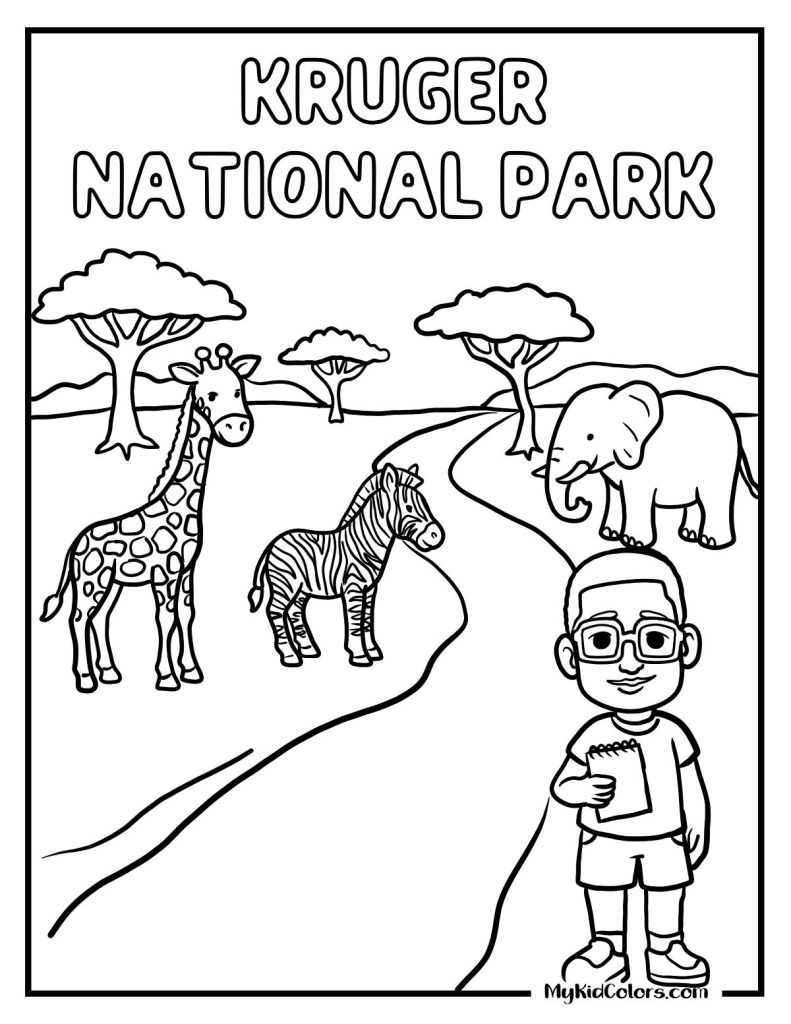
- Pages 2 & 3: Amboseli National Park and Kruger National Park help children explore elephants, zebras, giraffes, and Mount Kilimanjaro through easy-to-color safari scenes and educational wildlife learning.
- Pages 4 & 5: Chobe National Park and the African National Parks learning page introduce rivers, boats, maps, books, and outdoor curiosity while reinforcing geography and nature-based creativity.




Exploring Wildlife, Geography & Adventure (Pages 6–10)
Perfect for elementary learners. These pages connect children to migration, conservation, wildlife observation, and African landscapes through engaging National Parks printables and homeschool activities.
- Page 6: Maasai Mara National Reserve introduces migration patterns, zebras, and open savanna landscapes while encouraging curiosity about wildlife movement and ecosystems.
- Pages 7 & 8: Ngorongoro Conservation Area and Etosha National Park explore crater landscapes, family travel, waterholes, accessibility, and animal gathering spaces through thoughtful geography learning.
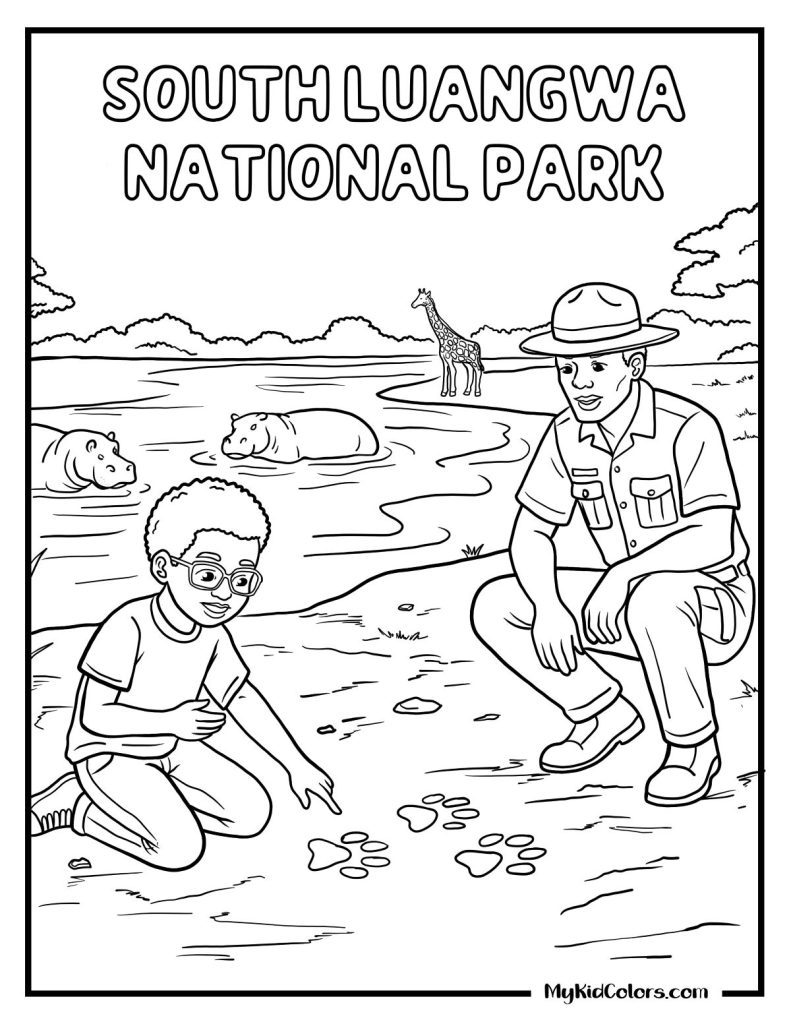
- Pages 9 & 10: South Luangwa National Park and Hwange National Park focus on guided exploration, animal tracks, sketching wildlife, and outdoor observation through calm educational storytelling scenes.



Conservation, Reflection & The Full Adventure (Pages 11–15)
Designed for older kids and deeper reflection. These pages blend conservation, geography, journaling, and environmental storytelling into meaningful educational experiences.
- Page 11: My Safari Journal encourages children to combine maps, sketches, stickers, and storytelling while building creativity and reflection through Coloring Book Art activities.
- Pages 12 & 13: Bwindi Impenetrable National Park and Virunga National Park introduce rainforest ecosystems, gorilla habitats, volcano landscapes, and conservation-focused learning through detailed nature scenes.
- Pages 14 & 15: Namib-Naukluft National Park and the National Parks of Africa hero page bring together dunes, maps, wildlife, and exploration while celebrating the beauty and diversity of African National Parks.


Perfect for Classrooms, Homeschools, and Nature Units
These pages work as geography anchors, wildlife and conservation unit starters, African studies activities, and quiet outdoor-themed table time. A few ways to extend the learning:
- Find it on the map first: Before printing any page, pull up a map of Africa together and find the country. Point out how the Serengeti sits in Tanzania, how Bwindi is tucked into southwestern Uganda near the Congo border, how the Namib Desert runs along the Atlantic coast of Namibia. The page lands differently when the child already knows where they are going.
- The safari journal page (Page 11): This page is designed as a creative anchor for the whole set. After coloring several park pages, use this one as a wrap-up — have your child draw their favorite animal from memory, write the name of one park they want to visit someday, and stick a sticker or draw a stamp for each page they have completed.
- Pair the gorilla pages with a conservation conversation: Pages 12 and 13 — Bwindi and Virunga — both feature mountain gorilla habitat. Mountain gorillas were once considered critically endangered; conservation efforts have brought their numbers back from fewer than 300 to over 1,000. These pages open a natural conversation about what protection means, who does the work, and why a species can come back from the edge.
Why We Choose Hand-Drawn Over AI
Every page in this set is human-drawn to a brief. The Ngorongoro page required understanding that the crater is a viewpoint experience — you stand at the rim and look down into a living bowl of wildlife.
The Etosha page required knowing that the salt pan creates a flat, wide-open expanse that is visually unlike any other African landscape. The Namib dunes needed the specific curved, layered quality of Sossusvlei — not a generic triangle hill.
That geographic specificity cannot be prompted. It has to be researched, briefed, and drawn with intention. And the child in each scene — with their specific hair, their specific tool (binoculars, notebook, sketchpad), their specific emotional register — was placed there deliberately, not generated.
Frequently Asked Questions
How can I use these National Parks coloring pages to teach geography?
Pair the coloring pages with maps, globes, or animal fact books. As children color each park, help them locate the country or region and discuss the animals, landscapes, and ecosystems connected to that area.
My child has never heard of any of these parks. Where should we start?
Start with Page 1 — the Serengeti page — because even young children who have never heard the name will recognize the landscape from nature documentaries. The wildebeest, the acacia trees, the wide flat savanna are all visually familiar. From there, Amboseli is a strong second page because Kilimanjaro in the background gives the child something to point to and ask about.
Are these appropriate for children who have never been to Africa?
Yes — that is precisely the point. These pages are designed to make African landscapes feel accessible, curious, and worth exploring to children who have never been there and may have only seen Africa represented through a narrow lens. The child in each scene is exploring, not performing. They are doing exactly what any curious kid does in a new place: looking, asking, sketching, noticing.
Can these be used as part of an endangered species or conservation unit?
Yes. Pages 12 and 13 — Bwindi and Virunga — are natural anchors for a conservation conversation because both parks are home to mountain gorillas, one of the great conservation success stories of the last 30 years. Page 8, the Etosha page, works well for discussions about water scarcity and how animals adapt in dry environments. Page 6, the Maasai Mara page, connects naturally to the Great Migration and seasonal animal movement.
My child uses a wheelchair or has sensory sensitivities. Are any pages designed with that in mind?
Yes. Page 8, the Etosha National Park page, includes a wheelchair-accessible viewing platform as part of the scene. Page 2, Amboseli, features a child with sensory headphones observing quietly. Page 3, Kruger, features a child with glasses. These are not afterthoughts — they are drawn into the scenes intentionally so that children who use adaptive tools or supports see themselves as the ones doing the exploring.
Download Your Free African National Parks Coloring Pages
These parks have been here for decades. The gorillas in Bwindi, the elephant herds at Chobe, the dunes at Sossusvlei. They do not need a coloring page to be extraordinary. But a child who colors them today is more likely to care about protecting them tomorrow.
Nature teaches curiosity, patience, wonder, and connection.
Help children explore wildlife, geography, and conservation through inclusive, hand-drawn National Parks Coloring Pages designed to make learning meaningful and memorable.
You Might Also Like
- 15 Endangered Animals Coloring Pages That Teach Kids to Care for Wildlife
- 60 African Flags Coloring Pages That Teach Kids Geography, Culture & Unity
- 15 Free Farm Animals Coloring Pages (Free PDF Printables)
- 15 Free Nigerian Landmarks Coloring Pages Featuring Famous Places in Nigeria
- 15 Free Ghanaian Landmarks Coloring Pages Beyond the Flag Worksheet
- 15 Free Woodland Coloring Pages Where Your Child Is Part of the Story

