
15 Down Syndrome Coloring Pages That Teach Kids Every Person Is Whole
If you’re searching for down syndrome coloring pages, you’re probably trying to do one specific thing well — help a child, a classroom, or your own kids understand that Down syndrome is one part of who someone is, not the whole story.
Most coloring pages built around this topic default to a ribbon, a sock, or a chromosome diagram. Kids don’t connect with symbols the way they connect with other kids.
This set was built differently. Fifteen hand-drawn pages of real children with Down syndrome playing, learning, making friends, and dreaming — because representation works best when it looks like an actual kid, not an awareness campaign.
A Note from Louisa (Founder of MyKidColors)
I don’t have a personal connection to Down syndrome in my immediate family, and I want to be upfront about that. What I do know, as a mom, is how hard it is when a child can’t yet say what they’re feeling, and how easily adults read frustration as “acting up” instead of communication.

Less searching. More MEANINGFUL moments.
When kids recognize themselves on the page, coloring changes.
The Inclusive Family Coloring Collection includes 25 human-drawn illustrations centered on everyday moments — designed to make inclusion feel normal, joyful, and intentional.
Because representation shouldn’t be reserved for one month.
That understanding shaped this set. I didn’t want symbols standing in for kids. I wanted real children — learning, communicating in their own way, loved fiercely by their families — because that’s the same seat at the table I want for every child.
Conversation Corner: 3 Questions to Ask While Coloring
Turn this activity into a bonding moment. While your child colors, try asking these questions:
- For “Friends at the Park” (Page 9): “What’s something you and your best friend are really good at doing together that neither of you could do as well alone?”
- For “Adults Thriving in Daily Life” (Page 13): “If you could have any job in the world when you grow up, what would it be — and what’s one thing you’d need to learn to get there?”
- For “World Down Syndrome Day March” (Page 14): “Have you ever stood up for someone who needed a friend? What did that feel like?”
The Collection: 15 Free Down Syndrome Coloring Pages
We’ve organized these into three sets to help you teach inclusion and belonging — from joyful friendship to independent thriving to community celebration.
For Little Hands: Joy & Friendship (Pages 1–5)
Best for toddlers and preschoolers. These pages focus on play, connection, and the simple, powerful truth that every child belongs.
- Page 1 — Three cheerful children play together with a ball, a book, and building blocks, surrounded by an empowering message about Down syndrome awareness. Great for starting an “I Am Special” conversation.
- Pages 2 & 3 — A trio of close friends stand arm-in-arm (one holding a skateboard), and a group of kids enjoy a bright day outdoors on scooters, laughing and chasing bubbles. Perfect companion pages for talking about what makes a true friend.
- Pages 4 & 5 — A warm family of five shares a joyful group hug, and three students focus happily on schoolwork together at a classroom table. Use these together for a “families and schools are for everyone” conversation.


Understanding & Celebrating: Education & Connection (Pages 6–10)
Perfect for elementary kids. These pages visualize communication, genetics basics, teamwork, and the full range of what kids with Down syndrome love to do.
- Page 6 — A four-panel comic strip showcases diverse kids using public speaking, sign language, tablets, and emotion cards. A wonderful springboard for a lesson on different ways people communicate.
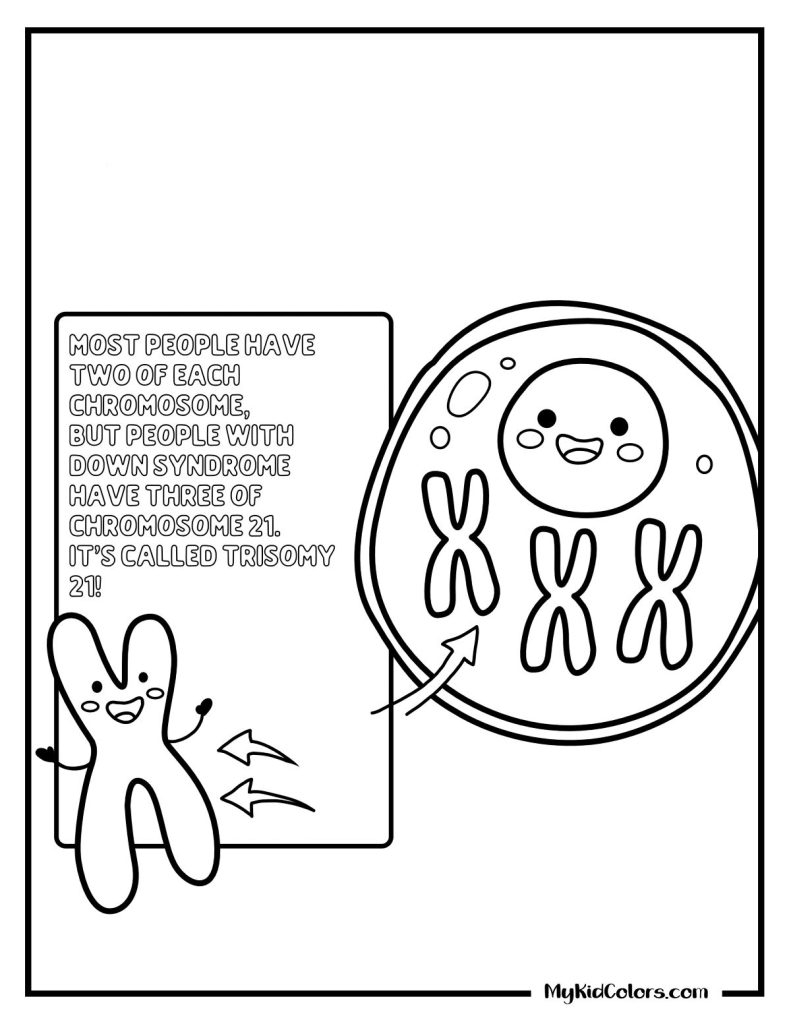
- Pages 7 & 8 — An educational diagram with a friendly cartoon cell explains the genetics of Trisomy 21 in kid-friendly terms, and an educator speaks at a podium with a blank speech bubble — invite your child to fill it in. These pair beautifully as a chromosome coloring worksheet activity.
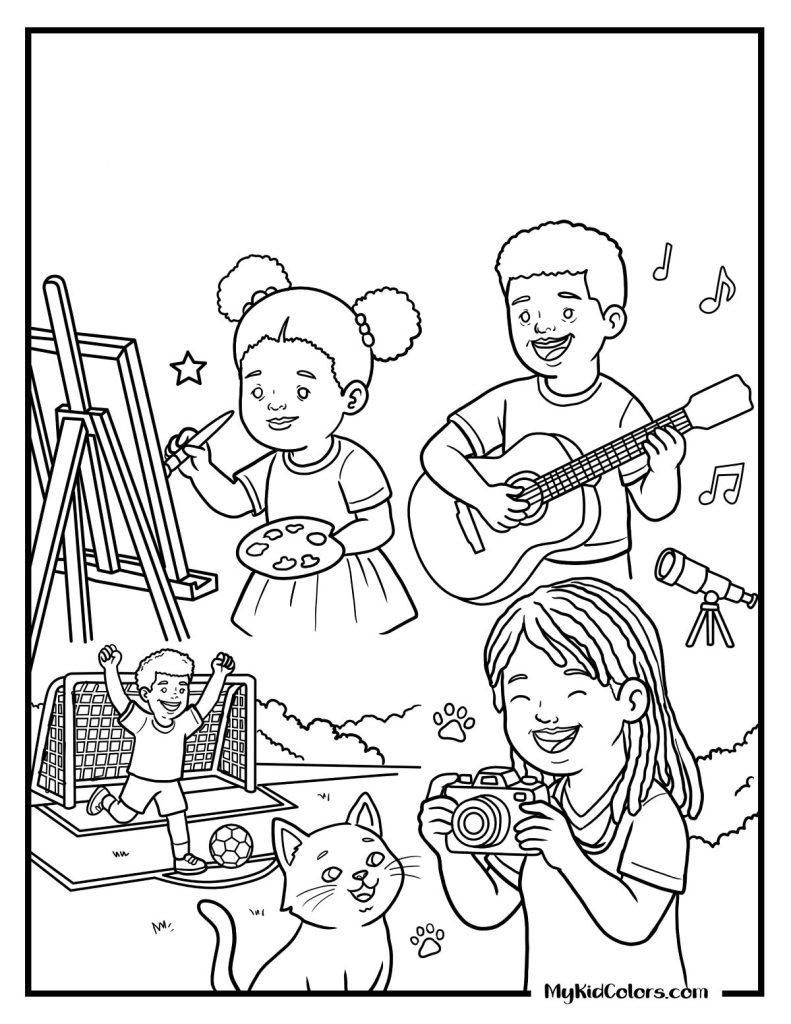
- Pages 9 & 10 — Friends high-five while building a giant sandcastle together, and a vibrant collage celebrates hobbies: painting, guitar, soccer, photography. Use Page 10 to let kids circle the hobbies they love too.



The Full Story & Application: Independence & Community (Pages 11–15)
Designed for older kids, quiet reflection, or group lessons. These scenes show the full, beautiful arc of a life — healthy habits, inclusive classrooms, adult independence, and community pride.
- Page 11 — A multi-scene page promotes healthy living: biking, doctor visits, dental care, meditation, and nutritious eating. Ideal for health and wellness units.
- Pages 12 & 13 — An inclusive, busy classroom features kids in group discussions, reading on the floor, and learning together; a multi-panel page shows adults with Down syndrome thriving at the office, baking, painting, delivering packages, and enjoying a dinner date. Page 13 is one of the most powerful in the set — show it to kids and ask what they notice first.
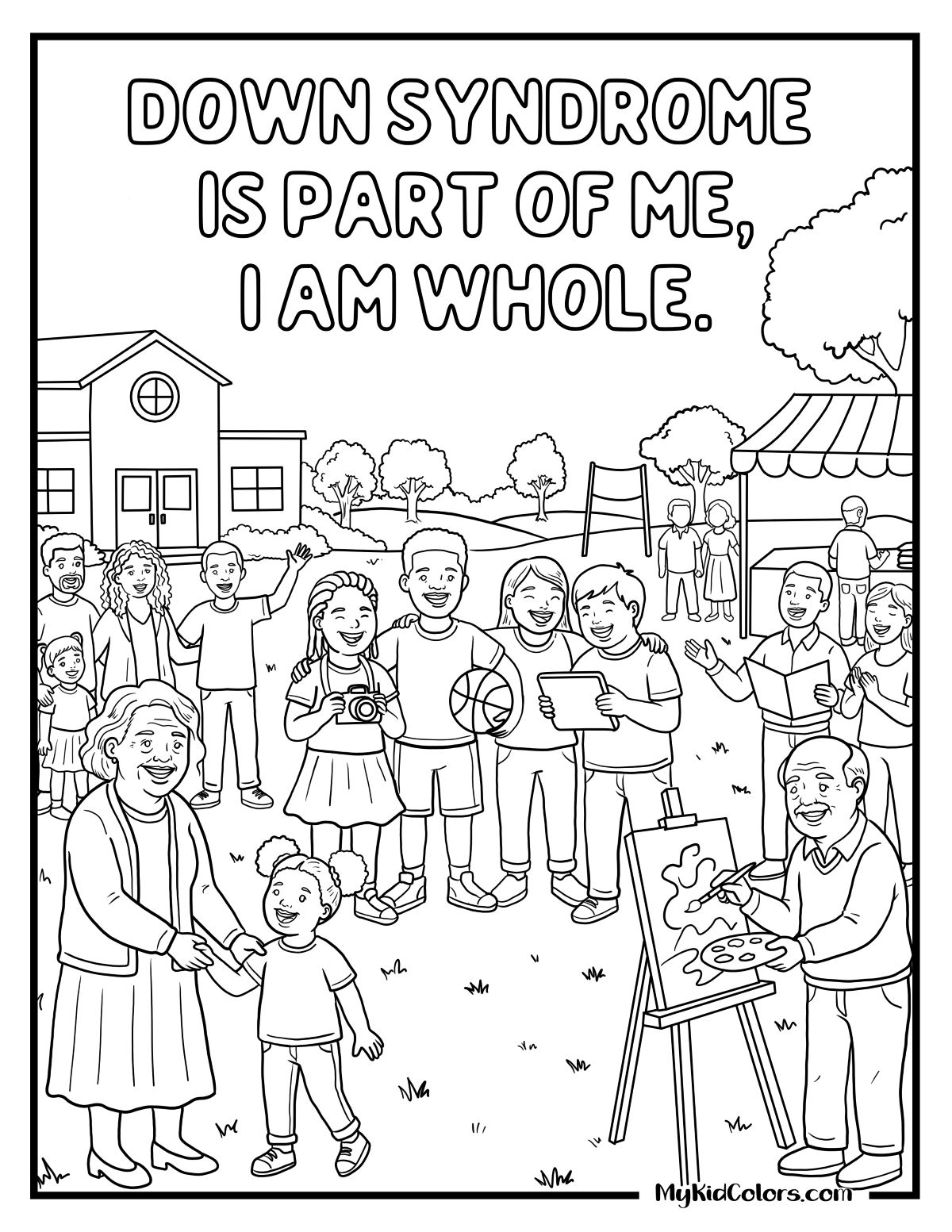
- Pages 14 & 15 — A diverse crowd of families carries signs and megaphones to celebrate World Down Syndrome Day on March 21st, and a bustling community festival closes the collection under a banner that reads, “Down syndrome is part of me, I am whole.” These two pages are the celebration the whole set has been building toward.


Perfect for Sunday School, Homeschool & Special Education
- Parents of toddlers and early readers (ages 2–8) who want a simple, joyful activity that opens a conversation about friendship and belonging — Pages 1, 2, 3, 4, and 5 are designed specifically for little ones, with clean lines, warm scenes of kids playing together, and a family hug that even a two-year-old can point to and name.
- Homeschool families running an inclusion, genetics, or social-emotional learning unit — Pages 6 (communication styles comic strip), 7 (Trisomy 21 diagram), and 10 (hobbies collage) anchor natural conversations about how people communicate differently, what chromosomes actually are, and the fact that kids with Down syndrome love the same things your child loves: painting, guitar, soccer, taking photos.
- Elementary teachers and after-school educators incorporating neurodiversity, health, or community themes — the World Down Syndrome Day march scene (Page 14) and community festival (Page 15) are especially strong for group observation and discussion: who is marching, what are the signs saying, what does it feel like to celebrate someone exactly as they are?
- Occupational therapists, special education teachers, and SEL facilitators — Page 13 (adults with Down syndrome thriving at work, in the kitchen, at a dinner date) and Page 12 (the fully inclusive classroom scene) offer representation in the most ordinary, dignified possible settings — not as inspiration, but as fact.
Why We Choose Hand-Drawn Coloring Pages
Kids with Down syndrome don’t all look the same — the shape of a smile, the set of the eyes, the way a face lights up varies from child to child, the same way it does for any of us.
That’s exactly the kind of detail a generic symbol can’t hold, and it’s easy for AI-generated art to smooth over into one interchangeable “type” of face.
That’s why I work with a single human illustrator on every set. One person, drawing all fifteen pages, means the faces stay consistent and specific instead of default.
When a child colors page after page and recognizes real variation — not a repeated template — the message lands without anyone having to say it out loud: there’s no one way to look like you belong.
Frequently Asked Questions
How can I use these coloring pages for a World Down Syndrome Day event on March 21st?
Pages 14 and 15 are your centerpiece — the march scene and community festival make incredible bulletin board backdrops. For younger kids, start with Pages 1–5 in the morning and work up to the independence panels (Page 13) with older ones. End the day by coloring the festival page together and asking each person to share one thing they’re proud of.
Can I use the Trisomy 21 genetics diagram (Page 7) in a science unit on chromosomes?
Yes — it’s the most versatile page in the set. Use it as a pre-assessment, a note-taking scaffold during a lesson, or a creative wrap-up where students annotate in their own words. For middle schoolers, always pair it with Page 13 so the genetics conversation stays grounded in a full, human story.
Some of my students use AAC devices or sign language instead of speech. Does this set actually reflect that?
Yes. Page 6 shows several communication methods side by side — speaking, signing, and AAC — as equally valid, not as a “special” page tacked on separately.
Download Your Free Set
Fifteen pages, one illustrator, real kids. Download the full set free and let your child color their way to understanding that different doesn’t mean less.
You might also like:
- 15 Free ADHD Coloring Pages Collection (Free Printable PDFs)
- 15 Free Autism Awareness Coloring Pages (PDF Printables)
- 15 Free Native American Coloring Pages That Celebrate Cultures & Community
- 15 Free Mental Health Coloring Pages That Teach Kids It’s Okay Not to Be Okay
- 15 Free Anxiety Coloring Pages That Help Kids Feel Safe, Brave & Understood

