

15 Free Mental Health Coloring Pages That Teach Kids It’s Okay Not to Be Okay
Nobody handed us a script for this. Most of us grew up in homes where feelings were something you managed privately, pushed through quietly, or didn’t name at all. And now here we are — raising children in a world that’s asking them to do something we were never taught: talk about what’s actually going on inside.
These free printable mental health coloring pages won’t fix everything. But they will give you something to sit down with together — a picture of a child meditating, a brain diagram to point at, a mountaintop that says you’re going to get there — and a reason to start the conversation you’ve been meaning to have.
A Note from Louisa (Founder of MyKidColors)
I still remember panicking during a thunderstorm as a kid — sobbing, overwhelmed, convinced I couldn’t make it back through the rain. It wasn’t really about the storm.
As a mom now, I try to remember that when my own kids get frustrated and can’t explain themselves — that big feelings need a name before they can be managed, not shame. This set is for the kid who needs to see that being scared, sad, or overwhelmed happens to everyone, not just them.

Less searching. More MEANINGFUL moments.
When kids recognize themselves on the page, coloring changes.
The Inclusive Family Coloring Collection includes 25 human-drawn illustrations centered on everyday moments — designed to make inclusion feel normal, joyful, and intentional.
Because representation shouldn’t be reserved for one month.
Conversation Corner: 3 Questions to Ask While Coloring
Turn this into a bonding moment. While your child colors, try asking:
- For “Four Feelings” (Page 2): “Which of these four faces feels most like you right now — and which one do you wish you felt more?”
- For “Stress vs. Calm” (Page 8): “Can you think of a time when everything felt like the overwhelming side? What’s one thing that helped — even a little — to get to the calm side?”
- For “Reaching Out” (Page 14): “If you were ever having a really hard time and didn’t want to tell me, who is one person you would feel okay talking to? Let’s think of a few names together.”
The Collection: 15 Free Mental Health Coloring Pages
We’ve organized these into three sets to help you teach emotional wellness — from recognizing feelings to building resilience to reaching out for help.
For Little Hands: Feelings Are for Everyone (Pages 1–5)
Best for toddlers and preschoolers. These pages center on faces, family, and the foundational message that all feelings are allowed and all people belong.
- Page 1 — Family Includes Everyone: A child and adult lovingly hold hands with a smiling person using a wheelchair, celebrating family support and belonging. A warm, simple opening that establishes the set’s core promise: everyone is included here, and no one navigates hard things alone.
- Pages 2 & 3 — Naming Feelings + Self-Care Basics: Page 2 features four children displaying joy, anger, worry, and peacefulness — a natural starting point for any feelings check-in, and one of the most useful mood coloring pages in the set for daily emotional literacy. Page 3 introduces healthy self-care — nutritious food, good sleep, time outdoors — through a peaceful child at rest. Simple enough for a preschooler, and worth revisiting at every age.
- Pages 4 & 5 — Family Hugs + Trusted Adults: Page 4 shows a diverse family in a joyful group hug — the kind of self-care coloring page that communicates emotional safety without a single word of explanation. Page 5 shows a caring adult with reassuring hands on a child’s shoulders: the visual language of “you are not alone in this,” offered at exactly the right developmental moment.


Understanding Your Mind (Pages 6–10)
Perfect for elementary kids. These pages move from feeling emotions to understanding where they come from — and what to do with them.
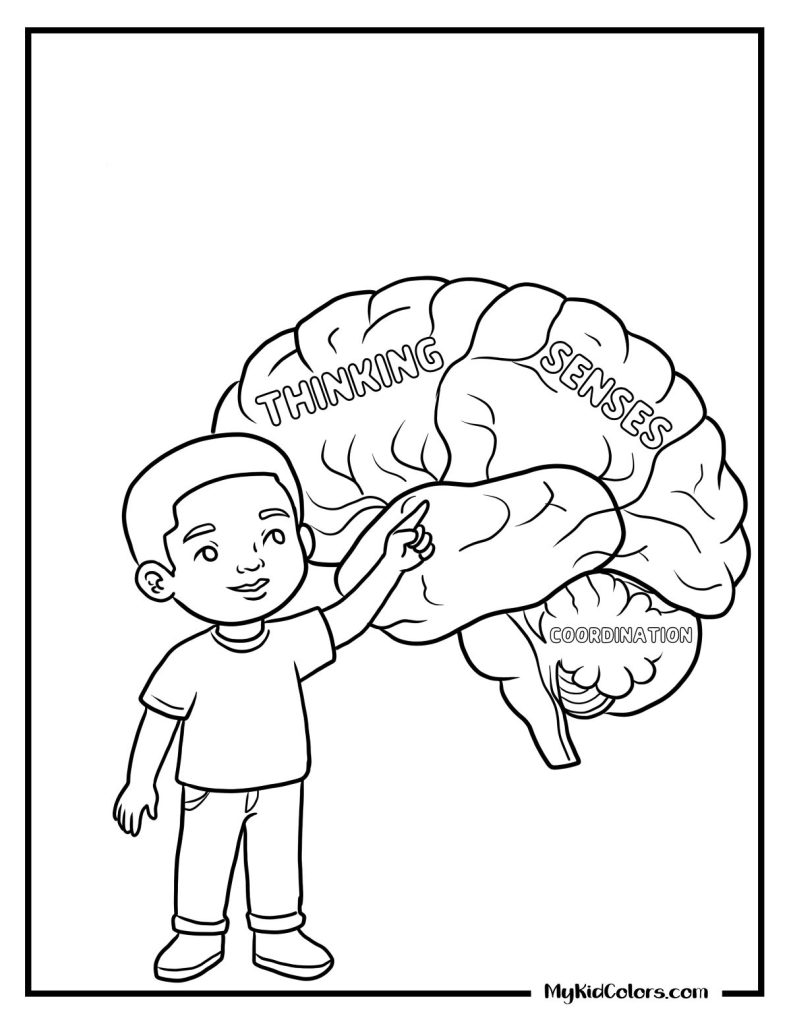
- Page 6 — Your Amazing Brain: A child points to a labeled brain diagram, introducing how different brain regions help us think, sense, and coordinate. This page works beautifully as a therapy coloring page or homeschool science crossover — it gives children a framework for understanding why they feel what they feel, which is one of the most empowering things we can offer them.
- Pages 7 & 8 — Coping Strategies + Stress vs. Calm: Page 7 (the coping strategies page) shows a meditating child surrounded by breathing, journaling, movement, creativity, music, and connection — a mindfulness coloring page that doubles as a reference poster for ongoing use. Page 8’s split-scene contrast between overwhelm and calm mindfulness is the most conceptually rich page in this section, ideal for older elementary children ready to name the difference between how stress feels and what relief feels like.
- Pages 9 & 10 — Different Minds + The Mountaintop: Page 9 features children with different neurodiverse experiences standing together under a “Different Minds” banner — a positive coloring page that celebrates neurodiversity with warmth rather than explanation. Page 10 shows a child reaching a mountaintop after overcoming physical and emotional challenges — resilience, perseverance, and the quiet message that hard things end.


The Full Story & Application (Pages 11–15)
Designed for older kids, teens, or quiet reflection. These pages address harder terrain — depression, grief, body image, crisis support, and community — with honesty and hope.
- Page 11 — Depression Is Treatable: An encouraging pathway reminds children that depression is not permanent, help is available, and brighter days are coming. This healing coloring page is one of the most important in the set — and one that deserves a slow, unhurried conversation rather than a quick pass with a crayon.
- Pages 12 & 13 — Grief and Memory + Body Diversity: Page 12 shows a grandparent and child looking through photographs together — a tender wellness coloring page for children navigating loss, that opens the door to conversations about grief, memory, and the healing that happens in small, quiet moments. Page 13 celebrates body diversity and self-love through inclusive illustrations of people with different body types and abilities — an affirmation coloring page that speaks directly to self-esteem in a media landscape that rarely does.
- Pages 14 & 15 — Asking for Help + Mental Health Matters: Page 14 depicts a child reaching out to a crisis support line — one of the bravest and most necessary images in the set. Use this page to have the specific conversation: here is what a helpline is, here is why calling one is strong, not weak, and here are the numbers we trust. Page 15 closes the set with a diverse community gathered under a flourishing tree, the words “Mental Health Matters” at the center — a feel better coloring page that doubles as a mural, a classroom anchor, or simply a reminder that none of us are doing this alone.


Perfect for School Counselors, Therapists, Homeschool Families, and Caregivers
- Teens and older children will find Pages 11, 13, and 14 most relevant — depression as something treatable rather than permanent, body diversity as something worth celebrating, and asking for help as an act of courage rather than weakness. These pages are not too young for teenagers; they are, in fact, designed with older readers in mind.
- Parents and caregivers wanting a non-clinical starting point will find Pages 5, 8, and 12 as natural conversation openers — the trusted adult, the calm-versus-overwhelm contrast, the grandparent with the photograph. These pages don’t require therapeutic language. They require sitting down together, which is often the harder and more important step.
- School counselors, child therapists, and classroom teachers will recognize this full set as a structured emotional literacy curriculum in printable form — moving from feelings identification (Pages 2–3) through coping tools (Pages 7–8) to community and crisis support (Pages 14–15). Pages 7 and 14 in particular are designed to be referenced repeatedly, not colored once and filed away.
Why We Hand-Draw Coloring Pages
When a child is learning to recognize what they’re feeling, the last thing they need is a stock illustration that could belong to any worksheet.
A real illustrator can draw a kid whose face actually looks worried, actually looks calm, actually looks like relief — the kind of subtle expression AI tends to flatten into a generic smile or frown.
That’s why one illustrator draws every page in this set. The same hand across all fifteen pages means a child’s face stays recognizable from the “big feelings” page to the “asking for help” page to the hero page, so the emotional arc holds together the way an actual feeling does.
Frequently Asked Questions
Most mental health coloring pages I find are for teens or adults. Is this actually appropriate for younger kids?
Yes — this set was built for elementary-age kids from the start, not adapted down from an adult mandala set. The language and scenes are age-appropriate throughout, including the harder topics.
How do I use the grief or depression pages without scaring my child?
Sit with them for those two pages specifically. They’re built to validate a hard feeling, not explain it in detail — let your child lead the conversation rather than filling in more than they ask for.
There’s a page about crisis and getting help. Is that safe for a classroom or should it stay home-only?
It’s built for age 7+ with an adult present, using the current 988 Suicide & Crisis Lifeline. Most teachers use it one-on-one or in small counseling settings rather than a full class activity — that’s worth deciding based on your specific kids.
Download Your Free Set
These 15 free mental health coloring pages are hand-drawn, inclusive, and designed to meet children where they actually are: sometimes joyful, sometimes overwhelmed, sometimes carrying something they don’t yet have words for.
Built for the kid still learning the words for what they feel. Grab all 15 pages free for your home, classroom, or counseling office.
You might also like:
- 15 Color Therapy Coloring Pages That Help Kids Feel Calm & Safe
- 15 Self Love Coloring Pages That Teach Kids Confidence and Self-Worth
- 15 Free Mental Health Coloring Pages That Teach Kids It’s Okay Not to Be Okay
- 15 Free Therapy Coloring Pages That Explain What Therapy Actually Is
- 15 Free Anxiety Coloring Pages That Help Kids Feel Safe, Brave & Understood

