

15 Free Therapy Coloring Pages That Explain What Therapy Actually Is
Somewhere between the waiting room and the car ride home, most kids never get a clear picture of what therapy actually is. They know they’re going. They rarely know why it helps — and most therapy coloring pages don’t close that gap either, since they’re usually a repurposed worksheet with a snowman standing in for a speech drill.
This set does something different. Fifteen hand-drawn pages show what art therapy, speech therapy, occupational therapy, and emotional healing actually look like — drawn to be understood, not just colored through.
It ends with the reminder that healing isn’t a straight line.
A Note from Louisa (Founder of MyKidColors)
I’ve been to therapy. I’ve also sat in the waiting room for people I love while they went. Both experiences taught me the same thing — that needing help doesn’t happen once and then you’re done. You return to it, the way you’d return to any skill worth building.

Less searching. More MEANINGFUL moments.
When kids recognize themselves on the page, coloring changes.
The Inclusive Family Coloring Collection includes 25 human-drawn illustrations centered on everyday moments — designed to make inclusion feel normal, joyful, and intentional.
Because representation shouldn’t be reserved for one month.
I want my children to grow up seeing that clearly, instead of picking it up in fragments the way I did. A parent going to therapy, a friend going back for a second round — none of it should feel like something to hide. This set is my attempt to make that ordinary and visible for kids.
Conversation Corner: 3 Questions to Ask While Coloring
Coloring works best as a bridge, not a distraction. While your child colors, try gently opening the door with one of these:
- For “Processing Feelings” (Page 7): “If today had weather — a storm, a rainbow, or sunshine — what would it be?”
- For “Talk and Color” (Page 5): “What’s one thing that happened today that you haven’t told anyone yet?”
- For “Therapy Journey / Healing Over Time” (Page 12): “Which step on this path do you think you’re on right now?”
There’s no wrong answer here — and no requirement to answer at all. Sometimes the question just needs to be in the room.
The Collection: 15 Free Therapy Coloring Pages
We organized these into three sets to help kids move from expressing feelings, to understanding them, to talking about them — from a blank page to real connection.
For Little Hands: Sensory & Self-Expression (Pages 1–5)
Best for toddlers and preschoolers who need to move feelings through their hands before they can put them into words.
- Page 1: “Art is Therapy” – Loose swirls and shapes with zero rules, perfect for pure creative release.
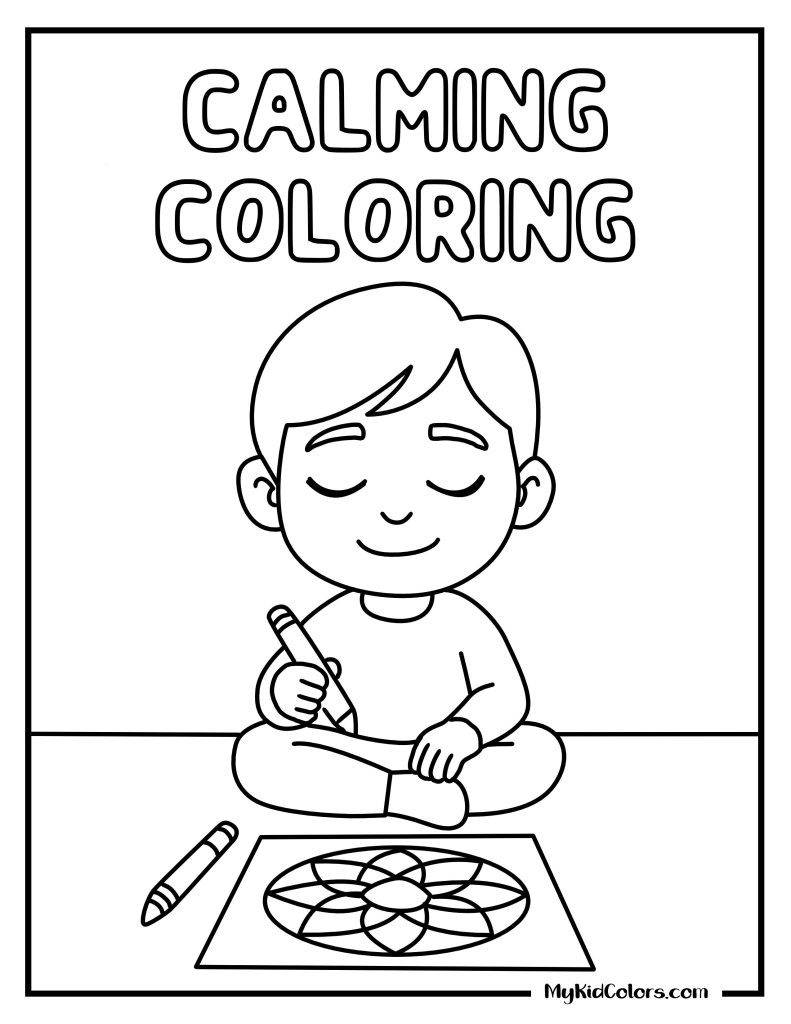
- Pages 2 & 3: “Calming Coloring” and “Building Strength” – A mandala for focus, plus a close-up grip exercise that doubles as fine-motor and self-care coloring pages for little ones still developing pencil control.
- Pages 4 & 5: “Sensory Coloring” and “Talk and Color” – Texture-based finger exploration, followed by a page designed to be colored with a trusted adult — not alone.




Everyday Skills & Big Emotions (Pages 6–10)
Perfect for elementary-age kids who are ready to connect coloring to real life — routines, emotions, confidence, and belonging.
- Page 6: “Everyday Skills” – A daily-routines chart (tying shoes, buttoning, brushing teeth) that turns occupational therapy goals into a mindful coloring page.
- Pages 7 & 8: “Processing Feelings” and “Confidence Building” – A storm-to-sunshine emotion wall, followed by a diverse group of kids proudly holding self-portraits — a favorite among our self love coloring pages fans.
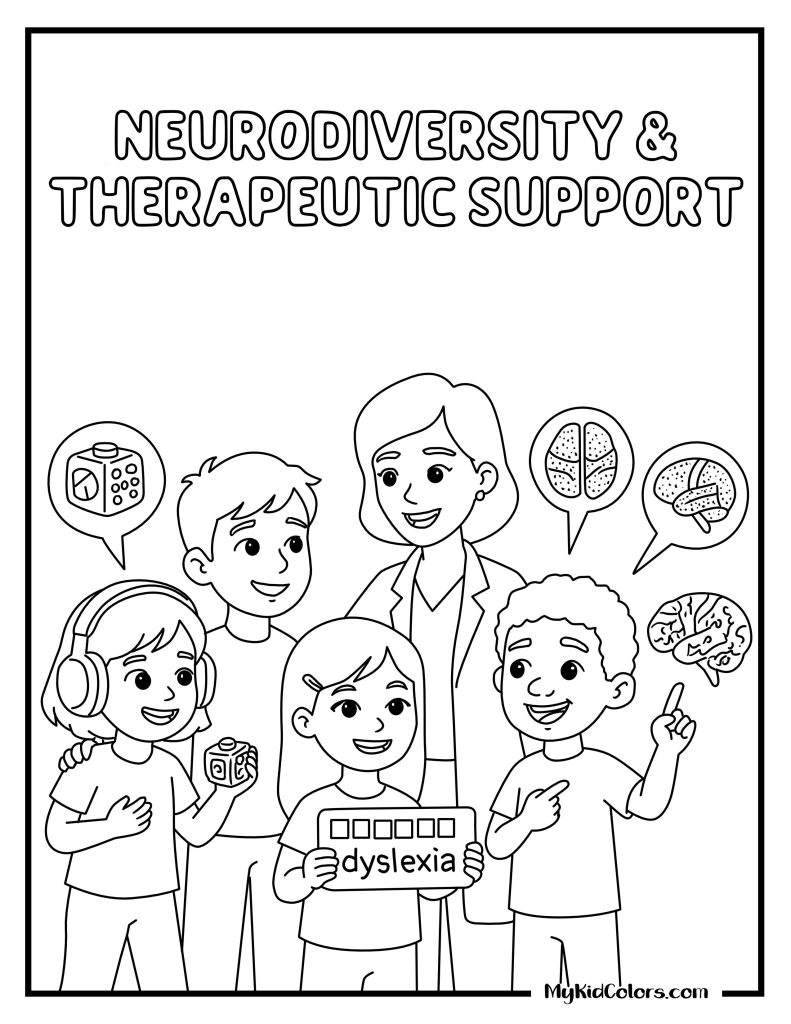
- Pages 9 & 10: “Therapy For All Ages” and “Neurodiversity & Therapeutic Support” – A multigenerational coloring scene plus a page that gently visualizes cognitive milestones like literacy and dyslexia support tools.


The Full Therapy Journey (Pages 11–15)
Designed for older kids, teens, or quiet reflection — these pages include more detailed storytelling and real therapeutic language.
- Page 11: “Coping Skills / Managing Stress” – A classroom full of calming activities (easel drawing, journaling, worksheets) that works beautifully as a set of mindfulness coloring pages for a classroom corner.
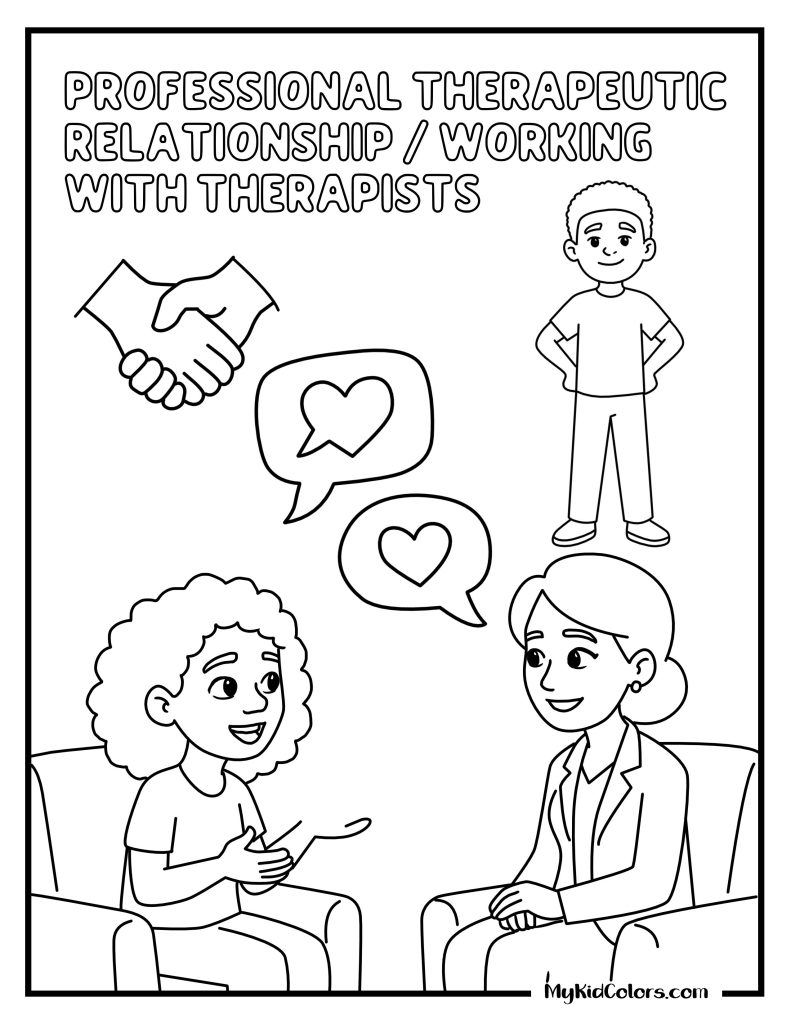
- Pages 12 & 13: “Therapy Journey” and “Professional Therapeutic Relationship” – A circular healing roadmap, followed by a warm scene of a child talking openly with a supportive professional.
- Pages 14 & 15: “Art + Therapy = Transformation” and “Creative Healing Is Powerful” – A split-panel page showing a boy with a hearing aid and an older adult with a hand splint, both coloring with loved ones — closing with a hopeful, floral affirmation page.



Perfect for Therapists, Counselors & Homeschool Parents
These pages were built to travel well beyond the therapy office. Parents, school counselors, and OTs love using them as self care worksheets for teens, calming corner activities, and low-pressure conversation starters.
Why Real Illustrators Make These Coloring Pages
Therapy looks different depending on what a child is working on — speech, movement, big feelings, a hard memory — and a generic template can’t hold that range without flattening it into one interchangeable “kid at a desk” image.
One illustrator drew every page in this set, which means the same child who’s nervous in the waiting room on Page 14 can show up steadier by Page 15 — a visual thread instead of fifteen disconnected stock scenes.
That continuity matters here specifically: the whole point of this set is showing that healing has a shape over time, and a single hand tracking that shape does it more honestly than a rotating cast of generated figures ever could.
Frequently Asked Questions
Can these be used in an actual therapy or counseling session, not just at home?
Yes — many child therapists and school counselors use pages like “Processing Feelings” (Page 7) and “Therapy Journey” (Page 12) as low-pressure entry points into a session, especially for kids who freeze up when asked to “just talk.” Try starting the session with 5 quiet minutes of coloring before any conversation begins.
My child has sensory sensitivities — which pages work best for them?
Start with Pages 3 and 4 (“Building Strength” and “Sensory Coloring”), which focus on grip and texture rather than fine detail. These are ideal for kids who find traditional coloring pages overwhelming, and they double as a gentle warm-up before moving into the more emotion-focused pages later in the set.
How do I use the “Therapy Journey” page (Page 12) without making my child feel like healing is a race?
Frame it as a map, not a scoreboard. Let your child color the whole path first, then ask which spot feels most like today — without any expectation of reaching the end. Revisiting this page monthly (in a new color each time) can help kids see gradual progress without pressure.
Download Your Free Set
However today feels, there’s a page here for it. Built for the kid who goes to therapy and has never seen a page that’s actually about it. Grab all 15 pages free.
You might also like:
- 15 Color Therapy Coloring Pages That Help Kids Feel Calm & Safe
- 15 Self Love Coloring Pages That Teach Kids Confidence and Self-Worth
- 15 Mindfulness Coloring Pages That Help Kids Slow Down and Feel Calm
- 15 Free Nature Coloring Pages That Show Every Child Belongs Outside
- 15 Free Bedroom Coloring Pages Where a Real Child Actually Lives

