
15 Free Frederick Douglass Coloring Pages About Reading and Standing Up for Freedom
An alphabet book is an ordinary part of childhood for many families. For Frederick Douglass, learning to read meant finding ways around people who wanted to keep him from learning. These Frederick Douglass coloring pages give you a place to begin that conversation, with books, letters, newspapers, and scenes inspired by his work to end slavery.
The collection brings together 15 hand-drawn designs: five simple, five medium, and five detailed. Alongside historical interpretations, diverse children share books, explore a library, and listen to family stories today, including a young reader using a wheelchair.
Use a page with an age-appropriate biography, a Black History Month lesson, or a conversation about why everyone should have the opportunity to learn. There is room to notice the little details, ask a question, and connect the history to the books your child can reach for now.
All 15 pages. One easy download. Get the complete human-drawn, ready-to-print PDF for $1.99, available instantly with a download link emailed to you for easy access anytime.
Prefer free JPGs? Right-click any coloring page and select “Save image as,” or press and hold the image on your phone to save it.
The PDF pages are US Letter size. Select “Fit” in your print settings if needed.

Less searching. More MEANINGFUL moments.
When kids recognize themselves on the page, coloring changes.
The Inclusive Family Coloring Collection includes 25 human-drawn illustrations centered on everyday moments — designed to make inclusion feel normal, joyful, and intentional.
Because representation shouldn’t be reserved for one month.
A Note from Louisa (Founder of MyKidColors)
I remember sitting at a little desk, struggling to learn my numbers while I could hear my twin sister playing behind the house. I wanted to be outside with her. Instead, I was working through a pattern that seemed to come so easily to her: one and one, eleven; one and two, twelve. I don’t know why it was so difficult for me then, but I remember how sad I felt.
Years later, I became one of the strongest students in my class. That little girl at the desk couldn’t have known what was ahead.
My experience was very different from the barriers Frederick Douglass faced under slavery. His determination to learn still touches something personal in me. If your child is struggling with letters or numbers, I hope you’ll remember that today’s difficulty doesn’t tell their whole story. There is still so much ahead of them.
Conversation Corner: 3 Questions to Ask While Coloring
Pick one question and leave room for your child to answer in their own way.
- For “Carrying Books” (Page 5): “What would you like to learn from one of these books?”
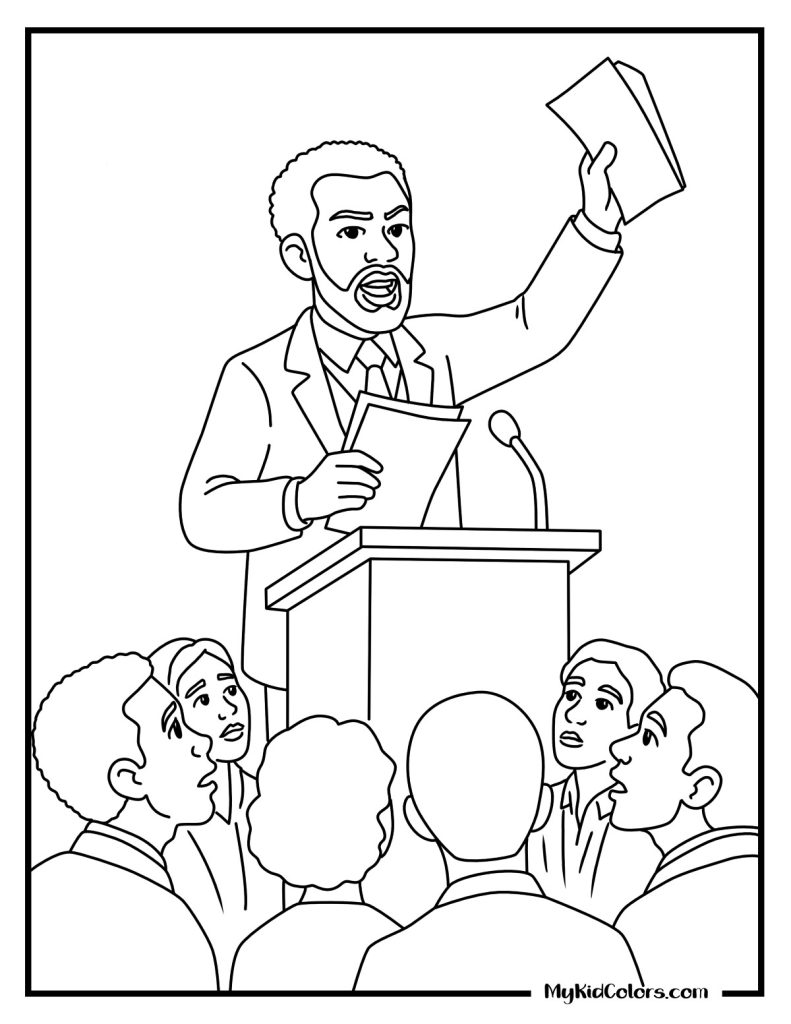
- For “Speaking to a Crowd” (Page 8): “What is something you want people to understand?”
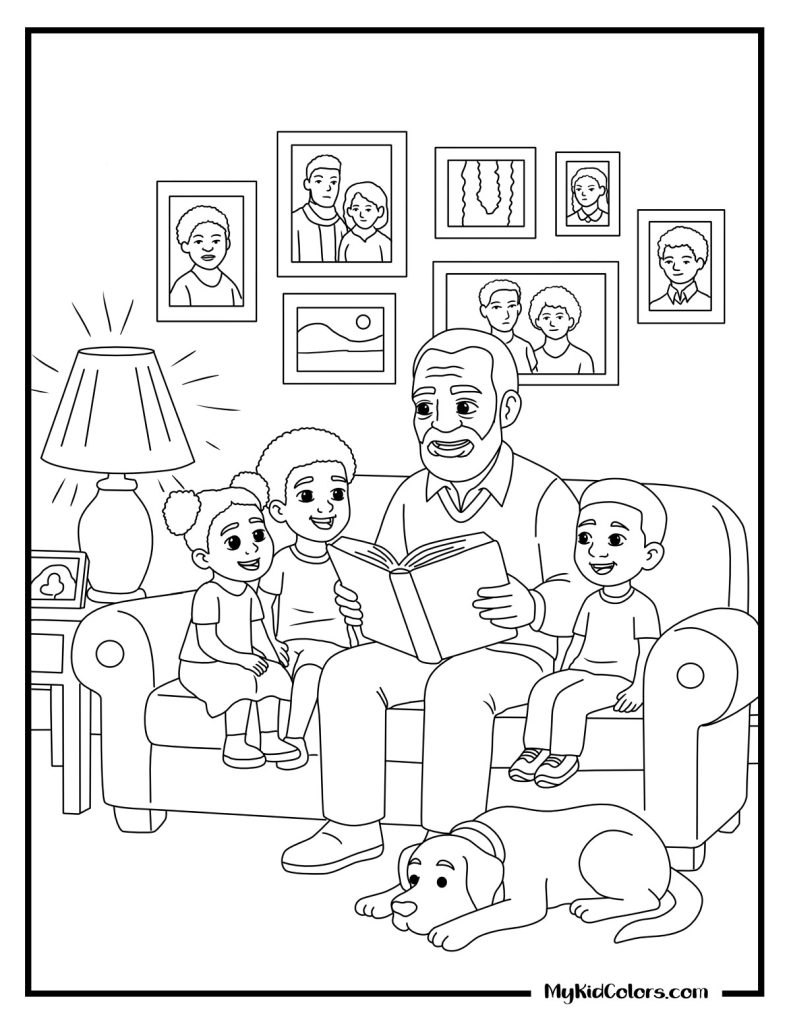
- For “Grandpa Reading” (Page 14): “Who would you like to share a book with?”
Your child can point, draw, sign, use their communication device, or tell you. For a simpler choice, offer two familiar book topics and let them choose. Speaking in front of a crowd is not required to share an idea.
The Collection: 15 Free Frederick Douglass Coloring Pages
Frederick Douglass was an African American abolitionist, author, newspaper editor, and public speaker. Born into slavery in Maryland, he learned to read and write despite efforts to stop him. After escaping slavery, he used writing and speeches to work for abolition and equal rights.
These pages combine modern literacy scenes with artistic interpretations of his learning and public work. The young children are not all portraits of Douglass, and the set is not a documented timeline.
Reading was important to his resistance and later work; it did not automatically end his enslavement. The National Park Service’s introduction to Frederick Douglass provides background for adults preparing a lesson.
For Little Hands: Books, Letters, and Shared Stories (Pages 1–5)
The simpler pages focus on one or two children and a familiar activity. Smaller letters, hair details, and book edges offer more careful coloring areas.
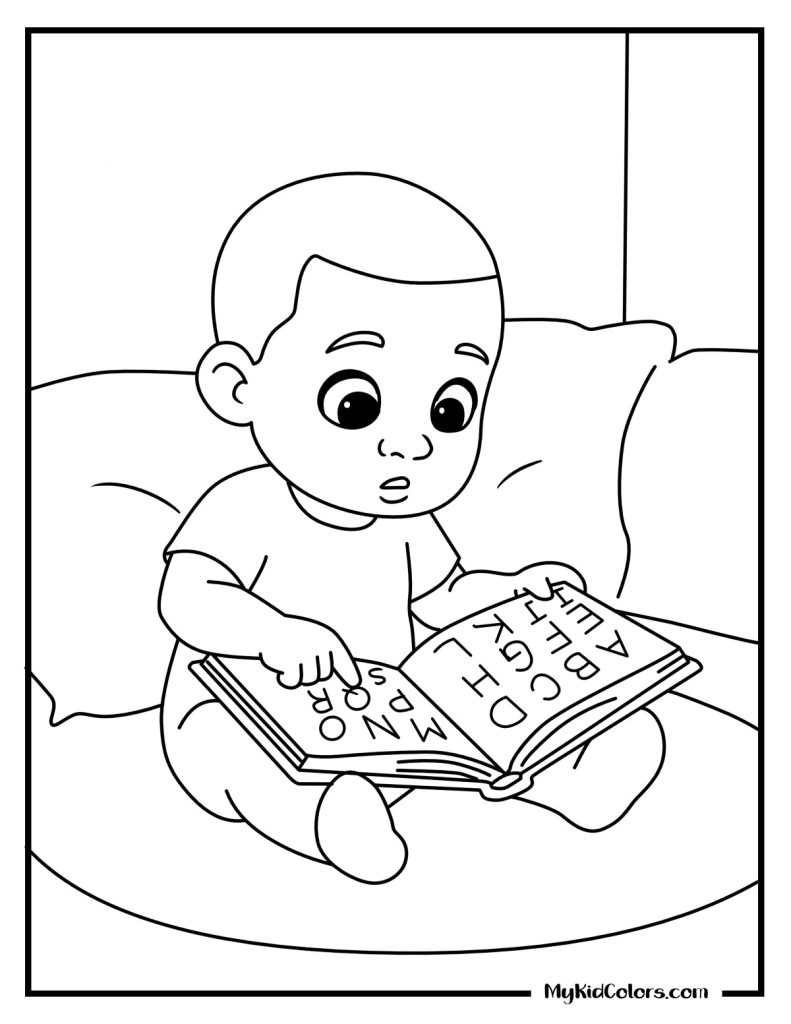
- Page 1: A toddler sits on a cushion with an open alphabet book, pointing toward the letters. Pair the picture with an alphabet book your child can explore beside you.
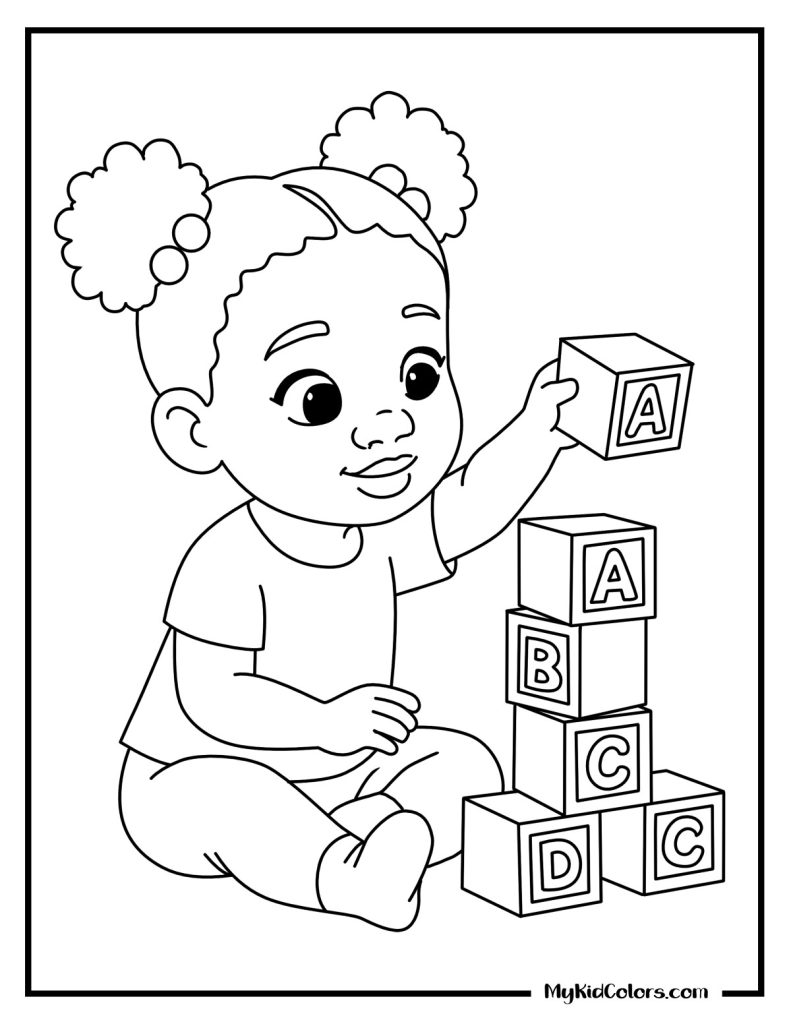
- Pages 2 & 3: A boy uses chalk on a small slate while a girl builds with alphabet blocks. The blocks offer a few large faces to color, while the slate keeps the activity focused on a single letter.
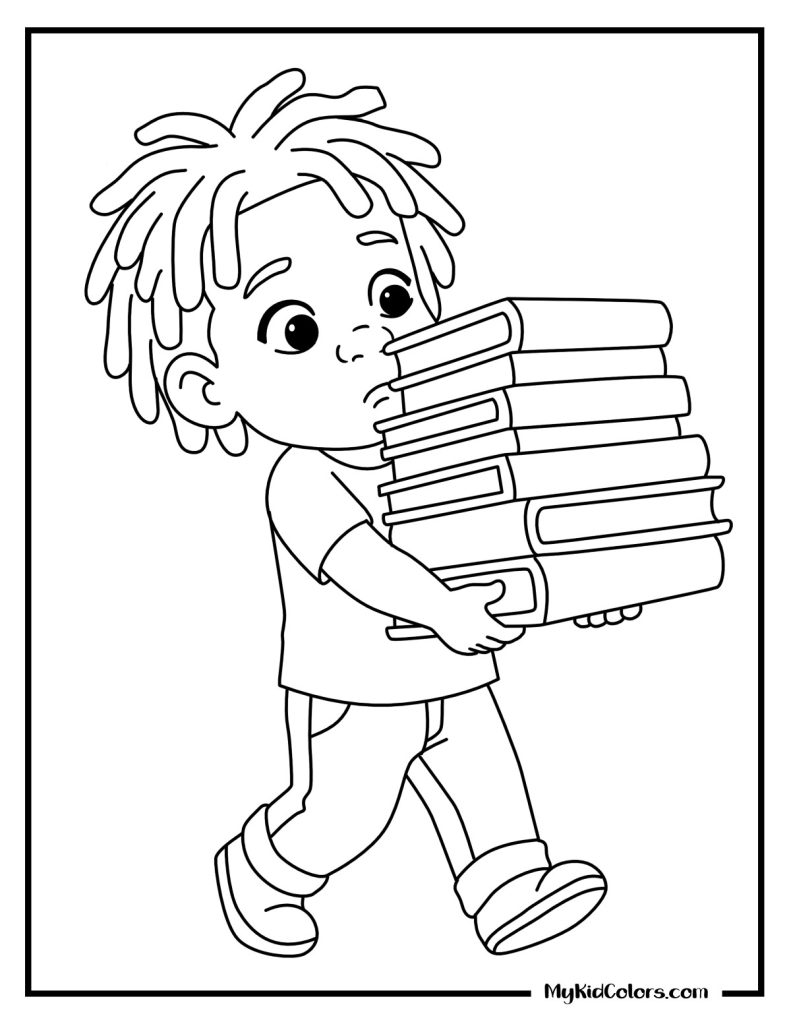
- Pages 4 & 5: A girl wearing glasses shares a book with a younger child. On the next page, a boy with locs carries a stack of books against his chest.


All 15 pages. One easy download. Get the complete human-drawn, ready-to-print PDF for $1.99, available instantly with a download link emailed to you for easy access anytime.
Prefer free JPGs? Right-click any coloring page and select “Save image as,” or press and hold the image on your phone to save it.
Learning, Publishing, and Speaking Up (Pages 6–10)
The medium pages move into scenes inspired by Douglass’s learning and public work, followed by a modern reader connecting with his legacy.
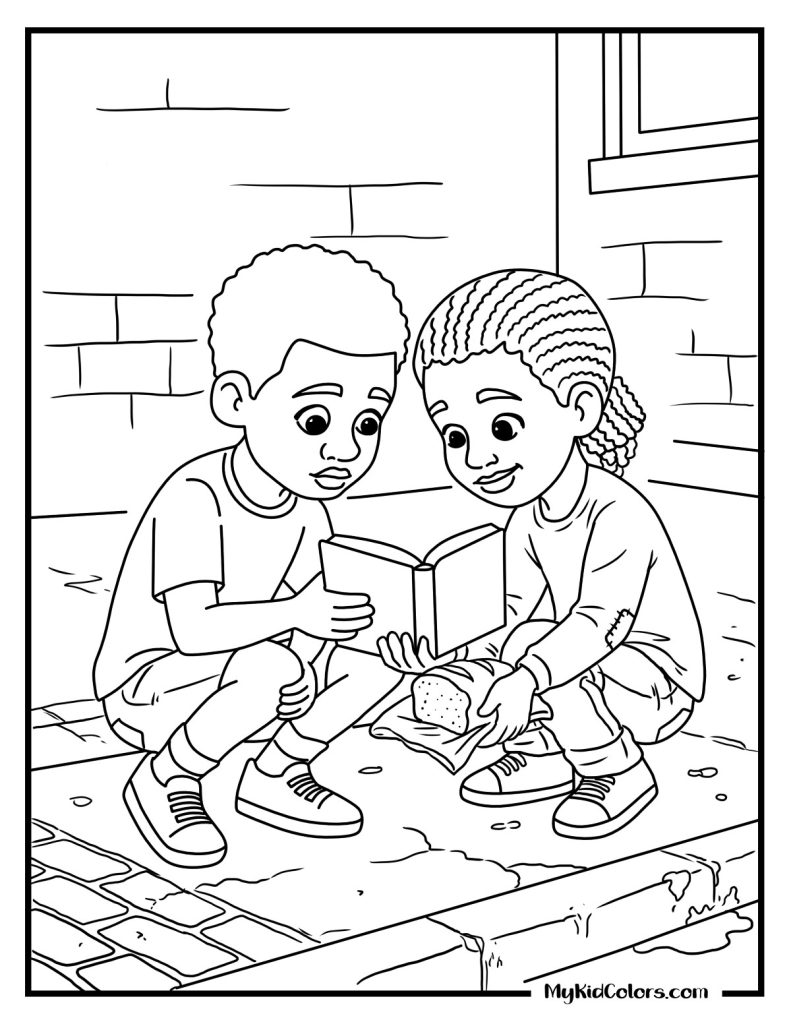
- Page 6: Two boys crouch together over an open book. Douglass described learning from boys he met in Baltimore and giving them bread in return for lessons; this illustration shows the shared reading, without depicting the bread exchange.
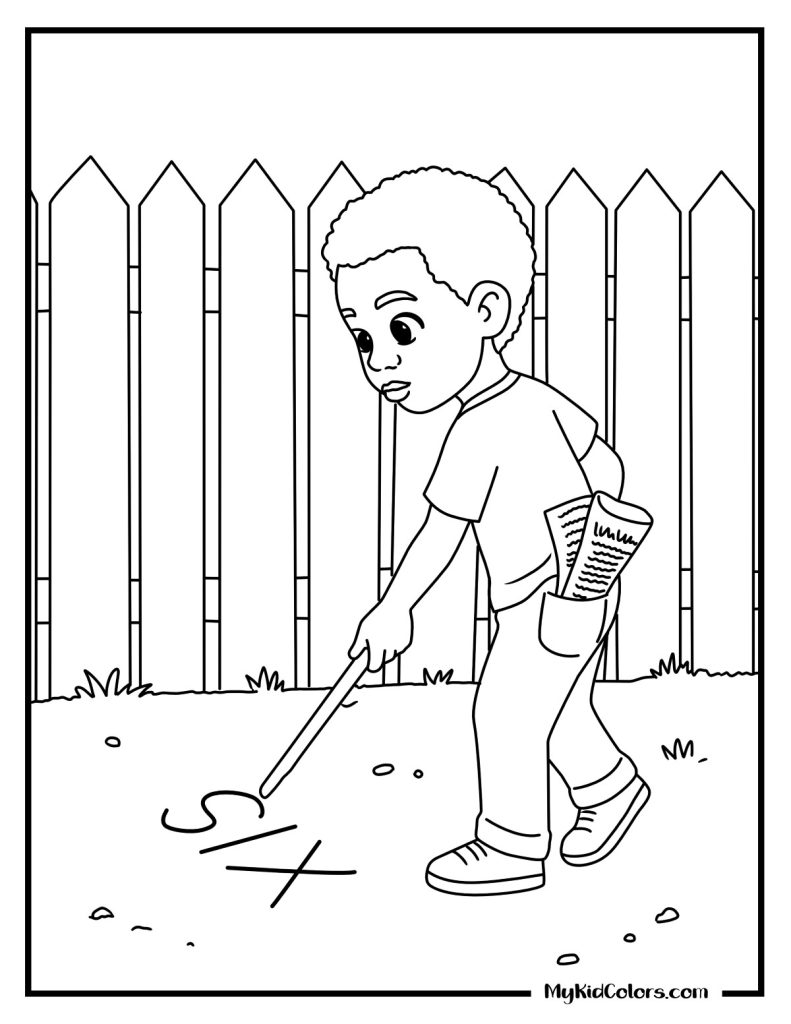
- Pages 7 & 8: A boy uses a stick to make letter shapes on the ground beside a fence, with paper tucked into his pocket. The next illustration shows a speaker raising papers before an audience.
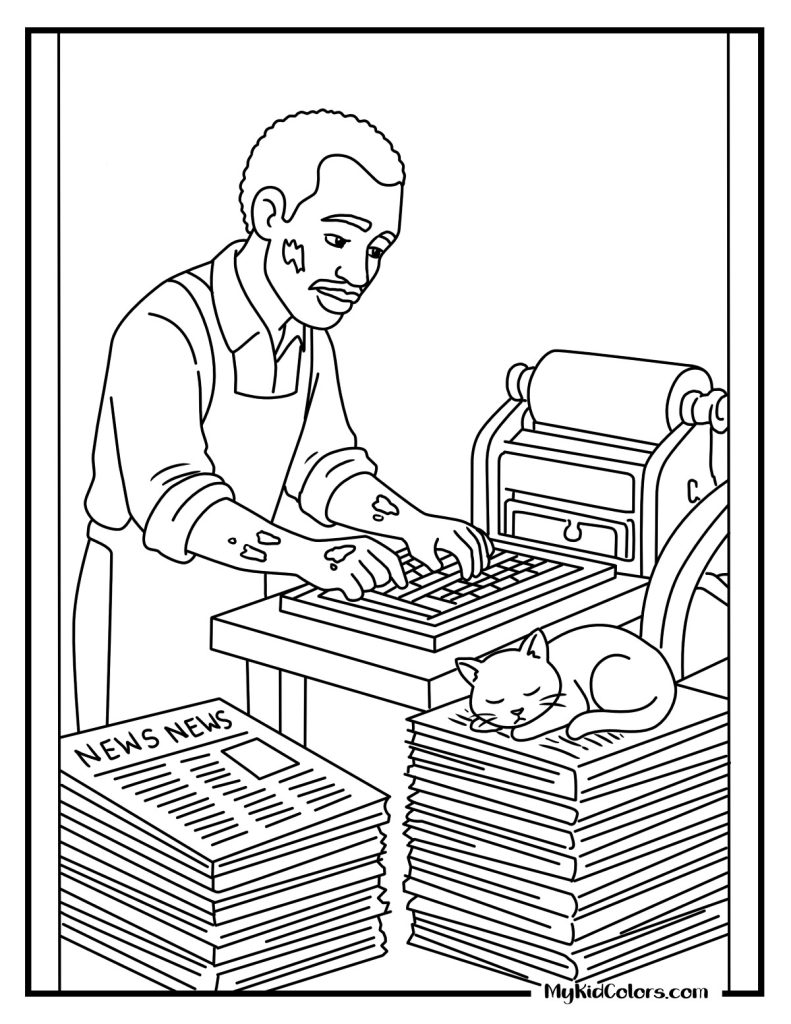
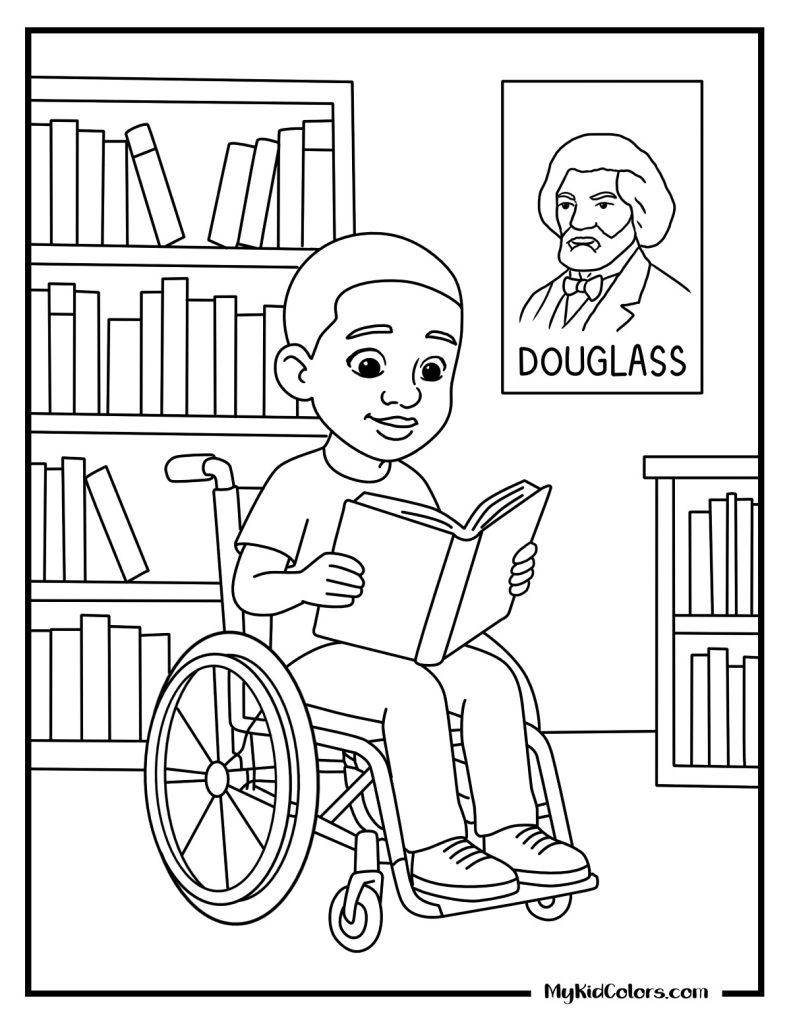
- Pages 9 & 10: A man works at a printing setup beside stacks of newspapers, with a cat resting on one pile. A present-day boy using a wheelchair reads in a library beneath a portrait labeled “DOUGLASS.”
All 15 pages. One easy download. Get the complete human-drawn, ready-to-print PDF for $1.99, available instantly with a download link emailed to you for easy access anytime.
Prefer free JPGs? Right-click any coloring page and select “Save image as,” or press and hold the image on your phone to save it.
Newspapers, Public Life, and Family Reading (Pages 11–15)
These detailed pictures add groups of people, buildings, shelves, and background objects. They offer more to notice during a longer coloring session.
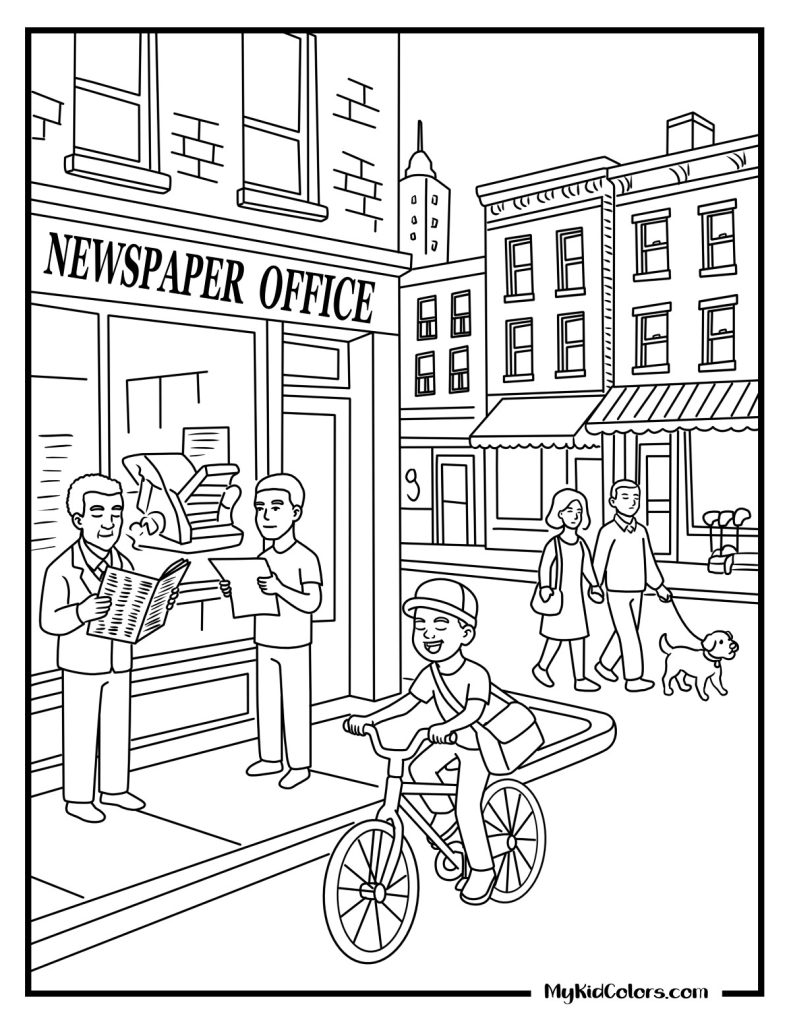
- Page 11: People gather outside a newspaper office as a child rides past on a bicycle and a dog walks along the street. The scene introduces the everyday work of getting newspapers to readers.
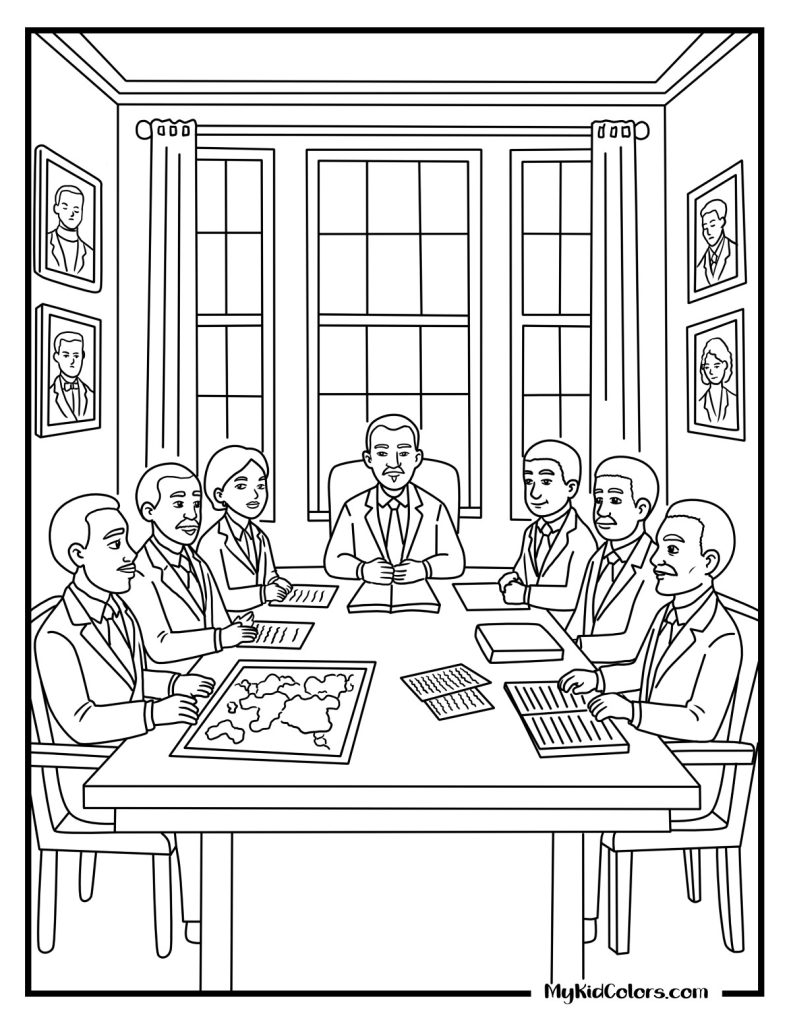
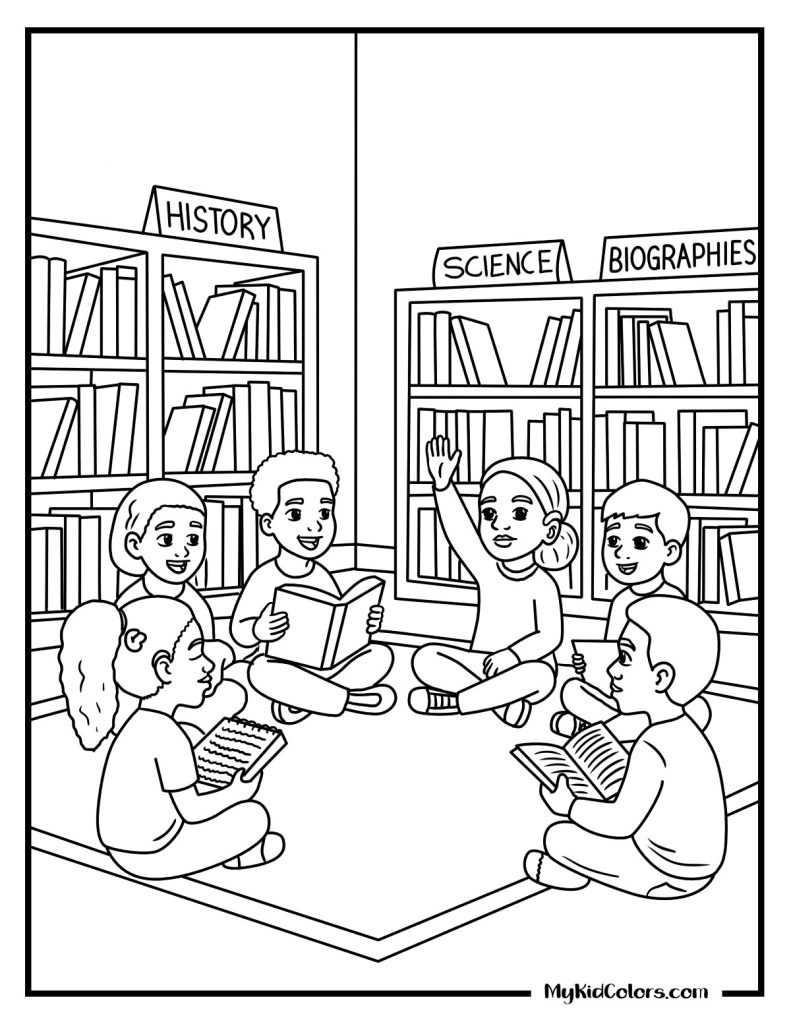
- Pages 12 & 13: Adults meet around a table covered with papers and a map. The next page returns to a modern library, where children read together beneath “HISTORY” and “BIOGRAPHIES” signs.
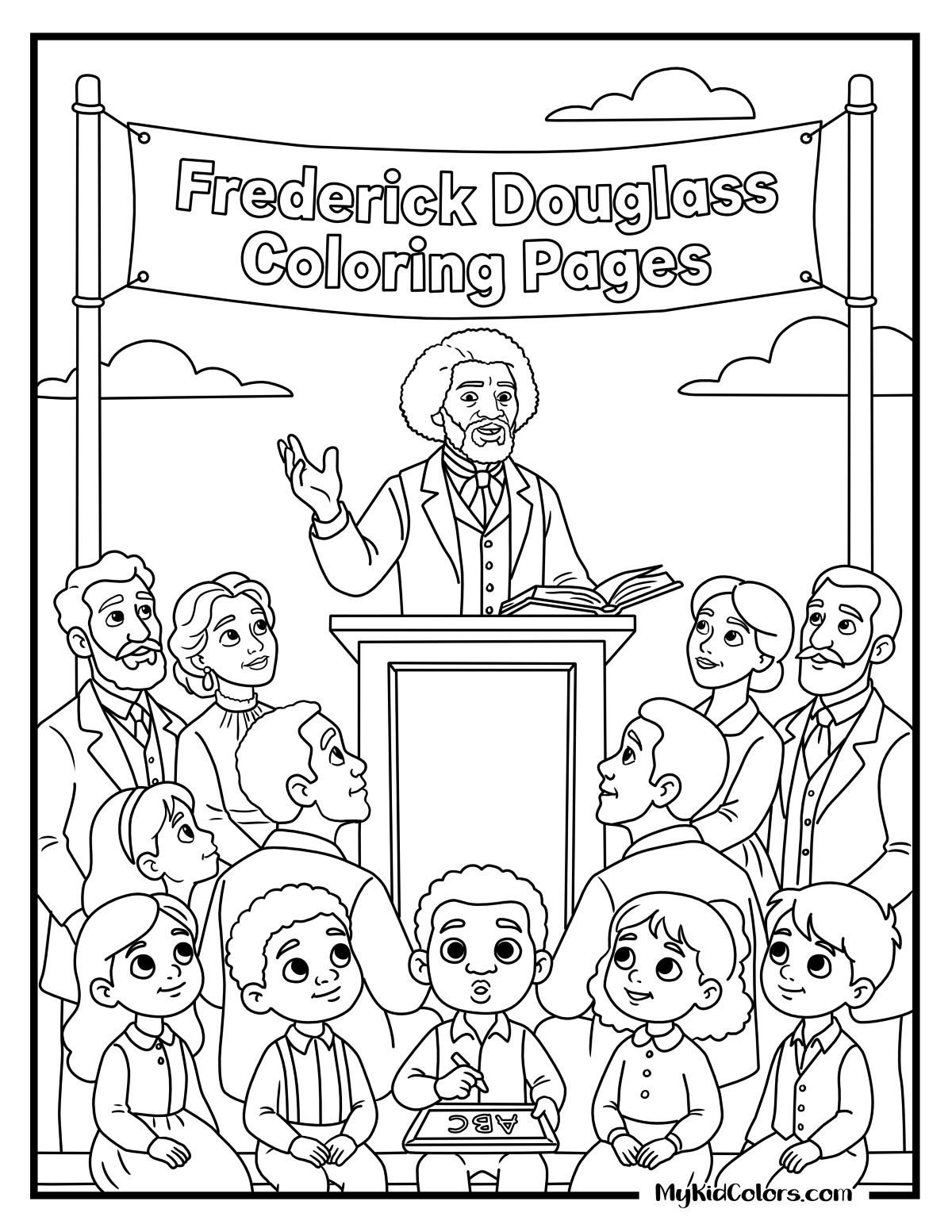
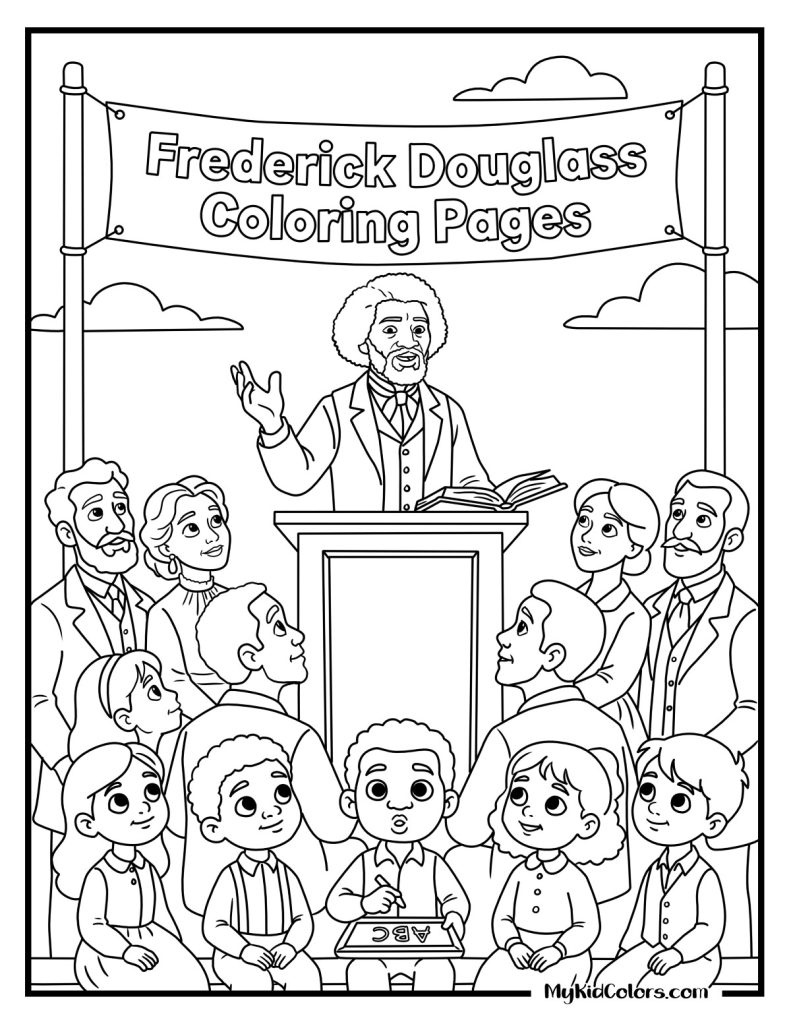
- Pages 14 & 15: A grandfather shares a book with children while a dog rests nearby. The final page brings a speaker and a multigenerational audience together beneath a Frederick Douglass banner, with a child holding a small alphabet slate in the front row.
All 15 pages. One easy download. Get the complete human-drawn, ready-to-print PDF for $1.99, available instantly with a download link emailed to you for easy access anytime.
Prefer free JPGs? Right-click any coloring page and select “Save image as,” or press and hold the image on your phone to save it.
Simple Activities for Classrooms, Libraries, and Homes
Choose one activity to accompany a page. An adult can write down a child’s ideas, and children can draw or use their usual communication tools.
- Find a familiar letter with Pages 1–3. Look for the first letter of your child’s name in a real alphabet book or on a block. Write it clearly on separate paper and invite them to decorate it. Use the printed reference rather than treating the illustration as a handwriting worksheet.
- Share a biography with Page 10 or 13. Read a short, age-appropriate account of Douglass’s life. Ask your child to choose one fact they want to remember, then add a drawing or a sentence on the back of the coloring page. Our library coloring pages offer more shared-reading scenes.
- Make a small newspaper with Page 9 or 11. Fold a sheet of paper and add a title, one drawing, and a short piece of news from your home or classroom. Explain that Douglass founded and edited an antislavery newspaper, The North Star, which began publication in 1847.
- Create a fair-learning message with Page 8. Invite your child to finish “Everyone should be able to learn…” with a word, drawing, or dictated idea. They can display the message without reading it aloud.
- Collect a family learning story with Page 14. Ask a relative who helped them learn something when they were young. Record one detail, add their name, and let your child illustrate it.
For a broader history activity, pair this set with our African American history coloring pages. Keep Douglass’s name and his work against slavery clear within the wider discussion.
Human-Drawn Details That Bring Reading Into the Picture
The books in this collection appear in many hands: a toddler pointing at letters, siblings sharing a story, children reading together, and a grandfather sitting with his grandchildren. Those familiar gestures give families places to begin a conversation before moving into the historical context.
Our human illustrator included cornrows, locs, puffs, glasses, and a young wheelchair user within these ordinary reading scenes. The newspaper pages add a different kind of detail, from stacks of printed sheets to the people gathered outside an office.
Every coloring page is hand-drawn. The simpler pages leave room around a child and an activity, while the detailed scenes offer shelves, pictures, buildings, and groups of people to explore. Choose a page for the time you have, then follow the detail that catches your child’s attention.
Frequently Asked Questions
How can I explain slavery and Douglass’s learning to a young child?
Keep the language clear: “Frederick Douglass was enslaved. That meant people treated him as property and forced him to work without freedom. They tried to stop him from learning to read, but he kept finding ways to learn. Later, he escaped and worked to end slavery.”
Use an age-appropriate biography for more detail and answer the questions your child actually asks. Learning to read was part of his story, but it did not automatically make him free.
Can these pages become a Black History Month display?
Choose a few pages and group them under themes such as “Learning,” “Sharing Information,” and “Working for Equal Rights.” Add a verified fact about Douglass beside the historical themes. Label the modern reading scenes as connections to learning today, rather than presenting the toddler pictures as documented moments from his childhood.
What is a useful discussion for the meeting scene on Page 12?
Ask, “How can a group make sure everyone has a way to contribute?” Children can suggest listening, taking turns, sharing written ideas, or using communication supports. The illustration is an imagined meeting scene, so do not identify the other people or a specific government event without a reliable reference.
Download Your Frederick Douglass Coloring Pages
A book shared with a sibling. A new letter recognized. A family story worth remembering. These small moments give you a place to begin talking about learning, while Douglass’s story helps explain why access to it matters.
Save your favorite pages as free JPGs, or get all 15 in one ready-to-print PDF for $1.99. Your purchase helps support our human illustrators and the work of creating diverse coloring pages for families like yours.
All 15 pages. One easy download. Get the complete human-drawn, ready-to-print PDF for $1.99, available instantly with a download link emailed to you for easy access anytime.
Prefer free JPGs? Right-click any coloring page and select “Save image as,” or press and hold the image on your phone to save it.
You might also like:
- 15 Harriet Tubman Coloring Pages That Teach Kids Courage and Leadership
- 15 Free African American Coloring Pages Celebrating Natural Hair
- 30 Women in STEM Coloring Pages — 15 Free Hidden Figures Printables for Kids

